· Marcus Delgado · AI & Automation · 15 min read
AI Receptionist for Phoenix Staffing Agencies: The Missed-Call Math (2026)
A Phoenix staffing desk lives on the phone — and loses placements every time one goes unanswered. Here's the honest missed-call math, the speed-to-lead data, and how a 24/7 AI receptionist inside GoHighLevel captures the candidates and job orders you're currently sending to voicemail.
Short answer: a Phoenix staffing agency loses more placements to unanswered phones than to any competitor’s better pitch. When a warehouse manager calls at 6 a.m. to cover a shift, or a candidate calls back on their lunch break, the agency that picks up — or answers in seconds — usually wins the job order or the applicant. An AI receptionist is a 24/7 voice agent that answers every inbound call in your agency’s name, qualifies the caller against the role, and books the screen straight into your GoHighLevel calendar, so no candidate and no client ever hits your voicemail and calls the next agency on the list. This is the honest, numbers-first case for why Phoenix recruiting desks need one — including what it won’t do.
Key takeaways
- Missed calls are a leak, not a nuisance. Industry phone-answering reports put the share of small-business calls that go unanswered at roughly 62%, and most callers who don’t reach a live person don’t leave a voicemail — they call a competitor (AMBS Call Center, 2026).
- Speed is the whole game in recruiting. In the landmark Lead Response Management study, contacting a new lead within 5 minutes vs. 30 minutes made you 21x more likely to qualify it and 100x more likely to even connect (Dr. James Oldroyd, MIT / InsideSales).
- An hour of delay is expensive. Firms that responded to an inbound query within an hour were nearly 7x more likely to have a meaningful (qualifying) conversation than those that waited just one hour longer (Harvard Business Review, 2011).
- Your candidates are mobile and impatient. 62% of job applications were submitted on a phone in 2023 — and 86% for hourly and gig roles (Appcast 2024) — so many of the calls that follow come after hours.
- Phoenix is a phone-driven staffing market. Metro Phoenix carries roughly 112,700 transportation and warehousing jobs as of 2025 (U.S. BLS / FRED) — high-turnover, high-volume desks where a single missed call can mean an unfilled shift.
- An AI receptionist is not an AI screener. It answers and captures inbound demand 24/7; it complements — it doesn’t replace — your recruiters or your outbound screening cadence.
Table of contents
- Why unanswered phones quietly bleed a Phoenix staffing desk
- The speed-to-lead problem in recruiting
- What an AI receptionist actually is (and isn’t)
- How it works, call by call
- The missed-call math for a Phoenix desk
- Where it fits in your GoHighLevel stack
- Compliance: consent, EEOC, and honesty
- What an AI receptionist won’t replace
- How to deploy one in Phoenix
- FAQ
Why unanswered phones quietly bleed a Phoenix staffing desk
Phoenix is one of the busiest light-industrial staffing markets in the West. The metro added tens of thousands of logistics and warehousing roles over the last few years and now carries roughly 112,700 transportation and warehousing jobs as of 2025 (U.S. Bureau of Labor Statistics via FRED). Fulfillment centers around the West Valley, freight corridors along the I-10, and seasonal surges all generate the same thing your desk runs on: inbound phone calls. A manager needs eight pickers by Monday. A candidate saw your job post and is calling to ask about the shift.
Here’s the uncomfortable part. Across small businesses, a large share of those calls never reach a person. Phone-answering industry reports estimate that around 62% of calls to small businesses go unanswered, and of the callers who land in voicemail, most simply hang up and dial the next number rather than leave a message (AMBS Call Center, 2026). For a staffing desk, that isn’t a missed message — it’s a filled req that went to a competitor, or a candidate who’s now in someone else’s pipeline.
And the calls don’t politely arrive between 9 and 5. Your audience is overwhelmingly mobile — 62% of job applications happen on a phone, rising to 86% for hourly and gig roles (Appcast 2024) — and hourly workers call when their own shift ends: early mornings, evenings, weekends. The busiest, most understaffed hours on your desk are exactly when a live pickup is least likely. That gap is the leak.
The speed-to-lead problem in recruiting
Recruiting is a speed business, and the data behind that is old, rigorous, and unambiguous. The Lead Response Management study — three years of data across thousands of leads and over 100,000 call attempts, led by Dr. James Oldroyd at MIT — found that contacting a new lead within 5 minutes instead of 30 minutes made you 100x more likely to connect and 21x more likely to qualify that lead (leadresponsemanagement.org). Not 21% better — 21 times.
Harvard Business Review’s audit of 2,241 U.S. companies found the same curve from the company side: firms that contacted an inbound lead within an hour were nearly 7x more likely to have a meaningful, qualifying conversation than those who waited just one hour longer — and more than 60x more likely than firms that waited 24 hours. Yet the average first-response time was 42 hours, and 23% of companies never responded at all (Harvard Business Review, 2011).
A staffing candidate behaves exactly like that lead. They applied to three or four agencies the same afternoon. The first recruiter to actually reach them books the screen; everyone else is calling a name that’s already committed. When your answer to an inbound call is a voicemail box checked “tomorrow morning,” you’ve placed yourself on the wrong end of every multiplier above.
What an AI receptionist actually is (and isn’t)
Let’s be precise, because the term gets muddy. An AI receptionist is a voice agent that sits on your inbound phone line (and, if you want, your website chat and SMS). When a call comes in, it answers in your agency’s name, has a natural back-and-forth conversation, understands what the caller wants, qualifies them against your real criteria, and takes an action — books an appointment, routes the call, or captures the details and tags the contact in your CRM. It runs 24/7, handles many calls at once, and never has a bad morning.
It is not the same thing as an AI screening agent that dials your candidate list to run structured interviews — that’s an outbound motion, and we cover it separately in AI phone screening for recruiters and AI candidate screening in GoHighLevel. The receptionist’s job is the front door: capture inbound demand that would otherwise ring out. The two work together — the receptionist answers and books the screen; the screening cadence takes it from there.
It’s also not a dumb IVR phone tree (“press 1 for candidates, press 2 for clients”). Menus lose people; a 2026 caller expects to talk. A modern AI receptionist built on a voice platform like VAPI is conversational — the caller just talks, and the agent responds in your script, your pay bands, your shift language. That’s the difference between deflecting a call and actually serving it.
How it works, call by call
The value is in the handoff being seamless. Here’s the path a single inbound call takes when an AI receptionist is wired into a GoHighLevel back end:
Every one of those steps used to require a human at a desk during business hours. Collapse them into a single always-on agent and the after-hours candidate who would have hit voicemail is now a booked screen on tomorrow’s calendar — captured while your recruiters slept. That’s the entire pitch: you stop paying to generate demand you can’t answer.
The missed-call math for a Phoenix desk
Put real numbers on it. This is illustrative — plug in your own — but the structure is what matters.
Say your Phoenix desk generates 200 inbound calls a month from job posts, referrals, Google, and repeat clients. If the industry pattern holds and roughly 60% go unanswered at the moment they come in (after-hours, on another call, short-staffed front desk), that’s about 120 missed calls. Most of those callers won’t leave a voicemail and won’t call back — they dial the next agency (AMBS Call Center).
Now assume even a conservative slice of those missed calls were placeable — say 10% would have become a screen, and a third of those a placement. That’s ~12 lost screens and ~4 lost placements every month. At a modest light-industrial placement margin, four recovered placements a month is real money, recovered from calls you already paid marketing dollars to generate. The AI receptionist doesn’t create new demand — it stops you from spilling the demand you’ve got.
Where it fits in your GoHighLevel stack
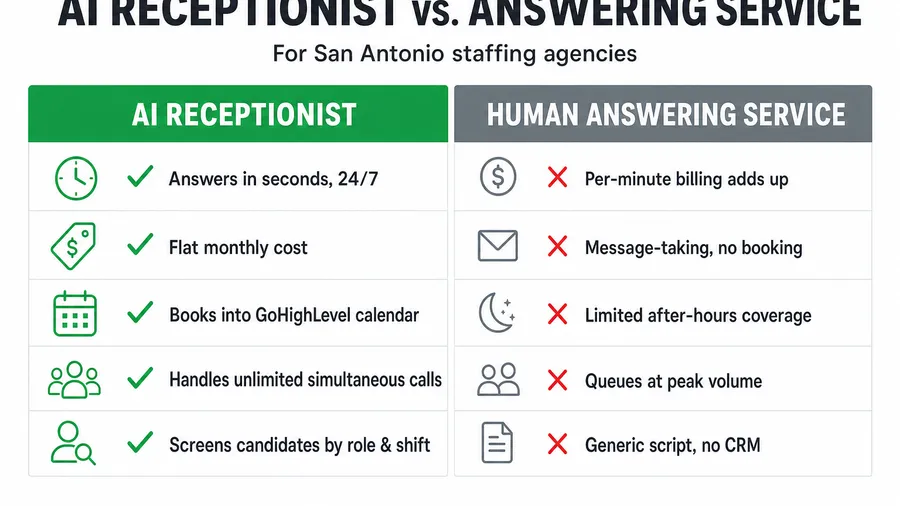
The reason this belongs in GoHighLevel rather than a standalone answering service is the handoff. A generic call center takes a message; an AI receptionist wired into GHL takes an action inside the system you already run your desk on. The moment a call ends, the contact exists in your pipeline, tagged by role family, with the screen already on a recruiter’s calendar and the nurture cadence firing.
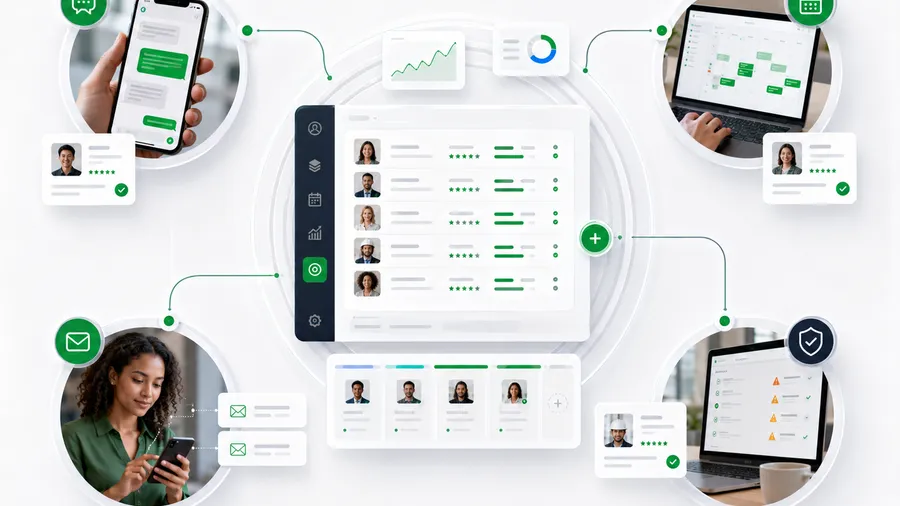
That’s the same engine the Hiring Snapshot runs on — capture, qualify, book, nurture — extended to the phone. On the candidate side, the receptionist feeds your applicant pipeline. On the client side, it can answer a hiring manager at 6 a.m., capture the job order details, and route an urgent coverage request to your on-call recruiter instead of a voicemail they find at 9. Both sides plug into the automations you’d otherwise be running by hand — the kind of build we do in our custom GHL development work, where the AI voice agent is trained on your roles, pay bands, and screening scripts rather than a generic template.
If the constraint isn’t the technology but the hours in your day, the other lever is people: a trained GoHighLevel VA can run the pipeline the receptionist fills, so inbound calls turn into worked candidates instead of a backlog. The receptionist answers; the VA (or your recruiters) closes.
Compliance: consent, EEOC, and honesty
Automation that outruns the rules is a liability, not an advantage — and recruiting is a regulated conversation. Three guardrails matter for an AI receptionist on a staffing desk:
- TCPA and consent. If the call transitions into SMS follow-up, you need proper consent captured before those texts fire. Build the opt-in into the call flow; don’t bolt it on. We walk through this in TCPA compliance for recruiting texts.
- EEOC and fair screening. The receptionist should qualify on job-related criteria — role fit, shift availability, work authorization, pay expectations — never on protected characteristics. Keep the script auditable and identical for every caller.
- Disclosure and honesty. Tell callers they’re speaking with an automated assistant, and make it effortless to reach a human. Candidates respond well to fast, clear help; they respond badly to feeling tricked.
Get those three right and the AI receptionist is both faster and more defensible than an overwhelmed front desk taking inconsistent notes — because every call is scripted, consented, and logged.
What an AI receptionist won’t replace
We name limits honestly. An AI receptionist is a capture-and-book layer, not a recruiter. It won’t sell a hesitant candidate on a career move, read the room on a tricky client negotiation, or judge whether a borderline applicant is worth a shot. Those are human calls, and they should stay human.
What it does is make sure your humans spend their time on those calls instead of on the ones that never should have gone to voicemail. It handles the volume, the after-hours, the simultaneous ring — the mechanical front-door work — so your recruiters walk in to a full, pre-qualified calendar rather than a stack of missed-call notifications. Used that way, it’s a force multiplier on the desk you already have, not a replacement for it.
How to deploy one in Phoenix
You don’t need to rip anything out. A practical rollout looks like this:
- Map your inbound. Pull a month of call logs. How many calls, from candidates vs. clients, and how many hit voicemail or went unanswered? That number is your leak — and your ROI baseline.
- Write the script. Your real qualifying questions per role family (light-industrial, warehouse, forklift-certified, healthcare), your pay bands, your shift language. The agent is only as good as the script it’s trained on.
- Wire it to GoHighLevel. Connect the voice agent to your GHL calendar, pipeline stages, and tags so a completed call becomes a booked, tagged contact — not a transcript nobody reads.
- Set the guardrails. Consent capture for SMS, an EEOC-clean question set, automated disclosure, and a one-tap path to a human.
- Measure the recovery. Track after-hours bookings, voicemail rate, and time-to-first-contact for 30 days. The missed-call math tells you what “good” looks like before you start.
That’s a build, not a plug-in — which is exactly why we scope it as custom GHL development with a fixed quote per agency. If you’d rather start with the automation the snapshot already includes and layer the receptionist on later, see how the Hiring Snapshot works first.
Frequently asked questions
What is an AI receptionist for a staffing agency?
It’s a 24/7 conversational voice agent that answers your agency’s inbound calls, talks naturally with candidates and hiring managers, qualifies them against your real criteria (role, shift, pay, location), and books the screen into your GoHighLevel calendar — capturing calls that would otherwise hit voicemail. It handles the front-door, capture-and-book work so your recruiters focus on closing.
How is an AI receptionist different from AI phone screening?
The receptionist handles inbound calls — it answers the phone and books the appointment. AI phone screening is an outbound motion that dials your candidate list to run structured interviews. They’re complementary: the receptionist books the screen, and the screening cadence takes it from there. See AI phone screening for recruiters for the outbound side.
Do Phoenix staffing agencies really lose that many calls?
Industry phone-answering reports estimate around 62% of small-business calls go unanswered at the moment they come in, and most of those callers don’t leave a voicemail — they call a competitor (AMBS Call Center). In a high-volume, high-turnover market like Phoenix warehousing and logistics — roughly 112,700 transportation and warehousing jobs (U.S. BLS / FRED) — those missed calls are unfilled shifts and lost candidates.
Is an AI receptionist compliant with TCPA and EEOC?
It can be, when it’s built correctly. Capture SMS consent inside the call flow before any texts fire (TCPA), qualify only on job-related criteria and keep the script identical for every caller (EEOC), and disclose that callers are speaking with an automated assistant with an easy path to a human. A scripted, logged agent is often more defensible than an overwhelmed front desk. See TCPA compliance for recruiting texts.
Will it replace my recruiters?
No. It replaces the missed call, not the recruiter. It handles volume, after-hours, and simultaneous calls — the mechanical capture work — so your team walks into a pre-qualified calendar instead of a pile of voicemails. Human recruiters still do the selling, judgment, and closing.
How much does a GoHighLevel AI voice agent cost to build?
Every build is scoped and quoted individually because no two desks have the same call volume, roles, and stack. Custom GHL AI agents and integrations typically start in the low four figures and scale with complexity. The fastest way to a real number is to book a call — we’ll look at your call logs and give you a fixed quote and timeline.
About the author
Marcus Delgado is the Staffing Agency Growth Lead behind the Hiring Snapshot, based in Tampa, FL. He ran a light-industrial staffing desk before moving to the snapshot team to focus on agency growth, and he thinks in placement economics — fill rates, redeploys, and gross margin per requisition. His posts lean on real desk math, not vanity metrics.
Related reading
- AI Phone Screening for Recruiters: How Voice Agents Screen and Book Candidates 24/7
- AI Candidate Screening in GoHighLevel: How to Qualify Applicants in Seconds
- SMS-First Recruiting: Why Email-Only Agencies Are Losing the 2026 Talent Market
- Cutting Interview No-Show Rate From 22% to 6% (The Cadence That Works)
- Astro vs GoHighLevel Websites for Dallas Staffing Agencies: Page Speed & SEO Compared
Ready to stop losing Phoenix placements to voicemail? Get a custom GHL AI voice agent, see how the Hiring Snapshot works, or have a trained GHL VA run the pipeline it fills.