· Adrienne Boyd · Field Reports · 16 min read
AI Receptionist vs. Answering Service for San Antonio Staffing Agencies: The Honest Comparison (2026)
A San Antonio staffing desk lives on the phone — and both a human answering service and an AI receptionist promise to catch the calls you miss. Here's the honest, numbers-first comparison: what each really costs, how fast each answers, what each does with the call, and which one actually books the candidate.
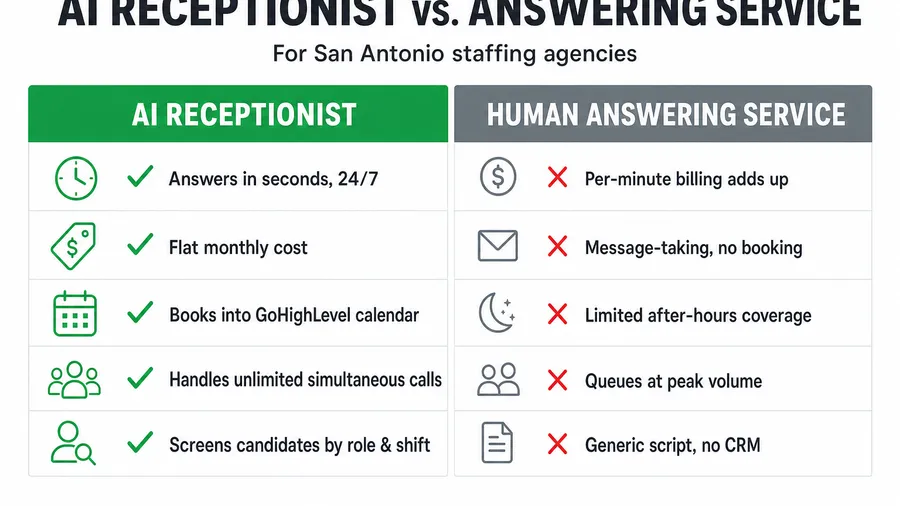
Short answer: a human answering service takes a message; an AI receptionist takes the placement. For a San Antonio staffing desk, a traditional answering service is people in a call center who pick up when you can’t and email or text you a message afterward — billed by the minute. An AI receptionist is a voice agent that answers every call in seconds, 24/7, qualifies the candidate or client against the actual role, and books the screen straight into your GoHighLevel calendar — for one flat monthly fee, no matter how many calls come in. If your goal is to never miss a message, either one helps. If your goal is to fill the req faster, the AI receptionist wins on speed, cost at volume, and what it does with the call. This is the honest breakdown — including where a human service still beats the bot.
Key takeaways
- Speed is the whole game, and both tools exist because you’re losing it. In the MIT / InsideSales Lead Response Management study, contacting a new lead within 5 minutes vs. 30 minutes made you 21× more likely to qualify it and 100× more likely to connect (Dr. James Oldroyd, MIT / InsideSales). An AI receptionist answers in seconds; a human service answers after a few rings, then you still call the candidate back later.
- The research is real, not folklore. An audit of 2,241 U.S. companies in Harvard Business Review found firms that answered a web lead within an hour were about 7× likelier to have a qualifying conversation than those who waited an hour longer — and roughly 60× likelier than firms that waited 24+ hours (HBR, 2011).
- Human answering services bill by the minute. Ruby’s published plans start around $235/month for ~50 minutes, and PATLive’s five plans run $235 to $1,050/month for 75–600 minutes, with $2.00–$2.60 per additional minute (Ruby, PATLive). Volume is a variable cost.
- An AI receptionist is a flat fee for unlimited calls. It doesn’t queue at peak, doesn’t cost more on a busy Monday, and never sleeps — which matters in a market where calls come in before dawn and after 6 p.m.
- San Antonio is a live, competitive desk. The San Antonio–New Braunfels metro carries roughly 1.18 million nonfarm jobs, with about 153,500 in professional & business services — the sector that houses most staffing and contract-labor placements (Dallas Fed / FRED, Dec 2025). The desk that answers first usually wins the order.
- Neither replaces a recruiter. Both are a front door. A human still closes the candidate, checks credentials, and manages the client. The question is only which front door feeds your pipeline faster and cheaper.
Table of contents
- Why San Antonio staffing desks bleed placements on the phone
- What each option actually is
- Head-to-head: the comparison table
- The cost comparison, in real 2026 numbers
- Speed-to-lead: the number that decides the placement
- Where a human answering service still wins
- Where the AI receptionist wins for staffing
- How to deploy an AI receptionist in San Antonio
- What an AI receptionist won’t do
- FAQ
Why San Antonio staffing desks bleed placements on the phone
San Antonio runs on hourly hiring velocity. The San Antonio–New Braunfels metro carries roughly 1.18 million nonfarm jobs, and professional & business services — the supersector that includes most staffing and contract-labor placements — accounts for about 153,500 of them (Dallas Fed / FRED). Distribution centers along I-35, home-health agencies across Bexar County, the medical corridor around the South Texas Medical Center, hospitality on the River Walk — all of them need bodies on shift, and they call when they need them, which is rarely 9-to-5.
Here’s the leak. A shift-manager calls at 6 a.m. to cover a no-show. A candidate calls back on their lunch break, from a job site, with two minutes to spare. A competing agency’s client calls at 7 p.m. after their current vendor missed a fill. On most desks, those calls hit a recruiter who’s on another line, in an interview, or asleep — and roll to voicemail. The job order goes to whoever picked up. The candidate texts the next agency on their list. You paid to generate that call, and you lost it to a ringtone.
Both a human answering service and an AI receptionist exist to plug that leak. The difference is how completely they plug it — and what it costs you to keep it plugged.
What each option actually is
These get conflated in sales copy, so let’s be precise.
A traditional answering service (Ruby, PATLive, AnswerConnect, Smith.ai’s human tier) is a team of live agents in a call center. When your line rings and you don’t pick up — or always, if you forward every call — one of their agents answers with your greeting, takes a message, maybe follows a short script, and relays it to you by text, email, or a portal. Some will patch urgent calls through or do light appointment-setting. You’re billed for the agents’ time, usually by the minute.
An AI receptionist is a voice agent — built on platforms like VAPI or Retell with a language model behind it — that answers the call itself. It speaks in your agency’s name, understands what the caller wants, asks your qualifying questions (“Which shift? Do you have your forklift cert? How soon can you start?”), and then acts: it creates or updates the contact in your CRM, tags them by role, and books the interview into your calendar. Because it’s software, it answers every call instantly, handles many at once, and costs the same whether you get 10 calls or 400. Our builds run inside GoHighLevel, so the call doesn’t end in a message — it ends in a booked, tagged candidate sitting in your pipeline.
That’s the core distinction: a human service captures the call; an AI receptionist converts it.
Head-to-head: the comparison table
| Factor | Human answering service | AI receptionist (GoHighLevel) |
|---|---|---|
| Speed to answer | A few rings; can queue at peak | Instant, every time, even on simultaneous calls |
| Hours | 24/7 available, but after-hours often costs more | 24/7 at the same flat rate |
| Pricing model | Per minute — variable, rises with volume | Flat monthly — fixed, unlimited calls |
| What it does with the call | Takes a message, light scripting | Qualifies against the role and books the interview |
| CRM integration | Message relayed to you; you re-key it | Writes the contact, tags, and pipeline stage directly |
| Simultaneous calls | Limited by staffed agents | Effectively unlimited |
| Consistency | Varies by agent and shift | Same script and screen every time |
| Empathy / nuance | Strong — real humans, real judgment | Good for routine calls; hands off edge cases |
| Setup | Fast — write a greeting and script | Custom build — trained on your roles and calendar |
Read the table honestly and the pattern is clear: the human service is easier to switch on and better at genuine human nuance; the AI receptionist is faster, cheaper at volume, and the only one of the two that actually advances the placement instead of parking it in your inbox.
The cost comparison, in real 2026 numbers
This is where the models diverge most. Human answering services bill for agent time, so your cost scales with your call volume — exactly when you’re busiest, you pay most.
Real published pricing as of 2026: Ruby’s virtual-receptionist plans start around $235/month for roughly 50 receptionist minutes, billed per minute (Ruby). PATLive publishes five tiers from about $235/month for 75 minutes up to $1,050/month for 600 minutes, with overage at $2.00–$2.60 per additional minute (PATLive). Smith.ai’s human receptionist plans start near $292.50/month for about 30 calls, while its separate AI tier starts around $95/month (Smith.ai). For a busy staffing desk fielding hundreds of candidate and client calls a month, the human tiers land in the $700–$1,200/month range fast — and keep climbing the busier you get.
An AI receptionist inverts that. You pay a flat monthly fee for unlimited calls, so the busy Monday that would blow past your answering-service minutes costs you exactly the same as a quiet Sunday. For a high-volume light-industrial or healthcare desk, that’s the difference between a predictable line item and a bill that punishes you for growing.
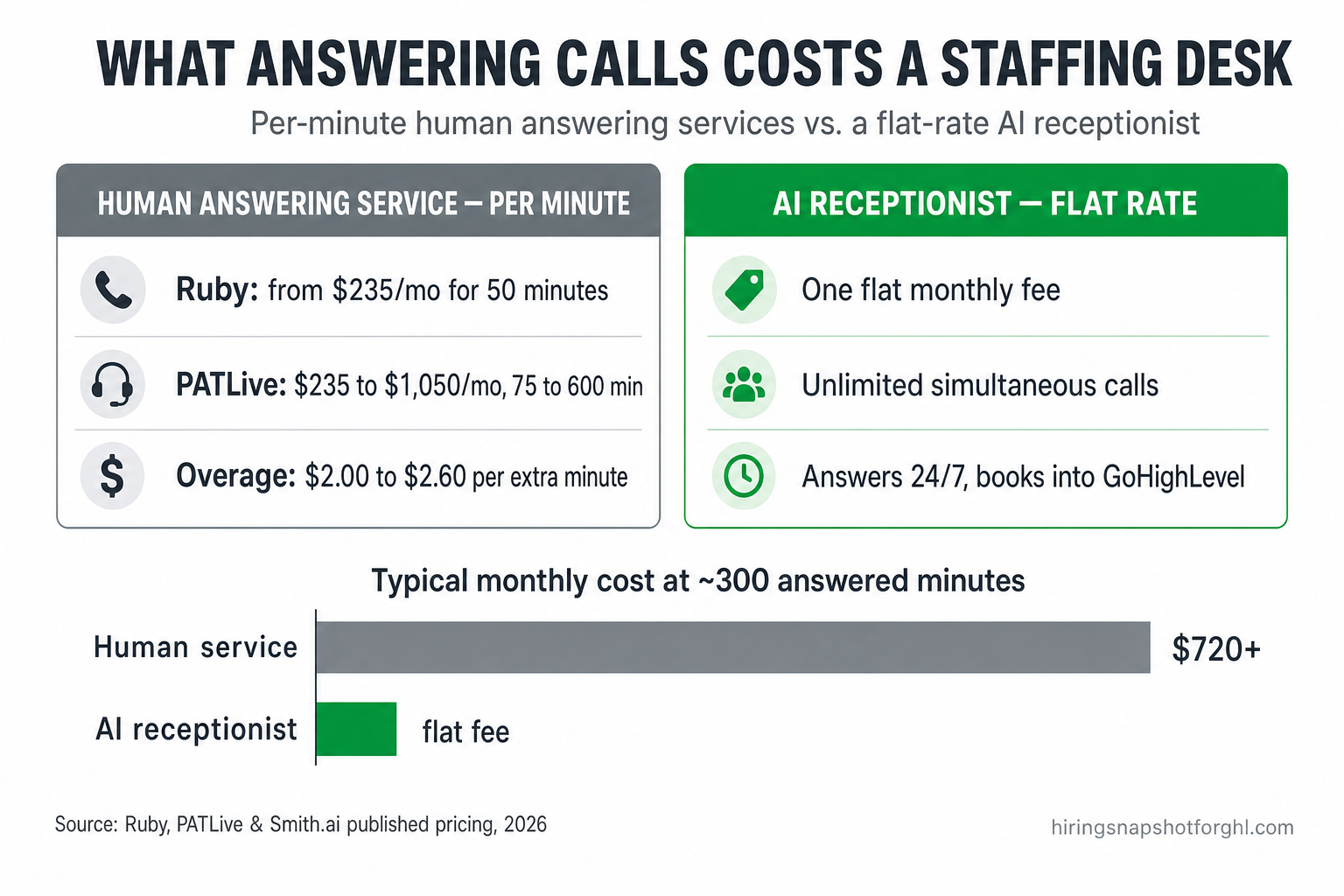
The honest caveat: at very low call volume — a two-req-a-week boutique that gets a handful of calls — a small answering-service plan can be cheaper than a custom AI build. The AI receptionist’s economics win as your volume climbs, which for most San Antonio desks is exactly where they live.
Speed-to-lead: the number that decides the placement
Every argument here reduces to how fast you engage the caller. The most-cited research in the field, Dr. James Oldroyd’s Lead Response Management study, found that reaching a new lead within 5 minutes instead of 30 made a firm 21× more likely to qualify the lead and 100× more likely to make contact at all (MIT / InsideSales).
That’s not a lone data point. A separate audit of 2,241 U.S. companies, published in Harvard Business Review, found firms responding to an inbound web lead within an hour were roughly 7× more likely to have a meaningful qualifying conversation than firms that waited even one hour longer — and about 60× more likely than those that waited 24 hours or more (HBR, 2011). A candidate call is an inbound lead. The clock starts the second the phone rings.
Here’s where the two tools split. A human answering service compresses your response from “hours” to “a few rings, then a message” — real progress, but you still have to call the candidate back, which reopens the delay. An AI receptionist collapses the whole thing to a single event: it answers in seconds, qualifies on that same call, and books the interview before hanging up. There’s no callback gap because there’s no callback. When you’re paying real money to fill reqs — SHRM benchmarking has pegged average cost-per-hire around $4,129 and median time-to-fill near 44 days (SHRM) — closing that gap is the cheapest lever you have. It’s the same lever we break down in how to reduce time-to-fill and SMS-first recruiting.
Where a human answering service still wins
This comparison is only useful if it’s fair, so here’s where a live service genuinely beats the bot:
- Nuanced, emotional, or messy calls. A distraught candidate, an angry client, a complicated custody-of-the-relationship conversation — a trained human reads the room in ways a voice agent shouldn’t be asked to.
- Zero build time. You can switch on an answering service this afternoon with a greeting and a script. A custom AI receptionist is a build — days, not minutes.
- Very low volume. If you take a handful of calls a month, a small per-minute plan can undercut the cost of a bespoke voice agent.
- Pure message-taking, by design. If all you want is “someone civilized picks up and takes a message,” that’s exactly what a human service is built to do, and it does it well.
If your bottleneck is politeness and coverage rather than speed-to-book, a human service may be all you need. Most staffing desks, though, don’t have a politeness problem — they have a speed and volume problem.
Where the AI receptionist wins for staffing
For a recruiting desk specifically, the AI receptionist’s advantages line up with how placements are actually won:
- It qualifies, not just greets. Right-to-work, shift availability, certifications, distance to the San Antonio job site — the screen happens on the first call, so recruiters only spend time on candidates who fit. That’s the same logic behind our AI candidate screening and AI phone screening builds.
- It books into your calendar. The call ends with an interview on the recruiter’s schedule, not a sticky note. No phone tag, which is where booked candidates quietly evaporate.
- It never queues. Monday-morning shift-fill rush, a job-fair spike, a viral job post — the agent answers all of them at once. A staffed call center has a finite number of agents.
- It’s flat-rate at volume. Your busiest month costs the same as your slowest, so growth doesn’t punish your P&L.
- It writes clean data. Contact, tags, source, pipeline stage — all in GoHighLevel, deduplicated, ready for automation. Nobody re-keys a message.
If you’ve read our Phoenix AI receptionist breakdown — the missed-call math behind why a voice agent pays for itself — this is the same argument, framed as a head-to-head against the alternative most agencies reach for first.
How to deploy an AI receptionist in San Antonio
You don’t rip anything out. A practical rollout looks like this:
- Map the calls you’re missing. After-hours, simultaneous rings, lunch-hour candidate callbacks — decide which the agent should own first. Most desks start with after-hours and overflow.
- Script the screen. Write the two-to-four qualifying questions per role family (shift, right-to-work, certs, distance). This is the reusable brain of the agent.
- Wire it to GoHighLevel. Point the agent at your recruiting pipeline and calendar so a qualified caller lands as a tagged contact with a booked interview. If you don’t have that pipeline yet, our GoHighLevel ATS guide is the place to start.
- Layer in compliant follow-up. Confirmations, reminders, and no-show recovery cadences — with TCPA-safe SMS consent — so booked interviews actually happen. (See interview no-show recovery.)
- Keep humans on the exceptions. Route the messy, high-value calls to a recruiter or a trained GoHighLevel VA. The agent handles the mechanical front door; your people handle judgment.
That’s the kind of build our GHL development team ships — a voice agent trained on your roles, pay bands, and screening scripts, wired straight into your pipeline.
What an AI receptionist won’t do
Honesty keeps this useful. An AI receptionist will not:
- Replace your recruiters. It captures, qualifies, and books. A human still closes the candidate, checks credentials, and owns the client relationship.
- Handle every call gracefully. For genuinely sensitive or complex conversations, it should hand off to a human — build that escape hatch in.
- Fix bad inputs. If your job ads bring the wrong callers, answering them faster just reaches the wrong people sooner.
- Text candidates without consent. Automated SMS follow-up still needs TCPA opt-in, an easy STOP, and A2P 10DLC registration — the same rules we treat as first-class in every cadence.
Set that expectation and the tool does exactly what it’s built for: make sure not one paid-for San Antonio call rolls to voicemail and walks to a competitor.
Frequently asked questions
What’s the difference between an AI receptionist and an answering service?
An answering service is a team of live human agents who pick up when you can’t, take a message, and relay it to you — billed by the minute. An AI receptionist is a voice agent that answers instantly, qualifies the caller against your role, and books the interview directly into your GoHighLevel calendar, for a flat monthly fee regardless of call volume. The human service captures the call; the AI receptionist converts it into a booked candidate.
Is an AI receptionist cheaper than a human answering service?
At most staffing-desk volumes, yes. Human services bill per minute — Ruby starts around $235/month for ~50 minutes and PATLive runs $235–$1,050/month for 75–600 minutes, with $2.00–$2.60 per extra minute — so your cost rises with call volume. An AI receptionist is a flat monthly fee for unlimited calls. At very low volume a small human plan can be cheaper; as your call count grows, the flat-rate AI wins.
Can an AI receptionist actually book interviews, not just take messages?
Yes — that’s the main reason staffing desks choose one. Built inside GoHighLevel, the agent qualifies the caller on the phone and books the screen straight into the recruiter’s calendar, creating a tagged contact in the pipeline. A traditional answering service typically only takes a message you have to act on later.
Will an AI receptionist sound robotic to my candidates and clients?
Modern voice agents are conversational and speak in your agency’s name, and they handle routine candidate and client calls well. For emotional, complex, or high-stakes conversations, a well-built agent hands off to a human — so you keep the speed on routine volume without losing judgment on the calls that need it.
Do I have to stop using my recruiters or my current phone system?
No. The AI receptionist sits in front of your existing setup — usually starting with after-hours and overflow calls — and routes exceptions to your team. It’s a force multiplier on the desk you already have, not a replacement for it.
How do I stay TCPA-compliant if the AI texts candidates afterward?
Capture prior express consent (a clear opt-in and easy STOP), log it against the contact in GoHighLevel, and register for A2P 10DLC so your texts deliver. Build the opt-in into the call flow and the automated follow-up is both fast and defensible.
About the author
Adrienne Boyd is the Recruiting Automation Strategist behind the Hiring Snapshot, based in Austin, TX. She spent a decade building applicant-capture funnels and SMS-first nurture cadences for staffing agencies before moving full-time into GoHighLevel automation. She writes the playbooks and field reports, and she is happiest when a manual, three-person process collapses into a single fast trigger.
Related reading
- AI Receptionist for Phoenix Staffing Agencies: The Missed-Call Math
- AI Phone Screening for Recruiters: The GoHighLevel Playbook
- The GoHighLevel ATS: Build a Recruiting Pipeline That Actually Closes
- SMS-First Recruiting: Why Email-Only Agencies Are Losing the 2026 Talent Market
- How to Reduce Time-to-Fill: The GoHighLevel Playbook
Want every San Antonio candidate and client call answered in seconds and booked automatically? Get a custom GHL AI receptionist, see how the Hiring Snapshot works, or have a trained GHL VA run it for you.