· Neha Chandra · Playbooks · 22 min read
Co-Employment Risk for Staffing Agencies: What You're Actually Liable For in 2026
When you place a W-2 temp at a client site, you and the client can both be the employer in the eyes of the law. Here is what co-employment really means, the five places it bites a staffing desk, the 2026 rule changes that just moved the line, and the contract and onboarding paper trail that keeps the liability where it belongs.
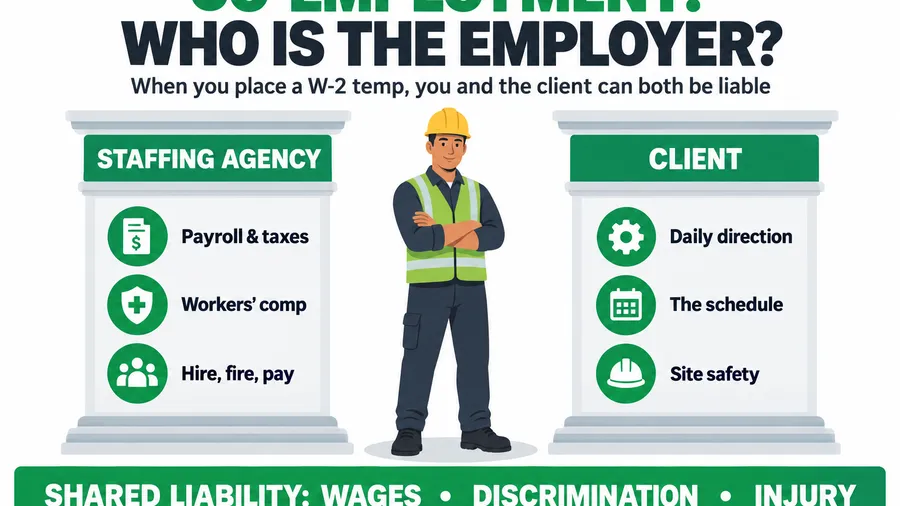
It is 6:15 on a Tuesday evening and you get the call every staffing owner dreads. One of your light-industrial temps caught his hand in a machine on the client’s floor two hours ago. He is at the ER. The client’s plant manager is telling your recruiter it is “your guy, your problem,” and in the same breath the client’s safety team is already deciding they never want to see your agency again. You placed that worker. You pay him. You carry the workers’ comp. But he was taking orders from the client’s foreman, on the client’s equipment, in the client’s building. So whose employee is he, really? The honest answer, the one nobody tells you when you open a desk, is that he is probably both of yours.
The short version: when you place a W-2 worker at a client site, you and the client can both be legal employers of that person at the same time. That is co-employment, and it is not a loophole or a risk to avoid, it is the normal structure of temporary staffing. You cannot make it go away. What you can do is decide, in writing and in advance, who controls what and who pays when something goes wrong, so a wage claim, a discrimination charge, or an injury does not land on whichever party the lawyer finds first. This is the plain guide to what co-employment actually means, the five places it hits a staffing desk, the 2026 rule changes that just moved the line, and the contract and onboarding paper trail that keeps the liability where it belongs.
Key takeaways
- Co-employment is structural, not a mistake. The American Staffing Association counts roughly 27,000 US staffing and recruiting companies operating about 54,000 offices, placing around 2.4 million temporary and contract workers in an average week (ASA). Almost every one of those placements is a shared-employer arrangement by design.
- Both parties can be liable, often jointly. Under the EEOC’s long-standing guidance, a staffing firm and its client that both control a worker are “joint employers,” and for discrimination damages they are “jointly and severally liable” (EEOC).
- The labor-law line just moved. In February 2026 the NLRB formally reinstated its 2020 joint-employer standard, which requires “substantial direct and immediate control” and makes reserved or indirect control, on its own, not enough (Littler).
- Wage-and-hour is still unsettled. The DOL issued a proposed rule in April 2026 to unify the joint-employer test across the FLSA, FMLA and MSPA. It was still a proposal, not a final rule, as of mid-2026 (Holland & Knight).
- Your defense is a paper trail, not a disclaimer. A control-allocation clause, an indemnity clause, and an onboarding acknowledgment the worker signs are what decide who pays. Calling the worker “the agency’s employee” in the contract does not bind a regulator or a court.
Table of contents
- What co-employment actually means
- Co-employment vs joint employment: the words matter
- The five places co-employment bites a staffing desk
- What just changed in 2026: the NLRB and DOL
- What it costs when you get it wrong
- Steal these: the contract clauses and the responsibility matrix
- How this plays out for a solo, mid, and high-volume desk
- Common objections, answered
- FAQ
What co-employment actually means
Co-employment is what you get any time two businesses share the legal rights and duties of an employer over the same worker. In staffing, that is the whole model. Your agency recruits the worker, runs payroll, withholds taxes, carries the workers’ comp policy, and can end the assignment. The client directs the day-to-day work, sets the schedule on its floor, supervises performance, and controls the actual job site. Neither of you holds all the cards, so the law treats both of you as employers for different purposes.
That is not a bug you introduced by being sloppy. It is the point of the arrangement. The client hires you precisely so it does not have to carry the worker on its own books, and you take on the employer-of-record duties in exchange for your markup. The risk is not that co-employment exists. The risk is pretending it does not, because the agencies that get hurt are the ones who assumed a line in the contract made the worker “100% ours” or “100% theirs” and then discovered, after a claim landed, that the law looks at who actually controlled the work, not what the paperwork called it.
Here is the rule that trips people up. Courts and agencies decide who is an employer by looking at control: who hires and fires, who supervises and sets the schedule, who determines pay, who owns the workplace and the equipment, and whose work is being done. They do not stop at the contract’s label. You can write “independent contractor” at the top of an agreement and still be found a joint employer if the facts show shared control, and the EEOC’s own guidance includes an example that finds joint employment even where the contract called the worker an independent contractor (EEOC).
Co-employment vs joint employment: the words matter
People use “co-employment” and “joint employment” as if they are the same thing, and in casual conversation they mostly are. It is worth being precise, because the two words carry different weight in a dispute.
“Joint employment” is the legal term of art. It is the finding that two entities are both employers of the same worker under a specific law, the FLSA, Title VII, the National Labor Relations Act, and so on. When a court or agency says “joint employer,” a legal consequence follows: shared liability under that statute. “Co-employment” is the business term for the ongoing shared-employer relationship that makes those findings possible, and it is how the industry describes the normal staffing structure.
The practical takeaway: co-employment is the room you live in, and joint employment is the specific door a plaintiff tries to open. You cannot leave the room, and you do not want to, it is where the business is. You can decide, in advance, which doors are locked and who holds the key.
The five places co-employment bites a staffing desk
Co-employment does not create one risk. It creates five, because “employer” means different things under different laws, and each law has its own test for who counts. Here is where it actually lands, and how each one breaks.
1. Wage and hour (FLSA). If a court finds you and the client jointly employ a worker, each of you is independently liable for wage violations, including unpaid overtime. That matters most when the client controls the hours. Say the client’s floor runs a temp 55 hours in a week but only approves 40 on the timesheet it sends you. If you pay 40 and the worker later proves he worked 55, a joint-employer finding can put the unpaid overtime on your agency even though the client is the one who ran the extra hours. The DOL’s proposed 2026 rule uses a vertical joint-employment test aimed at exactly this arrangement, where the worker is clearly the agency’s employee and the question is whether the client that benefits from the work is also on the hook (Holland & Knight). How it breaks: you trust a client’s timesheet you cannot verify. The fix is to control time capture yourself, at the worker level, instead of taking the client’s word for it.
2. Discrimination and harassment (EEOC, Title VII, ADA). This is the clearest shared liability of all. The EEOC’s enforcement guidance states that if both the staffing firm and its client have the right to control the worker, they are covered as joint employers, and for compensatory damages, back pay, and front pay “the two respondents are jointly and severally liable” (EEOC). Jointly and severally means a claimant can collect the full amount from either one of you. Worse, the guidance says a staffing firm is also liable if it knew or should have known of a client’s discrimination and failed to take prompt corrective action within its control. So if a temp tells your recruiter the client’s supervisor is harassing her and your recruiter does nothing, your agency owns a piece of that claim. How it breaks: a worker reports a problem to your desk and it dies in a voicemail. The fix is a logged complaint channel and a documented response, every time.
3. Workplace injury and workers’ comp. This is the ER call from the top of this article. In most states, workers’ comp is the exclusive remedy against an employer for a workplace injury, which means the injured worker generally cannot sue the employer in civil court. The twist for staffing is the “borrowed servant” or “special employer” doctrine: because the client directs and supervises the worker, courts often treat the client as a special employer too, so the client can also claim exclusive-remedy protection and block a lawsuit (Insurance Journal). That can actually protect both of you, but it varies heavily by state, and it only holds up if your coverage is real and in force. How it breaks: a lapsed or misclassified workers’ comp policy. If your coverage does not actually cover the worker, the exclusive-remedy shield can fall away and you are exposed to a civil suit. The fix is to treat your comp policy and your job-classification codes as sacred, and to confirm the client carries its own general liability coverage in your contract.
4. Union organizing and labor relations (NLRB). If your temps and the client’s direct employees end up in the same bargaining unit, or the client exercises enough control over your workers’ terms, the client can be pulled in as a joint employer for labor purposes, with duties to bargain and exposure to unfair-labor-practice charges. The standard for this just changed, which is the next section. How it breaks: a client that sets your workers’ pay, schedules, and discipline directly, rather than routing those decisions through you. The fix is to keep the essential employment terms, pay, hiring, firing, discipline, running through your agency, not the client’s managers.
5. Taxes, unemployment, and benefits. You are the employer of record for payroll taxes and unemployment insurance, so a misclassified worker or a missed filing lands on you. Benefits add another layer. Under the Affordable Care Act, the common-law employer is generally responsible for the offer of coverage, and for staffing that is usually your agency, not the client, unless a specific arrangement shifts it. Get the classification wrong and the bill, plus penalties, is yours. How it breaks: treating long-term temps as if they never cross a benefits or classification threshold. The fix is to track assignment length and hours so a worker who crosses a line gets handled on purpose, not by accident.
What just changed in 2026: the NLRB and DOL
Two federal developments in 2026 moved the joint-employer line, and both matter to a staffing desk because they change how much client control it takes to pull the client in as a co-employer.
The NLRB went back to the 2020 standard. The joint-employer test under labor law has bounced back and forth for a decade. A 2023 rule would have made it much easier to find joint employment by counting reserved or indirect control. A federal court in Texas struck that rule down in March 2024 before it took effect. Then, in February 2026, the Board formally reinstated its 2020 standard (Littler). Under the 2020 rule, a company is a joint employer only if it has “substantial direct and immediate control” over essential terms of employment such as hiring, firing, discipline, supervision, and pay, and must actually exercise that control, not merely reserve the right to. Indirect influence and reserved-but-unused control, on their own, no longer establish joint-employer status.
For you, the narrower standard is mostly good news on the labor-relations front, because it takes more client control to create a joint-employer finding. But it cuts both ways: it is a reminder that control is the whole game. The cleaner you keep the line, with pay, discipline, and hiring decisions running through your agency rather than the client’s floor managers, the less exposure either of you carries.
The DOL proposed a new wage-and-hour test. In April 2026 the Department of Labor’s Wage and Hour Division issued a proposed rule to create one joint-employer standard across the FLSA, FMLA, and MSPA (Holland & Knight). As of mid-2026 it was a proposal, not final law, with a comment period that ran into the summer. Do not build your whole program around a rule that is not final. Do watch it, because the wage-and-hour test is the one most likely to put a client’s unpaid overtime back on your agency, and it is the area where co-employment turns into real dollars fastest.
The honest summary of 2026: the labor-law standard narrowed, the wage-and-hour standard is in flux, and the discrimination and workers’ comp rules did not change. None of that removes co-employment. It just reinforces that the line is drawn by who controls the work, which is something you can manage.
What it costs when you get it wrong
The dollars are not abstract. When a joint-employer finding lands under the EEOC’s framework, the two employers are jointly and severally liable for back pay, front pay, and compensatory damages, which means a claimant can collect the entire award from your agency alone and leave you to chase the client for its share (EEOC). On the wage-and-hour side, a joint-employer finding makes each employer independently liable, so a client’s unpaid overtime can become your back-wage liability, often doubled as liquidated damages, plus attorney fees. For a desk running dozens of temps on a floor where someone else controls the timesheets, that exposure scales with every worker and every week.
Then there is the cost that never shows up in a judgment: the client relationship. A worker injury, a discrimination charge, or a wage dispute that drags your agency’s name into a filing is exactly the kind of thing a client’s legal and HR teams read before they renew your contract. You can win the legal argument and still lose the account. That is why the goal is never to litigate co-employment after the fact. It is to document the control split before anything goes wrong, so the claim lands where the facts and the paper both say it should.
Steal these: the contract clauses and the responsibility matrix
This is the part you can put to work this week. None of it is legal advice, and you should have your own counsel adapt it to your states, but these are the pieces every staffing service agreement needs to allocate co-employment risk, plus the acknowledgment that puts the worker on notice.
1. The control-allocation clause
“Agency is the employer of record for the assigned worker and is responsible for payroll, tax withholding, workers’ compensation coverage, and the assigned worker’s wages. Agency retains the authority to hire, assign, discipline, reassign, and end the assignment of the worker. Client is responsible for day-to-day direction of the work, workplace safety and training specific to the Client site, and reporting of hours worked. Client will not alter the worker’s pay rate, hire, terminate, or discipline the worker without routing the decision through Agency.”
2. The indemnification clause
“Client will indemnify and hold Agency harmless from claims arising out of the Client’s direction of the work, the condition of the Client’s premises and equipment, and any discriminatory or harassing conduct by the Client’s personnel. Agency will indemnify Client for claims arising out of Agency’s payroll, tax, and workers’ compensation obligations. Each party will maintain insurance appropriate to its obligations under this Agreement and provide a certificate on request.”
3. The timekeeping clause (your FLSA defense)
“Hours worked by the assigned worker will be recorded by Agency’s timekeeping system and confirmed by the worker. Client will approve recorded hours promptly. Client will not require or permit the worker to perform work that is not recorded. Any hours worked beyond the approved schedule must be reported to Agency within 24 hours.”
4. The worker onboarding acknowledgment
“I understand that [Agency] is my employer of record and handles my pay, taxes, and workers’ compensation. I understand that I take day-to-day direction from the client where I am assigned. If I am ever injured at work, treated unfairly, harassed, asked to work off the clock, or asked to work hours not on my schedule, I will report it to [Agency] right away at [phone/text/email]. I have received this information and the reporting contact.”
That fourth one does more than cover a box. A signed, dated acknowledgment that names your agency as the employer and gives the worker a direct channel to report injuries, harassment, and off-the-clock work is the single most useful document you can hold, because it both reinforces your employer role and creates the “prompt corrective action” trail the EEOC guidance rewards. Capturing it on an automated candidate onboarding flow means the acknowledgment, the timestamp, and the worker’s confirmation live on the record without a recruiter remembering to file anything.
Alongside the clauses, hand every new client a plain responsibility matrix so there is no argument later about who owned what.
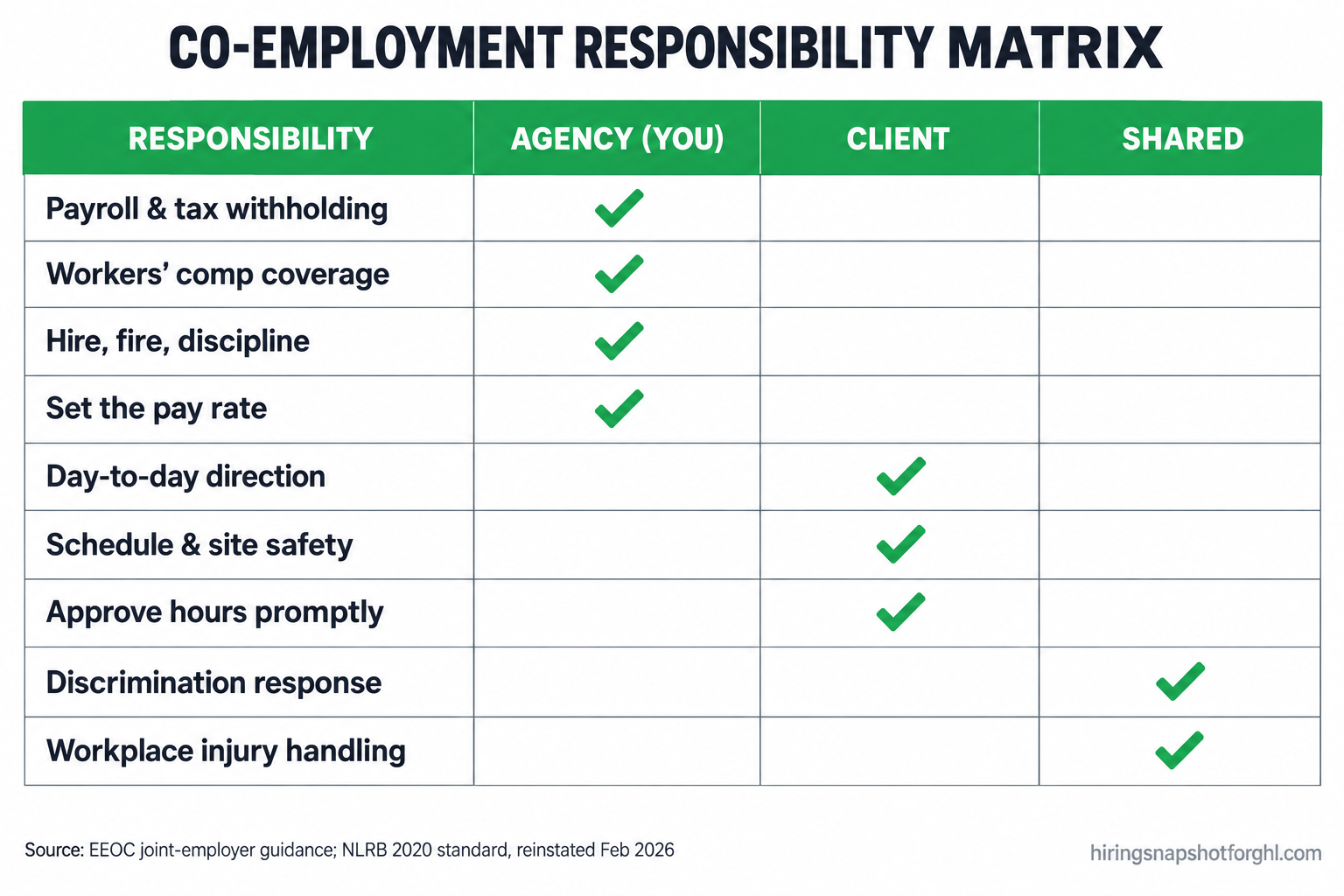
The written version of that same split, the one you can paste into an onboarding packet:
| Responsibility | Agency (you) | Client | Shared |
|---|---|---|---|
| Payroll, tax withholding | Yes | No | |
| Workers’ comp coverage | Yes | No | |
| Hire, fire, reassign | Yes | No | |
| Discipline and pay rate | Yes | No | |
| Day-to-day direction | No | Yes | |
| Schedule on the floor | No | Yes | |
| Site safety and training | No | Yes | |
| Prompt approval of hours | No | Yes | |
| Discrimination / harassment response | Yes | ||
| Workplace injury handling | Yes |
How this plays out for a solo, mid, and high-volume desk
The same rules land very differently depending on what you place and how much.
The solo contingency recruiter doing direct-hire. If you place candidates on a client’s own payroll for a one-time fee and never run a W-2 temp, your co-employment exposure is genuinely low, because you are not the employer of record for anyone on assignment. The worker becomes the client’s employee on day one. Your real risk is narrower: discrimination in the screening and referral process itself. Keep your screening criteria job-related, document why you referred or rejected each candidate, and do not drift into directing anyone’s work. You live mostly outside the co-employment room, so your job is to stay out of it.
The mid-size light-industrial temp desk. Now you are squarely in it. You run W-2 temps on client floors, you carry the comp, and the client’s foremen supervise the work. This is the profile with the most exposure and the most to gain from getting the paperwork right. Your program is three things: the control-allocation and indemnity clauses in every client agreement, the signed worker acknowledgment on every placement, and timekeeping you control rather than inherit from the client. The trap is the handshake client you have worked with for years on no real contract. That is the one that will cost you, because when a claim lands there is no paper to point to. Paper up the old accounts first.
The high-volume healthcare or multi-site desk. At scale, co-employment compounds with credentialing and benefits. You are placing dozens or hundreds of workers, some on long assignments that cross ACA and classification thresholds, often across several states where the workers’ comp borrowed-servant rules differ. Manual tracking fails here, not because your team is careless but because the volume guarantees something slips. Your durable answer is a system: every worker’s acknowledgment, assignment length, hours, and reporting history on one record, with alerts when an assignment crosses a threshold that changes your obligations. The goal is that the compliance posture is a property of your workflow, not a thing a coordinator has to remember for 200 people at once.
Common objections, answered
“My service agreement says the worker is my employee, not the client’s. Doesn’t that settle it?” No. Every agency’s contract says that, and it helps, but a court or agency decides joint employment by looking at who actually controls the work, not what the contract calls the relationship. The EEOC guidance explicitly finds joint employment in a case where the contract called the worker an independent contractor. The contract is useful for allocating responsibility and indemnity between you and the client. It does not bind a regulator or the worker.
“We have never had a claim in ten years. Why spend time on this now?” Because the cost of co-employment is not steady, it is a spike. You carry zero cost for years and then one injury, one harassment complaint, or one overtime dispute arrives and the exposure is six figures with your name on the filing. The paperwork is cheap insurance against a rare, expensive event, and the 2026 rule changes are a reminder that the ground under this shifts whether or not you are watching.
“Won’t asking a client to sign a control-allocation and indemnity clause scare them off?” The opposite, usually. A client’s own legal team wants this allocation spelled out as much as you do, because it protects them too, the exclusive-remedy shield on injuries and the indemnity for your payroll obligations both cut in their favor. A clean agreement signals that you run a real operation. The clients who balk at defining who is responsible for what are exactly the clients who will blame you when something breaks.
“The client controls the floor and the schedule. How can I keep control of the employment terms?” You split it on purpose. The client absolutely directs the work, that is the deal. What you keep is the set of decisions that define the employment relationship: who gets hired and placed, who gets disciplined or removed, what the pay rate is, and how hours are recorded. If a client wants to discipline or fire your worker, that decision routes through you. That single habit keeps the line clean under both the narrowed NLRB standard and the wage-and-hour test.
FAQ
What is co-employment in staffing?
Co-employment is the normal arrangement where a staffing agency and its client both hold employer rights and duties over the same worker at the same time. The agency is the employer of record for payroll, taxes, and workers’ compensation and controls hiring and firing, while the client directs the day-to-day work on its site. It is the standard structure of temporary and contract staffing, not a mistake to avoid.
Is co-employment the same as joint employment?
They are closely related but not identical. Co-employment is the business term for the ongoing shared-employer relationship. Joint employment is the legal finding that two entities are both employers of a worker under a specific law, such as the FLSA or Title VII, which triggers shared liability under that law. Co-employment is the structure; a joint-employer finding is the legal consequence a claim can produce.
Can a staffing agency and its client both be sued for the same worker’s claim?
Yes. Under the EEOC’s guidance, when both the agency and client control the worker they are joint employers, and for discrimination damages they are jointly and severally liable, meaning a claimant can recover the full amount from either one. Wage-and-hour law can likewise make each joint employer independently liable. This is why the control-allocation and indemnity terms in your client agreement matter so much.
Who is liable if a temp is injured at a client’s worksite?
In most states, workers’ compensation is the exclusive remedy, so the injured worker is generally limited to a comp claim rather than a lawsuit. Because the client directs and supervises the work, the “borrowed servant” or “special employer” doctrine often lets the client share that exclusive-remedy protection too. The rules vary by state and depend on your workers’ comp coverage being valid and in force, so confirm both your coverage and the client’s insurance in writing.
Did the joint-employer rules change in 2026?
Yes, partly. In February 2026 the NLRB reinstated its 2020 joint-employer standard, which requires substantial direct and immediate control and no longer treats reserved or indirect control alone as enough. Separately, the Department of Labor proposed a new wage-and-hour joint-employer rule in April 2026, which was still a proposal and not final law as of mid-2026. The discrimination and workers’ compensation frameworks did not change.
How do I protect my staffing agency from co-employment liability?
You cannot remove co-employment, but you can manage it. Put a control-allocation clause and an indemnity clause in every client agreement, have every placed worker sign an employer-of-record acknowledgment with a direct reporting channel, control your own timekeeping instead of relying on the client’s timesheet, keep hiring, firing, discipline, and pay decisions running through your agency, and maintain valid workers’ compensation coverage. Document everything, because the paper trail is what decides where liability lands.
About the author
Neha Chandra is the Staffing Compliance and Operations Expert behind the Hiring Snapshot. With a background in HR operations and contingent-workforce compliance, she audits every cadence against TCPA, EEOC, and FCRA realities so automation never outruns the rules. This article is general information for staffing operators, not legal advice; confirm the current rules for the states you place in, and the wording of any contract clause, with your own counsel.
Related reading
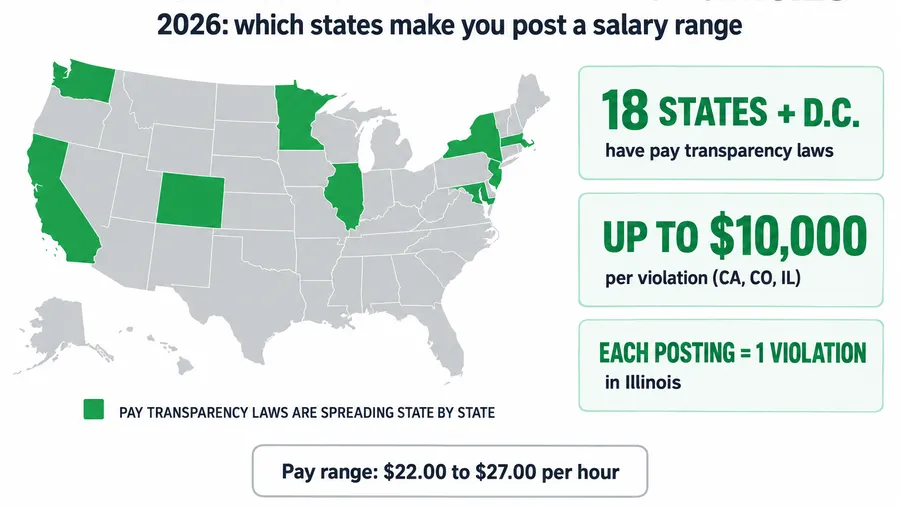
- Pay Transparency Laws for Staffing Agencies in 2026: Which States Make You Post a Salary Range
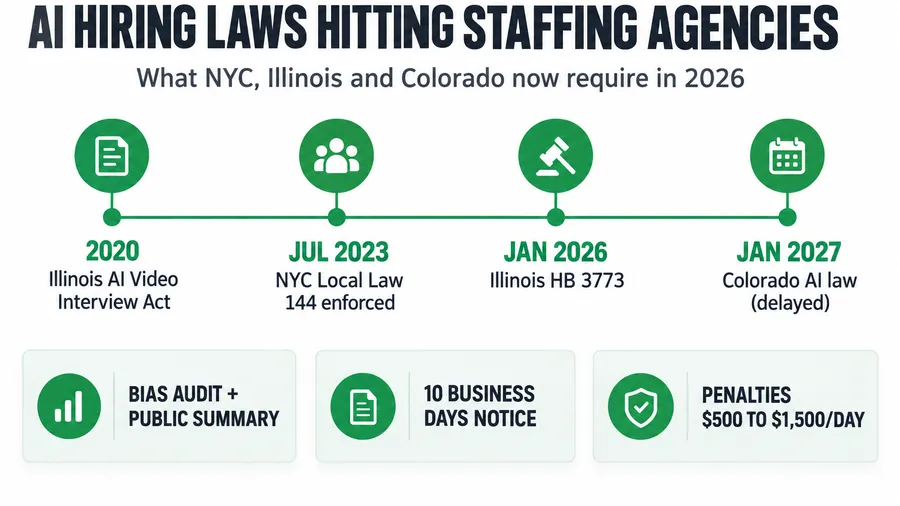
- AI Hiring Laws for Staffing Agencies in 2026: What NYC, Illinois and Colorado Now Require
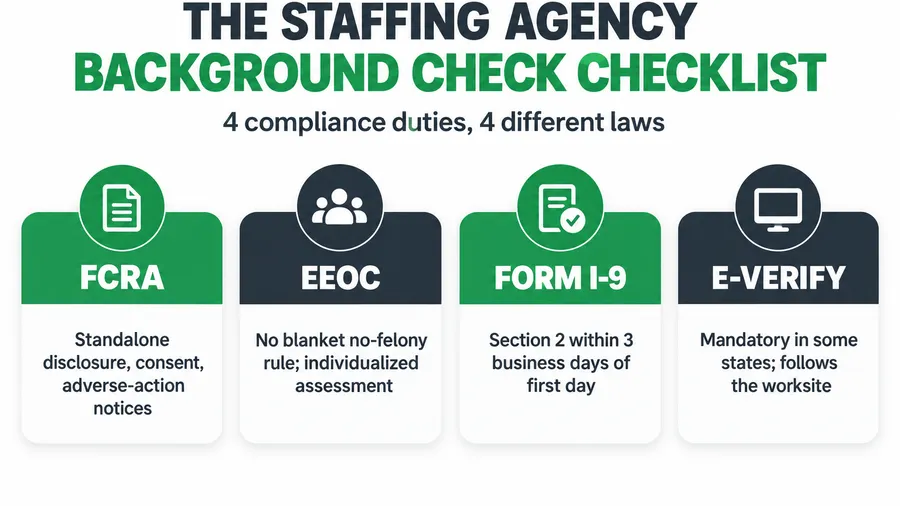
- The Staffing Agency Background Check Checklist: FCRA, I-9 and E-Verify Without a Lawsuit
- Candidate Onboarding Automation for Staffing Agencies
- How to Use GoHighLevel as an ATS: Build a Recruiting Pipeline That Fills Reqs Faster
Want recruiting automation that keeps you fast without outrunning the rules? See how the Hiring Snapshot works, then get the full snapshot for a one-time $997.