· Marcus Delgado · Field Reports · 13 min read
Why Atlanta Staffing Agencies Are Hiring a GoHighLevel VA Instead of Another Recruiter
Your next hire doesn't have to be a recruiter. For most Atlanta staffing desks, a trained GoHighLevel VA recovers more billable hours per dollar than another headcount — here's the desk math, the sources, and where the line actually falls.
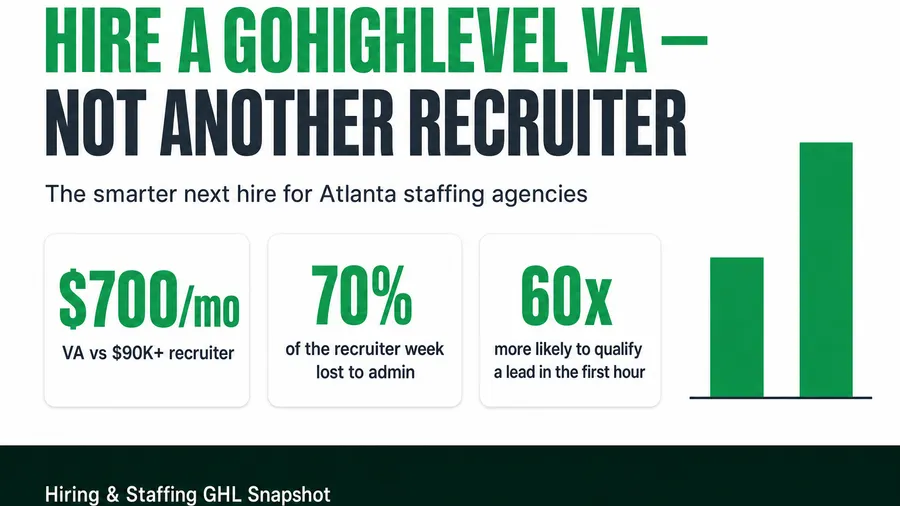
Short answer: if your recruiters are drowning in GoHighLevel admin instead of placing candidates, your next hire should be a trained GoHighLevel VA — not another recruiter. In Atlanta’s crowded staffing market, another $70K–$95K recruiter takes months to ramp and still loses a third of the week to CRM data entry, follow-up, and pipeline hygiene. A recruiting-niche GHL VA starts at $700/month, absorbs the admin that pulls your closers off the phones, and answers candidates in minutes — when the placement is actually won. This is the desk math on why Atlanta agencies are choosing the VA, where the line falls, and where hiring a recruiter still wins.
Key takeaways
- Your closers aren’t closing. Salesforce found sales reps spend less than 30% of their week actually selling — the rest goes to admin, data entry, and meetings (Salesforce, 2023). Recruiters lose the same hours to the CRM.
- Speed is the placement. Firms that contact a new lead within an hour are nearly 7× more likely to qualify it than those who wait even an hour longer — and 60× more likely than those who wait a day (Harvard Business Review).
- A recruiter is the expensive fix. The median U.S. HR/recruiting specialist earns $72,910 base (BLS, May 2024) — roughly $90K+ loaded. A full-time GHL VA runs about $15K/year.
- A bad hire compounds it. SHRM puts the cost of a bad hire at 50%–200% of the role’s annual salary — real money on a mis-hired recruiter you’re still training.
- Communication keeps talent. Contingent workers who heard from their recruiter more than once a week were far likelier to stay and re-engage (Bullhorn GRID 2024) — exactly the cadence a VA-run GHL keeps running automatically.
Table of contents
- The real problem in an Atlanta staffing desk
- Pain point 1: your recruiters are doing data entry
- Pain point 2: slow follow-up is bleeding placements
- Pain point 3: another recruiter is the costly fix
- What a GoHighLevel VA actually runs for you
- Why this hits Atlanta desks especially hard
- Recruiter vs. GHL VA: which to hire next
- FAQ
The real problem in an Atlanta staffing desk
Walk into almost any Atlanta staffing office — light-industrial desks feeding the Fulton and Gwinnett warehouse corridors, healthcare recruiters staffing metro hospital systems, IT contract shops around Midtown — and you’ll find the same bottleneck. It isn’t a shortage of candidates or job orders. It’s that your most expensive people, the ones who actually close placements, are spending half their day inside GoHighLevel: retyping candidate details, chasing reminders that didn’t send, cleaning up a pipeline stage nobody moved, and manually texting the applicant who inquired four hours ago.
The instinct, when the desk is buried, is to hire another recruiter. But that solves the wrong problem. You don’t have a recruiting shortage — you have an administrative one. Adding a second closer who also loses a third of the week to CRM busywork just doubles the leak. The agencies pulling ahead in Atlanta are hiring the thing that removes the busywork: a trained GoHighLevel VA who runs the system so the recruiters can run the desk.
Let’s put real numbers on why.
Pain point 1: your recruiters are doing data entry
Here’s the uncomfortable benchmark. Salesforce’s State of Sales research found that sales professionals spend less than 30% of their time actually selling — the majority of the week disappears into administrative work, manual data entry, and internal meetings (Salesforce, 2023). Recruiting is a sales job with a candidate on the other end, and the pattern holds: intake notes, CRM updates, scheduling, reminder texts, and status changes swallow the hours that should go to sourcing and closing.
It’s not just line staff. Owner-operators lose the same way — one survey of entrepreneurs found they spend roughly 16 hours a week, about a third of the work week, on small administrative tasks instead of the work that grows the business (Time etc / Forbes, 2023). If you own the desk and configure the automations, that’s your billable time evaporating.
Every one of those admin tasks is a GoHighLevel workflow, snippet, or automation waiting to be built. The problem is that building and maintaining them is itself a skill — and the person best at closing placements is rarely the person who should be debugging a broken trigger. That’s the exact gap a dedicated GHL VA fills: they own the ATS and recruiting pipeline inside GoHighLevel so your recruiters never touch it except to work the candidates it surfaces.
Pain point 2: slow follow-up is bleeding placements
In staffing, speed is not a nicety — it’s the whole game. The first agency to respond to a candidate or a job order usually wins it, and the data on response speed is brutal.
The landmark Harvard Business Review analysis of over a million sales leads found that firms trying to contact a lead within an hour were nearly 7× more likely to have a meaningful conversation with a decision-maker than firms that waited even 60 minutes longer — and more than 60× more likely than firms that waited 24 hours or more (Harvard Business Review). The underlying lead-response research is even sharper at the top: responding in 5 minutes versus 30 can lift the odds of qualifying a lead by an order of magnitude.
No human recruiter juggling ten reqs replies to every inbound application in five minutes. A GoHighLevel VA makes sure the system does — instant SMS acknowledgement, a qualification survey, and a booked interview slot fire the second a candidate applies, and the VA keeps those SMS-first cadences tuned and compliant. The payoff isn’t only in the first touch. Bullhorn’s 2024 talent research found that contingent workers who heard from their recruiter more than once a week were dramatically more likely to keep working with the firm and refer others (Bullhorn GRID 2024). That steady cadence is precisely what a VA-maintained GHL keeps running on autopilot — the same engine behind reactivating a cold candidate database and recovering interview no-shows.
Pain point 3: another recruiter is the costly fix
Now the part that changes the hiring decision. Compare what you actually pay to solve “the desk is buried” each way.
The median U.S. human-resources/recruiting specialist earns $72,910 a year in base wages (U.S. Bureau of Labor Statistics, May 2024). Load in payroll taxes, benefits, software seats, and desk space and the true cost lands north of $90,000 — before they’ve made a single placement, and after weeks of ramp. And if that hire is the wrong fit, SHRM estimates the cost of a bad hire at 50% to 200% of the role’s annual salary once you count lost productivity, re-recruiting, and the reqs that went unfilled.
A recruiting-niche GoHighLevel VA is a different order of magnitude. Our hire-a-GHL-VA plans start at $700/month part-time, $1,250/month full-time, and $1,500/month for the Elite tier with dedicated development — no payroll taxes, no benefits load, no long ramp, and a dedicated project manager on every plan. A full-time VA is roughly $15,000 a year: about one-sixth the loaded cost of a single in-house recruiter, aimed squarely at the administrative bottleneck that was slowing your closers down in the first place.
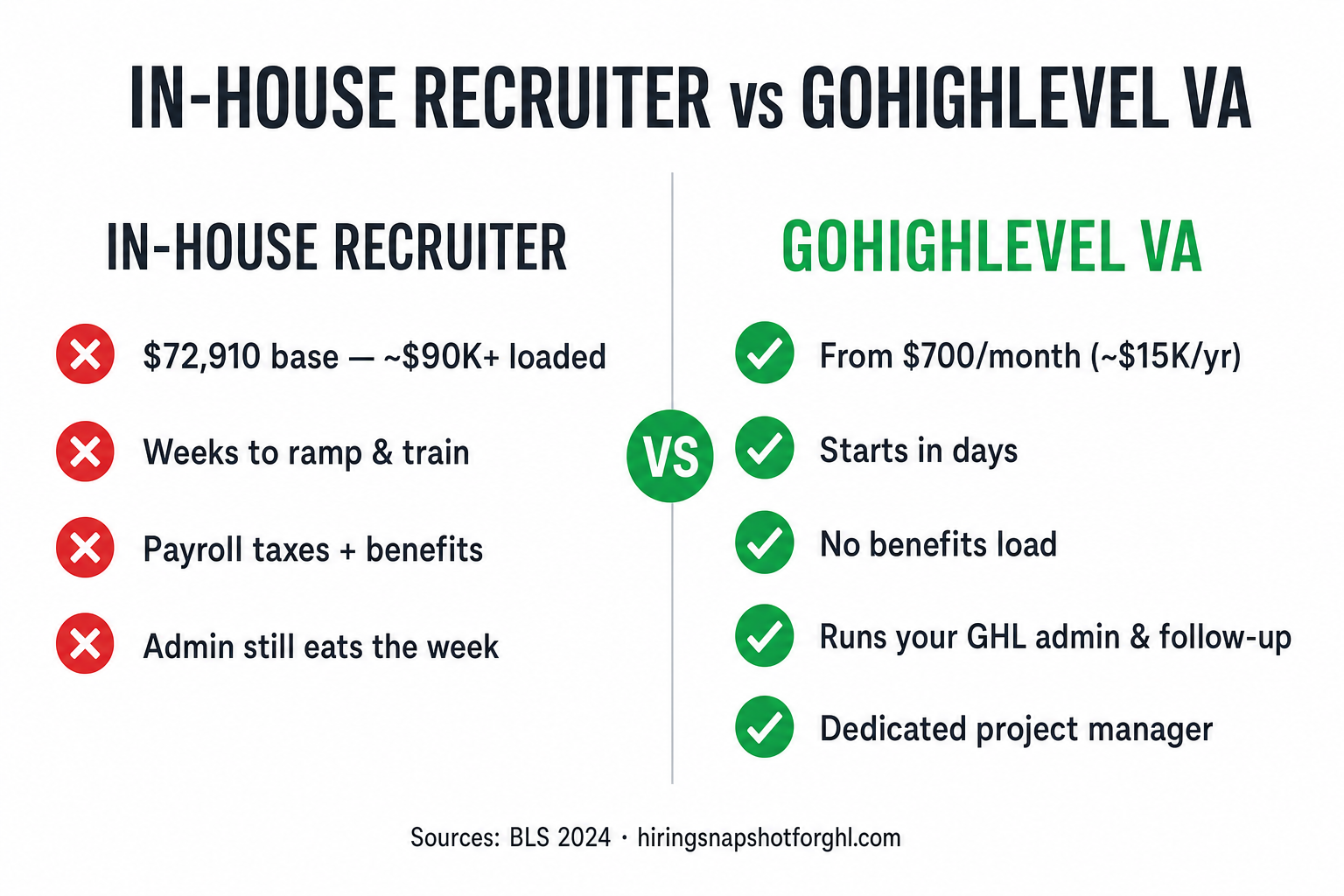
To be fair about it: a VA does not source and close placements the way a strong recruiter does — that’s the recruiter’s job, and it’s the one you want them spending all their time on. The point isn’t “VA instead of recruiters forever.” It’s that when the desk is buried, the highest-ROI next hire is usually the one that gives your existing closers their week back, not a second closer who inherits the same admin drag.
| What you’re buying | Another in-house recruiter | GoHighLevel VA |
|---|---|---|
| Starting cost | ~$72,910 base (BLS), ~$90K+ loaded | From $700/mo (~$15K/yr full-time) |
| Time to productive | Weeks of ramp + training | Days — trained on the niche |
| Payroll tax & benefits | Yes | None |
| Runs your GHL admin & automations | Rarely — usually adds to it | Yes — it’s the whole job |
| Speed-to-lead follow-up | Manual, best-effort | Automated & maintained |
| Cost of a bad hire | 50–200% of salary (SHRM) | Cancel anytime, no contract |
| Best at | Sourcing & closing placements | Removing the admin drag |
What a GoHighLevel VA actually runs for you
“VA” undersells it when the person is trained specifically on recruiting automation. A GHL VA on a staffing desk owns the system end to end:
- Candidate capture & instant response — inbound applications hit an ATS pipeline with automatic SMS/email acknowledgement and a qualification survey, so no applicant waits hours for a first reply.
- Interview scheduling & no-show recovery — calendars, reminder sequences, and no-show win-back flows run without a coordinator babysitting them.
- Pipeline hygiene — stages moved, statuses updated, stale candidates re-engaged, so your reporting is real and your recruiters trust the board.
- Compliance-aware SMS cadences — TCPA-consented, SMS-first nurture that keeps candidates warm without risking the rules.
- Database reactivation — mining your existing candidate list for redeployments instead of paying to source the same people twice.
- AI chat widget, AI receptionist & outbound calls — front-door coverage so inquiries get answered after hours, when your competitors’ voicemail is picking up.
If you’d rather have that automation built once and handed off rather than staffed monthly, that’s what our GoHighLevel development service and the Hiring Snapshot itself are for — the VA then runs and refines what’s already built.
Why this hits Atlanta desks especially hard
Atlanta is one of the densest staffing markets in the Southeast, and the mix makes the admin drag worse than average. The metro is a national logistics and warehousing hub — Hartsfield-Jackson, the I-85/I-75 freight corridors, and the Savannah port pipeline feed a constant churn of light-industrial and supply-chain reqs — layered on top of a large healthcare system footprint and a fast-growing tech and film economy. Georgia’s own labor projections point to sustained demand across exactly the transportation, warehousing, and healthcare roles that staffing agencies fill (Georgia Department of Labor).
That volume is the point. High-churn, high-volume desks live or die on speed and follow-up — the metrics we’ve just shown are the ones a buried CRM quietly destroys. And it’s a big prize: the U.S. staffing industry generated about $124 billion in sales in 2024 and staffing companies employed roughly 2.2 million temporary and contract workers per week, more than 11 million over the course of the year (American Staffing Association). Georgia is consistently among the top states for staffing employment. In a market moving that fast, the Atlanta agency whose GoHighLevel actually responds in minutes — because someone owns it full-time — takes the placements the slower desks fumble. It’s the same high-volume recruiting engine we build the snapshot around, just staffed so it never falls behind.
Recruiter vs. GHL VA: which to hire next
This isn’t dogma — sometimes another recruiter genuinely is the right call. Run these questions in order:
- Are your current recruiters at capacity on selling, or on admin? If they’re maxed on real sourcing and closing, hire a recruiter. If they’re maxed because the CRM eats their day, hire a VA.
- Do candidates and clients wait hours for a first response? If yes, that’s an automation-and-follow-up problem a VA fixes far cheaper than a headcount.
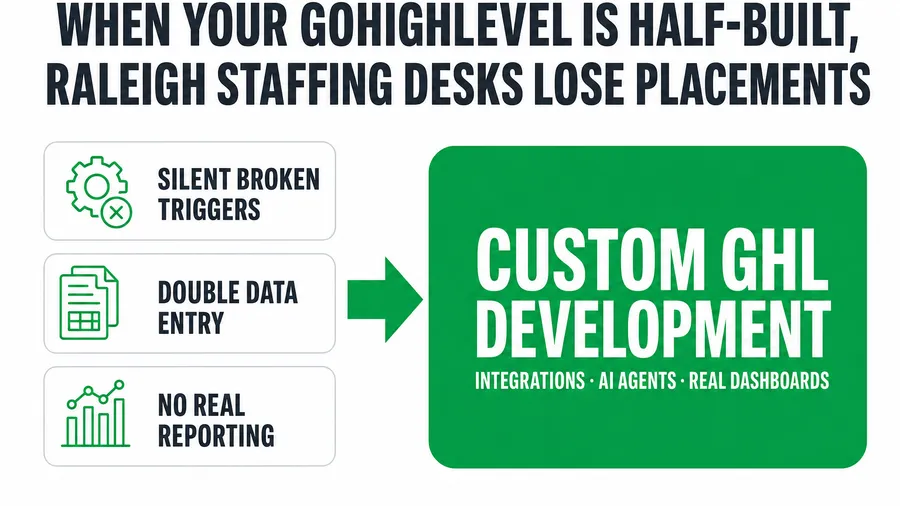
- Is your GoHighLevel half-built or constantly breaking? A VA who lives in GHL fixes and maintains it; a new recruiter will just work around it.
- What’s your budget per recovered hour? ~$90K loaded for a recruiter vs. ~$15K/year for a full-time VA aimed straight at the bottleneck.
- Do you have the job orders to keep a new closer busy today? If not, a VA that helps you win more from existing demand beats a recruiter with nothing to work.
For most Atlanta desks that feel buried, the honest answer is: hire the VA first. Give your closers their week and their speed-to-lead back, let the automated cadences keep candidates warm, and add the next recruiter when the constraint is genuinely demand — not data entry.
Frequently asked questions
Is a GoHighLevel VA really cheaper than hiring a recruiter?
Substantially. The median U.S. HR/recruiting specialist earns $72,910 in base wages (BLS, May 2024) — roughly $90,000+ once you add payroll taxes, benefits, and software. A full-time GoHighLevel VA runs about $15,000 a year with no benefits load and no long ramp. They solve different problems, but for the administrative bottleneck slowing your desk, the VA is far more cost-effective per recovered hour.
Won’t a VA just replace my recruiters?
No — and they shouldn’t. A VA doesn’t source and close placements; that’s your recruiters’ highest-value work. The VA removes the admin, CRM data entry, and follow-up that currently steal a third or more of your recruiters’ week, so your closers spend their time closing. It’s a force multiplier for the team you have, not a replacement for it.
What does a GoHighLevel VA actually do on a staffing desk?
They own your GoHighLevel: candidate-capture pipelines, instant SMS/email acknowledgement, qualification surveys, interview scheduling and no-show recovery, pipeline hygiene, compliance-aware SMS cadences, database reactivation, and AI chat/receptionist coverage. In short, everything inside the CRM that a recruiter shouldn’t be spending their day on. See the full scope on our hire-a-GHL-VA page.
How fast does response speed really need to be?
Very. Firms that contact a lead within an hour are nearly 7× more likely to qualify it than those who wait even an hour longer, and more than 60× more likely than those who wait 24 hours (HBR). A VA-maintained GoHighLevel replies in minutes automatically, so you’re not depending on a busy recruiter to catch every inbound application in time.
Why does this matter specifically for Atlanta staffing agencies?
Atlanta is a high-volume, high-churn staffing market — heavy in logistics, warehousing, healthcare, and light-industrial roles driven by the airport, freight corridors, and Georgia’s labor demand (Georgia DOL). Fast-moving, high-volume desks are exactly where a slow, half-maintained CRM costs the most placements, and where a full-time VA running your automations pays for itself quickest.
How much does a GoHighLevel VA cost?
Our plans are $700/month part-time, $1,250/month full-time, and $1,500/month for the Elite tier with dedicated development. Every plan includes a dedicated project manager, is NDA-ready and background-checked, and is trained on the Hiring Snapshot — with no long-term contract. See current VA plans or book a walkthrough.
About the author
Marcus Delgado is the Staffing Agency Growth Lead behind the Hiring Snapshot, based in Tampa, FL. He ran a light-industrial staffing desk before moving to the snapshot team to focus on agency growth. He thinks in placement economics — fill rates, redeploys, gross margin per requisition — and translates those numbers into the automations that actually move them. His posts lean on real desk math, not vanity metrics.
Related reading
- GoHighLevel ATS: Building a Recruiting Pipeline That Runs Itself
- SMS-First Recruiting: Why Email-Only Agencies Are Losing the 2026 Talent Market
- How to Reduce Time-to-Fill: The GoHighLevel Playbook
- High-Volume Recruiting in GoHighLevel: The Automation Stack
- Reactivate a Cold Candidate Database in GoHighLevel
Buried in GoHighLevel admin instead of placing candidates? See our GHL VA plans, book a walkthrough, or see how the Hiring Snapshot works.