· Marcus Delgado · Growth · 15 min read
YouTube Recruiting for Orlando Staffing Agencies: Why You're Invisible on the #2 Search Engine (2026)
An Orlando candidate researches your agency before they apply — and on YouTube, the platform 84% of US adults use, most staffing desks return nothing while a competitor's 'day in the life' video plays. Here's what that invisibility quietly costs, with the real data, and the done-for-you fix.
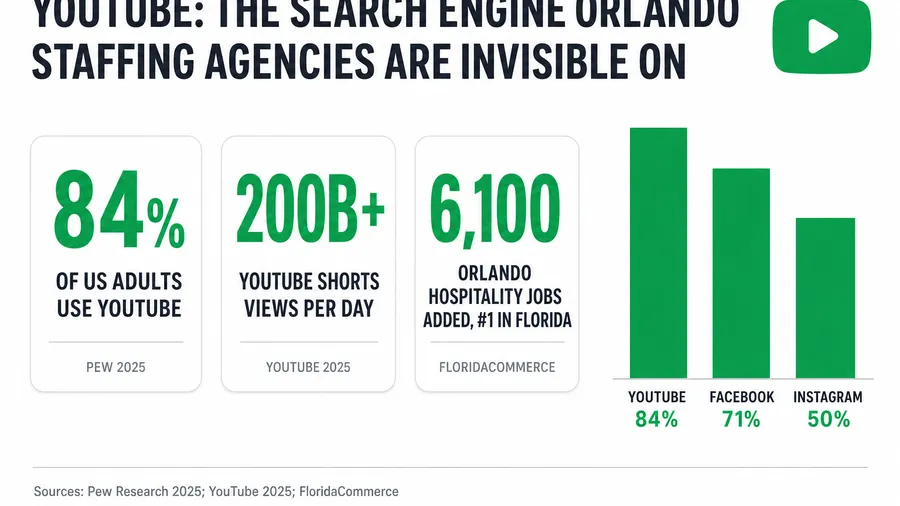
Short answer: most Orlando staffing agencies are completely invisible on YouTube — the second most-visited site on the internet and the platform 84% of US adults now use — so when a candidate or hiring manager searches your agency’s name, or “warehouse jobs Orlando,” the video results belong to a competitor. That gap matters because YouTube isn’t just entertainment; it’s a search engine candidates use to decide whether your desk is real, active, and worth their next application. A recruiter with even a handful of short, honest videos looks like the safe choice. A recruiter with none looks like it closed. This is what that invisibility actually costs an Orlando desk, the sourced data behind it, and how a done-for-you video engine fixes it — without you learning to edit or standing in front of a camera every week.
Key takeaways
- YouTube is where the audience already is. 84% of US adults use YouTube — more than Facebook (71%) or Instagram (50%) — and about half use it every day (Pew Research Center, 2025).
- Video makes people apply. Job postings with video see about a 34% higher application rate than those without (CareerBuilder research, via Recruitics).
- Candidates check you first. Roughly 3 in 4 job seekers research a company — its reputation and presence — before they apply (Glassdoor), and a blank video profile reads as a cold desk.
- Short-form removed the excuse. YouTube Shorts now averages over 200 billion views a day (YouTube / Google, 2025) — you can reach candidates with a 30-second phone clip, no studio required.
- Video pays. 93% of marketers report positive ROI from video and 88% say video helped generate leads (Wyzowl State of Video Marketing, 2025).
- Orlando’s demand is exploding. Orlando led every Florida metro in leisure & hospitality job gains, adding 6,100 jobs over the year to August 2025 (FloridaCommerce) — the high-volume, hard-to-fill demand video recruiting reaches best.
Table of contents
- Why Orlando recruiters are invisible on YouTube
- What YouTube invisibility actually costs
- YouTube is where candidates research you
- The four reasons staffing agencies skip YouTube
- Shorts removed the last excuse
- What “done-for-you” actually replaces
- How this plugs into GoHighLevel
- What YouTube won’t fix
- FAQ
Why Orlando recruiters are invisible on YouTube
Orlando is one of the hungriest hiring markets in the country right now. Over the year to August 2025, the metro led every Florida metro area in leisure and hospitality job gains, adding 6,100 jobs, and its labor force grew by nearly 6,000 people (FloridaCommerce). Add the healthcare hiring and the ramp around new attractions like Epic Universe, and you have a metro where hospitality, healthcare, and light-industrial roles turn over constantly (Orlando Economic Partnership). Every staffing desk in Central Florida is fishing the same crowded pond.
That’s exactly why visibility decides who wins. When a line cook, a CNA, or a warehouse associate is choosing which agency to trust with their next job — and when a hospitality operator is choosing who to hand a 40-person seasonal ramp — they do what everyone does now: they look you up. And a growing share of that looking happens on video.
Here’s the uncomfortable part: the platform where they look is the one almost no staffing agency shows up on. 84% of US adults use YouTube — more than any other platform, ahead of Facebook and Instagram — and roughly half of them are on it every single day (Pew Research Center, 2025). Yet the typical Orlando recruiting agency has an empty channel or none at all. You never hear about the candidate who watched a competitor’s “what it’s like to work our warehouse floor” clip and applied there instead. The loss is silent. It just happens.
What YouTube invisibility actually costs
“Make YouTube videos” sounds like a vanity chore until you translate it into placement economics — the only language a staffing owner should care about.
Start with application rate. Recruiting research has long found that job postings with video attract roughly 34% more applications than text-only listings (CareerBuilder research, via Recruitics). That’s not a branding nicety; it’s more candidates entering the top of your funnel from the same job. When you’re filling high-turnover hospitality and healthcare roles at Orlando’s volume, a third more applicants per req is the difference between filling on time and eating an overtime bill or losing the client.
Now the reputation side. Roughly 3 in 4 job seekers research a company before they apply (Glassdoor), and employers with a weak or absent presence pay for it: Glassdoor’s data pegs the penalty at around 10% more per hire for companies with poor reputations. A strong employer brand runs the other way — LinkedIn’s talent research found companies with a strong brand see up to a 50% lower cost-per-hire (LinkedIn, Why Your Employer Brand Matters). For a staffing agency, cost-per-hire is your cost of goods. Every dollar you don’t spend re-sourcing a role is margin.
So the cost of a blank YouTube channel isn’t “fewer views.” It’s fewer applicants per req, a weaker close against agencies that look established, and a higher effective cost to fill every seat. It compounds quietly, month after month, in the wrong direction.
YouTube is where candidates research you
The mistake most recruiters make is filing YouTube under “entertainment” instead of “search.” It is both. YouTube is the world’s second most-visited website and, by most industry reckonings, its second-largest search engine — people don’t just scroll it, they query it. “What’s it like to work at [company],” “warehouse job interview tips,” “staffing agency vs applying direct” — these are searches with a job-seeker on the other end, and the results are video.
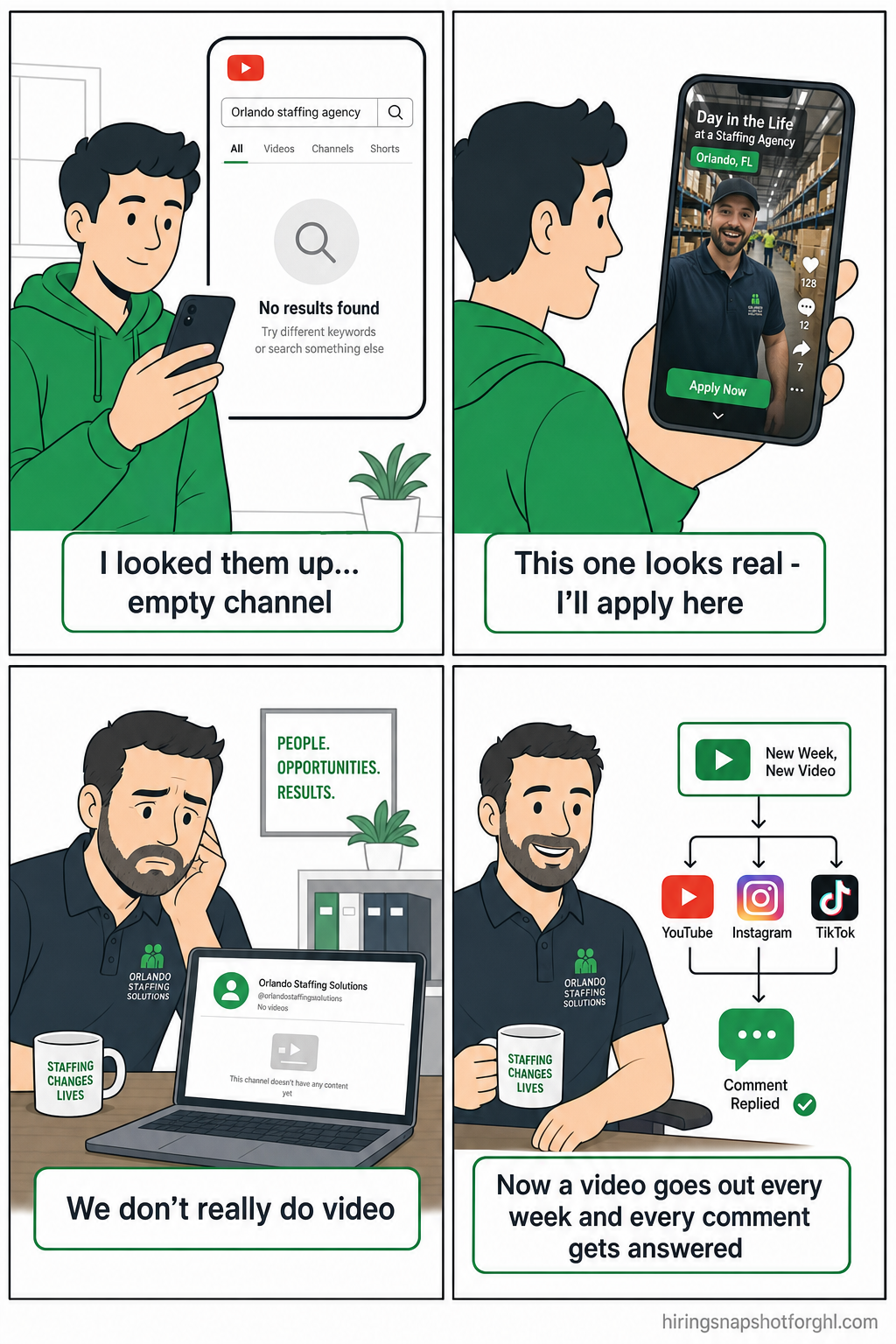
When an Orlando candidate types your agency’s name into that search box and gets nothing, the absence speaks. It doesn’t read as neutral; it reads as “this desk isn’t really active.” When they search the role and a competitor’s 45-second floor tour comes up, that competitor just became the safe, human, real-feeling choice — before you ever got a chance to make an offer. This is the same dynamic that makes Google reviews make or break an agency: candidates are pre-qualifying you on public signals, and video is the richest signal there is.
It also feeds the rest of your funnel. The majority of job applications are now submitted on mobile (Appcast) — the same phone that plays the video. The path from “watched your Short on the couch” to “tapped apply” is a few seconds on one device, if you’re in the results at all. And the ROI case is no longer speculative: 93% of marketers report positive ROI from video and 88% say it helped generate leads (Wyzowl, 2025). Video is the best-performing content format on the internet, and staffing is one of the few industries barely using it.
The four reasons staffing agencies skip YouTube
When we audit an Orlando recruiting agency’s video presence, the same four blockers show up almost every time. Each one is a reason candidates are meeting your competitor on screen instead of you.
- The “I’m not on camera” block. Owners assume YouTube means a polished, on-camera production. It doesn’t. A captioned 30-second clip of the actual job site, or a text-on-screen “3 things to bring to your warehouse interview,” outperforms a stiff corporate video — and nobody’s face has to be in it.
- The “no time to edit” block. Between intake calls, screens, and client updates, editing never wins the day. So the channel stays empty, or a single video from 2023 sits there like a tombstone — which is worse than nothing.
- The “one video isn’t worth it” block. A lone upload does nothing; YouTube rewards consistency and a back catalog. Agencies try once, see no traffic, and quit right before the point where a library starts compounding.
- The “and then what?” block. Even agencies that post never connect the video to a booking. Someone watches, gets interested, and… has to hunt for a phone number. The comment asking “is this still hiring?” sits unanswered for two days. The intent evaporates.
The first three leaks cost you reach. The fourth costs you placements you already earned — a candidate raised their hand under your video and nobody was there to grab it. In staffing, that fourth one is the most expensive, because replying to a new lead within 5 minutes instead of 30 makes you about 21x more likely to qualify it (Lead Response Management study, MIT/InsideSales, via HBR). A comment at 9 p.m. has a five-minute half-life. No recruiter is watching YouTube comments at 9 p.m. — but an automation is.
Shorts removed the last excuse
The reason “I’m not a video person” no longer holds is that YouTube’s center of gravity moved to short-form. YouTube Shorts now averages more than 200 billion views a day, up from roughly 70 billion in early 2024 (YouTube / Google, 2025). That is a firehose of vertical, phone-shot, sub-60-second video — exactly the format a recruiter can actually produce, and exactly where hourly candidates already spend their attention.
The winning content for a staffing desk isn’t cinematic. It’s honest and specific: a 30-second walk-through of a real job site, a “day in the life” of a placed worker, a quick “what to wear to your hospitality interview,” a client testimonial, a “we just placed 12 people this week” celebration. Film it on a phone, add captions, publish it as a Short. The same clip works as an Instagram Reel and a TikTok — which is why the smart move isn’t “start a YouTube channel,” it’s publish one video everywhere at once, the way our short-form video playbook for Charlotte agencies lays out. YouTube is simply the channel with the most reach and the longest shelf life, because a Short you post today keeps getting found in search for months.
What “done-for-you” actually replaces
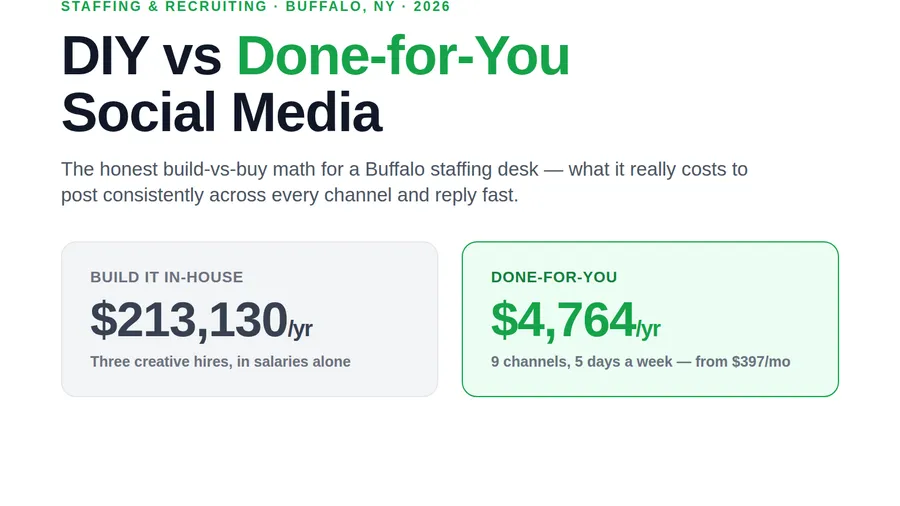
The honest reason most Orlando recruiters don’t fix this themselves is that doing it right is a whole team’s worth of work: someone to script and film, a video editor to cut and caption, a channel manager to publish and optimize titles, and a community manager to answer every comment fast. Hiring even one of those in-house isn’t cheap, and doing it yourself means it’s the thing that never happens between placements.
That’s the gap a done-for-you recruiting video and social service closes. Instead of another hire, you get the whole function as a system: a weekly content set written in your agency’s voice — including a short vertical reel every week — published 5 days a week across all 9 channels (YouTube, Instagram, TikTok, Facebook, LinkedIn, Google Business Profile, Pinterest, Threads, and Bluesky), plus three AI agents that reply to comments, answer DMs, and handle your website chat — qualifying candidates and hiring managers and booking calls straight to your calendar. Every lead lands in one CRM you can log into. It’s built specifically for staffing and recruiting, not a generic small-business package, and it starts at $397/month per brand, white-label.
The point isn’t to make you a YouTuber. It’s to make sure that when an Orlando candidate or client goes looking — and roughly 3 in 4 of them look before they apply — your agency is the one that shows up on video, looks active and real, and answers in seconds.
How this plugs into GoHighLevel
A video only pays off if the interest it creates lands somewhere it can be worked. That’s where GoHighLevel comes in, and why this pairs with the rest of your stack instead of bolting on beside it.
Every comment reply, DM, and web-chat conversation the AI agents run drops the candidate or hiring manager — with their name, phone, and the full thread — straight into your GHL pipeline. From there the Hiring Snapshot takes over: it captures TCPA consent, qualifies against the open req, and books the interview onto your calendar automatically. A YouTube Short is the top of the funnel; the automation is the machine that closes it. The same comment-to-DM automations that Miami agencies use on Instagram and Facebook turn a “still hiring?” comment into a booked call, 24/7.
If you’d rather not touch any of it, a trained GoHighLevel VA can run the whole back end for you — the same way our GHL development and get-a-website work are meant to hand you the outcome, not the homework. And if your channel and career page still feel disconnected, that’s usually a pipeline leak worth closing first.
What YouTube won’t fix
We name limits honestly, because overselling video is how agencies waste six months.
- It won’t work overnight. A YouTube library compounds over roughly 3–6 months. A single Short can break out sooner, but anyone promising viral results next week is lying. This is an asset that keeps getting found in search, not a slot machine.
- It won’t fix a broken offer. If your bill rates are uncompetitive or your candidate experience is poor, more visibility just spreads that faster. Video amplifies what’s true about your desk.
- It won’t replace relationships. For executive search and high-touch client work, referrals and reputation still carry the load. Video supports those relationships; it doesn’t substitute for them.
- It won’t stay compliant on its own. Every automated candidate touch that follows a comment or DM still has to respect TCPA consent and EEOC fairness — which is exactly how the Snapshot’s cadences are built.
Used right, YouTube is the highest-reach, longest-shelf-life top-of-funnel a modern staffing agency has, and almost none of your Orlando competitors are using it yet. That’s the opening. The difference between a channel that sits empty and one that fills reqs is a system: consistent video, published everywhere, with instant replies and a CRM that actually works the leads.
Frequently asked questions
Do Orlando staffing agencies really need YouTube?
Yes — because that’s where candidates are and where they research you. 84% of US adults use YouTube, more than any other platform, and about half use it daily (Pew Research Center, 2025). When an Orlando candidate looks up your agency or a role and finds an empty channel while a competitor’s “day in the life” Short plays, that competitor becomes the safe choice. Even a small library of honest, phone-shot videos makes your desk look active and real.
Do I have to be on camera to make recruiting videos?
No. The best-performing recruiting content is often faceless: a captioned walk-through of a real job site, text-on-screen interview tips, a “we just placed 12 people” celebration, or a placed worker’s short testimonial. Film on a phone, add captions, publish as a YouTube Short. Job postings with video already see about 34% higher application rates (CareerBuilder research, via Recruitics), and none of it requires you on screen.
How often should a staffing agency post video?
Consistency beats production value. YouTube rewards a steady cadence and a back catalog, so a short reel every week — republished across YouTube, Instagram, TikTok, and the rest — outperforms one polished video a quarter. That weekly rhythm is exactly what a done-for-you service delivers: a reel plus a full content set published 5 days a week across 9 channels.
How fast do I need to reply to comments and DMs on my videos?
As fast as possible — ideally minutes. Replying to a new lead within 5 minutes instead of 30 makes you about 21x more likely to qualify it (MIT/InsideSales study, via HBR). Since no recruiter can watch YouTube, Instagram, and TikTok comments at 9 p.m., an AI agent that answers, qualifies, and books instantly is what turns viewers into booked interviews.
Is YouTube worth it for high-volume hospitality and warehouse roles?
Especially for those. Orlando led every Florida metro in leisure and hospitality job gains, adding 6,100 jobs over the year to August 2025 (FloridaCommerce), and those candidates are heavily mobile and video-first. A short clip showing the actual work reaches people who were never scanning a job board — and the majority of applications now come from the same phone that played it (Appcast).
Is it worth paying for done-for-you video instead of doing it myself?
For most recruiting owners, yes — doing it right needs someone to film, an editor, a channel manager, and a community manager who replies within minutes. A done-for-you service delivers all of that plus AI reply agents from $397/month per brand, published across 9 channels, so you stay focused on placements instead of editing at midnight.
About the author
Marcus Delgado is the Staffing Agency Growth Lead behind the Hiring Snapshot, based in Tampa, FL. He ran a light-industrial staffing desk before joining the snapshot team, and he thinks in placement economics — fill rates, redeploys, gross margin per requisition. His posts lean on real desk math, not vanity metrics, and he’s happiest when a recruiter stops paying per applicant and starts getting inbound instead.
Related reading
- Short-Form Video for Charlotte Staffing Agencies: The Reels & TikTok Recruiting Playbook (2026)
- Social Media for Philadelphia Staffing Agencies: Why Recruiters Lose Candidates to Louder Competitors
- How Miami Staffing Agencies Can Use Instagram & Facebook Auto-DM to Recruit Hourly Workers
- Why Google Reviews Make or Break Chicago Staffing Agencies
- Why Recruiters Lose Candidates — and How to Stop the Leak
Want your Orlando staffing agency to be the one candidates find on YouTube? See the done-for-you social plan, book a walkthrough, or have a trained GHL VA run it for you.