· Marcus Delgado · Growth · 26 min read
When Your Placed Candidate Backs Out: Counteroffers, Cold Feet, and the System That Locks the Start
The deal felt done, then the resignation got countered and your fee vanished. Here is why placements die in the window between yes and day one, what a backed-out candidate really costs you, and the six-stage system that locks the start before a counteroffer can land.
It is Thursday afternoon and the placement is as good as banked. Your candidate accepted the offer on Monday, you sent the client the start date, and you have already pictured the invoice. Then the phone buzzes: “Hey, can we talk? My boss heard I resigned and they came back with more money and a new title. I feel terrible, but I think I’m going to stay.” In ten seconds, a month of work and a four- or five-figure fee is gone. The client is annoyed. The candidate is embarrassed. And you are back to square one with a req you thought you had closed.
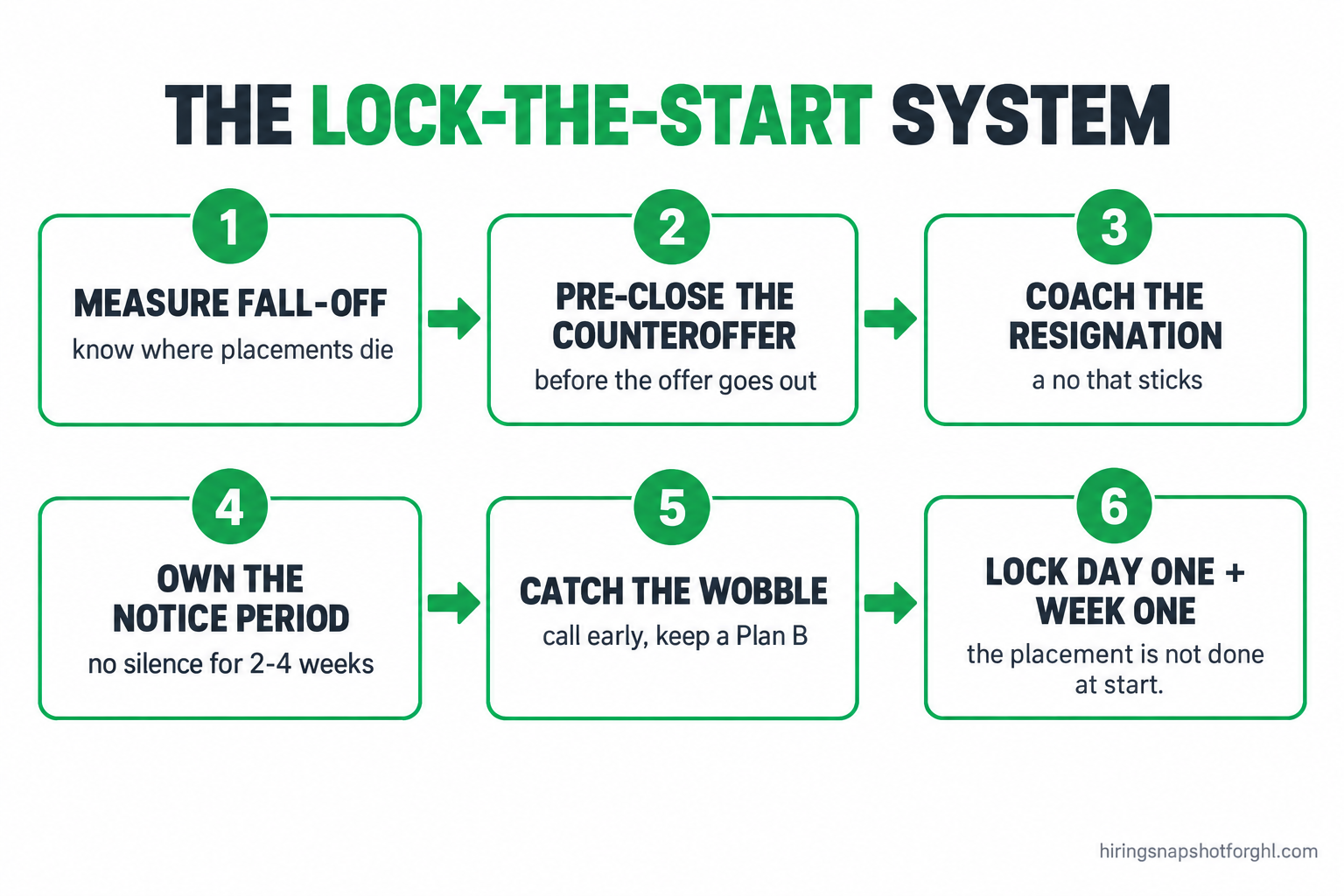
The short answer: placements do not die at the offer, they die in the silent window between the yes and the first day. A candidate backs out because the yes was emotional and untested, nobody prepared them for the counteroffer their boss was always going to make, and the days between acceptance and start date gave cold feet and competing offers all the room they needed. You fix it by treating the gap between accepted and started as a managed stage, not a waiting room. Measure where your placements fall off, pre-close the counteroffer before the offer ever goes out, coach the resignation so it sticks, own the notice period with a real cadence, catch the wobble early with a backup ready, and lock day one and the first week. This is the whole lock-the-start system, with the exact scripts you can steal, the desk math on what a fall-off really costs, and the places it quietly breaks.
Key takeaways
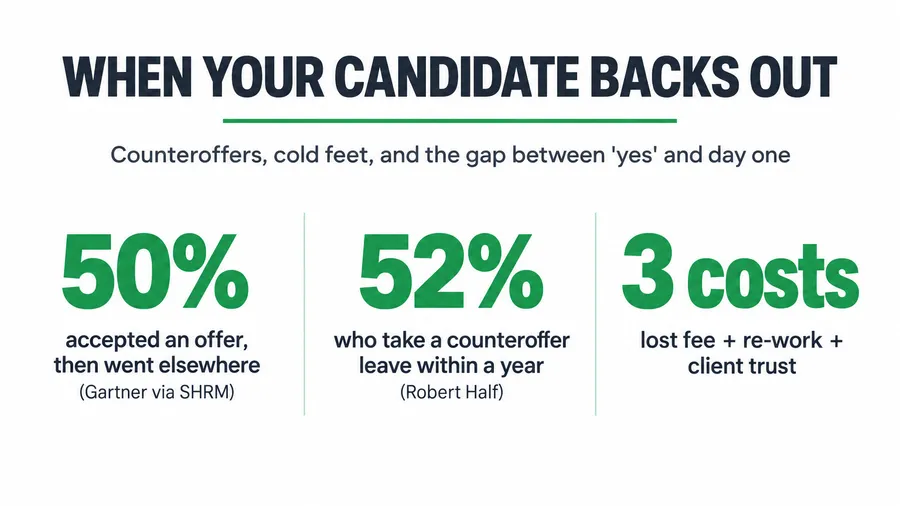
- Backing out is normal market behavior, not a rare betrayal. Gartner research reported by SHRM found 50% of candidates accepted a job offer and then started somewhere else instead, with 47% of recent hires still open to other offers and 42% sure they could find something better (survey of nearly 3,500 people, May 2022 to May 2023).
- The counteroffer is coming, so plan for it. The resignation is what triggers the counteroffer, which means the time to defuse it is before the offer goes out, not after the candidate is already wobbling on the phone.
- Counteroffers do not actually retain people. Robert Half found 52% of employees who accept a counteroffer leave within a year anyway, and 19% within six months. The raise rarely fixes the reason they were leaving.
- A backed-out placement is not one cost, it is three. You lose the fee, the re-work hours to reopen the search, and a chunk of trust with a client who now wonders if you can deliver.
- The gap is a stage you can systematize. Confirm, coach, and nurture a candidate from acceptance to first week, and most fall-offs turn into starts.
Table of contents
- Why a candidate backs out after saying yes
- What a backed-out placement actually costs you
- The lock-the-start system, six stages
- Stage 1: Measure your fall-off rate and where it happens
- Stage 2: Pre-close the counteroffer before the offer goes out
- Stage 3: Coach the resignation so it sticks
- Stage 4: Own the notice period, not just the start date
- Stage 5: Catch the wobble early and keep a Plan B warm
- Stage 6: Lock day one and the first week
- Three real scenarios: solo, 8-seat, and 25-seat
- Common objections, answered
- FAQ
Why a candidate backs out after saying yes
Start by killing the story that a candidate who backs out was just dishonest. There are roughly 27,000 staffing and recruiting companies in the United States running about 54,000 offices, and together they hired 12.7 million temporary and contract workers across 2023 and keep nearly 2.2 million working in an average week (American Staffing Association). Fall-off is a daily event across all of them, and the desks that beat it are not the ones with more loyal candidates. They are the ones who manage the window where loyalty gets tested.
A candidate backs out for a short list of reasons, and almost all of them live in the days between the yes and the start. The big one is the counteroffer. The moment they resign, their current employer realizes what it costs to replace them and throws money, a title, or a promise at the problem. Then there is the second offer, because a good candidate is rarely talking to only you, and a slow start date gives a competing recruiter time to close. There is plain cold feet, the loss aversion that kicks in once leaving stops being a fantasy and becomes a Monday on the calendar. And there is the oversold role, where the job on the offer letter does not match the job they pictured, so vanishing feels easier than a hard conversation.
Notice what is not driving most of this: a dishonest candidate. The numbers say this is market behavior, not character. Gartner, in research reported by SHRM, found that 50% of candidates accepted an offer and then went to work somewhere else instead, that 47% of recent hires were still open to other offers, and that 42% believed they could find a better job if they kept looking. When half the market treats a yes as provisional, a desk that treats a yes as final is going to keep getting surprised.
What a backed-out placement actually costs you
Put a number on a fall-off so you stop treating it as bad luck. A backed-out candidate is not one cost, it is three, and they stack hard on a small desk.
First, the fee, and this is the brutal one for a contingency recruiter. On a perm placement at a $70,000 salary and a 22% fee, you are out $15,400 the instant the candidate stays put. There is no partial credit for a req you almost filled. If that fee was going to be a meaningful share of your month, one counteroffer is not an annoyance, it is a hole in your income you now have to dig out of with a fresh search.
Second, the re-work. Reopening the search is not free. You go back to the client, explain the fall-off without sounding like you cannot deliver, re-engage backup candidates who may have cooled or taken other roles, and run the interview loop again. For a staffing firm, the cost of filling a role is real money: SHRM’s 2025 benchmarking put the average cost per hire at $5,475 for nonexecutive roles and $35,879 for executive ones. Whether you measure it as your own hours or the client’s, you are paying that bill twice for one placement.
Third, and this is the quiet killer, the trust. A client remembers a fall-off. The next time you send a strong candidate, there is a small voice asking whether this one will actually start. Lose two placements to counteroffers in a quarter and a good account starts hedging its reqs with another agency. The fee you lost is visible. The reqs you never get because the client stopped trusting your close are not, and they are usually the bigger number.
For a light-industrial or healthcare desk the shape is different but the stacking is the same: a candidate who accepts a temp assignment and then no-shows day one costs you the spread, the frantic morning backfill, and the client supervisor who now double-checks everything you promise. That day-one no-start is the hourly-side version of the counteroffer, and it responds to the same system.
The lock-the-start system, six stages
The window between yes and day one feels like something you survive by crossing your fingers. It is actually a stage you can run like every other stage in your pipeline. The desks whose candidates start are not luckier. They close the gap deliberately: they know their fall-off numbers, they defuse the counteroffer before the offer goes out, they coach the resignation, they stay close through the notice period, they watch for the wobble with a backup ready, and they treat day one and week one as part of the placement, not the end of it. Six stages, in order. Skip one and the rest have to carry it.
Stage 1: Measure your fall-off rate and where it happens
You cannot fix a leak you do not measure. Most desks know they lose placements after the yes the way they know some clients pay late, by feel, which means they cannot tell whether anything they try is working. So count it. For a rolling quarter, log every offer that was accepted and every one that then fell off, and crucially, where in the window it happened: did they renege before resigning, back out during the notice period, or no-start on day one? Those are three different failures with three different fixes.
Split the number into stages. The accept-to-resign gap tells you whether your pre-close is weak, because a candidate who accepts but will not actually resign never meant it. The resign-to-start gap tells you whether the counteroffer or cold feet is winning during the notice period. The start-to-week-one gap tells you whether the job was oversold or the first day was a mess. Track all three and the right fix for each becomes obvious instead of guessed at.
How it breaks. The usual failure is tracking a single blended fall-off rate and then aiming every fix at the wrong stage. If you only know that “deals fall through,” you will spend your energy babysitting the day-one logistics when the real leak is that you never asked about the counteroffer, or you will over-prep the resignation for candidates who were already gone the week before. Separate the stages, and you stop treating a counteroffer problem with a reminder-text solution.
Stage 2: Pre-close the counteroffer before the offer goes out
This is the stage that saves the most placements, so build it first. The single biggest mistake recruiters make is treating the counteroffer as a surprise when it is the most predictable event in the whole process. If your candidate is any good, their employer will try to keep them. Your job is to make that conversation happen in your office, out loud, before the offer is ever extended, instead of on a Thursday afternoon when it is too late.
Pre-closing means getting three things on the table before you send an offer: the real reason they are leaving, what number or change would make them stay where they are, and a commitment for how they will respond when the counteroffer comes. If money is the only reason they are leaving, a counteroffer will probably win, and you need to know that now. If the reason is a bad manager, a dead-end role, or a long commute, then no raise fixes it, and you can say so to their face before they forget it under pressure.
Steal this: the pre-close counteroffer question (before the offer goes out)
“Before I take this offer back to them, I want to make sure we are not about to waste everyone’s time. When you hand in your notice, there is a very good chance your current boss comes back with more money or a new title to keep you. It happens almost every time with someone they value. So let me ask you straight: if they offered you another [X] to stay, would you take it? And if the answer is no, why not? Tell me the real reason you are leaving, because that is the thing that will still be true after any raise wears off.”
Get the answer, then make them say the plan out loud: “So if the counteroffer comes, what are you going to tell them?” A candidate who rehearses the no with you is far more likely to hold it in the room. This is also where you confirm the start date is real, that any PTO or notice logistics are handled, and that their partner or family is on board, because a quiet veto at home is a classic late fall-off.
How it breaks. Recruiters skip this because it feels like talking the candidate out of the job. It does the opposite: it surfaces the weak yes early, when you can still fix it or walk away, instead of after you have told the client to prep a desk. The other failure is doing it once and never writing down the answer, so nobody can remind the candidate of their own words when the wobble comes. Log the real reason and the rehearsed no on the record, because you will use both in Stage 5.
Stage 3: Coach the resignation so it sticks
A resignation is a skill, and most candidates have never done it well. Left alone, they write a warm, apologetic, open-ended note that practically invites a negotiation, then they sit in a closed-door meeting where their boss gets emotional and the counteroffer lands on a person who is unprepared and guilty. You can prevent most of that by coaching the resignation before it happens.
The resignation that sticks is short, firm, grateful, and gives no opening. It thanks the employer, states a clear last day, offers a clean handover, and does not list grievances or leave the door ajar for a counter. Tell your candidate to expect the counteroffer and to have a line ready, because the hardest counteroffers to refuse are the ones that catch you flat-footed in the moment.
Steal this: the resignation script for the candidate
“I want to tell you in person that I’m resigning, with my last day on [date]. This was a hard decision because I’ve valued my time here, and I’ll do everything I can to hand my work over cleanly in the next two weeks. I’ve thought about this carefully and I’ve accepted a role that’s the right next step for me, so my decision is final. I’m not looking to negotiate, I just want to leave on good terms.”
And the line for when the counteroffer comes: “I really appreciate that, it means a lot. But this was never about the money, and I’ve already given my word. I’d rather we part on good terms than have me stay for the wrong reason.”
Walk them through it, then have them say it back to you. The goal is that when their boss says “what would it take to keep you,” the candidate already knows their answer is “nothing, I’ve decided,” instead of freezing and leaving a gap a good manager will fill. Remind them that accepting a counteroffer rarely ends well: Robert Half found 52% of people who accept one leave within a year regardless, and 19% within six months, because the raise does not fix the reason they wanted out.
Stage 4: Own the notice period, not just the start date
The two to four weeks of a notice period is where most placements quietly unravel, and most recruiters go silent for all of it. They treat the accepted offer as a finished deal and move on to the next req, leaving the candidate alone with their doubts, their counteroffer, and a competing recruiter who is still calling. Silence is not neutral here. It is the gap a second offer and a case of cold feet both need to grow.
Own the notice period with a light, warm, scheduled cadence that keeps the new job real and the candidate connected. A check-in a day or two after the resignation to see how it went, a mid-notice touch to share something about the new team or the first-week plan, and a message in the final days to confirm logistics. None of it is heavy. All of it signals that you and the client are already treating them as part of the team, which is exactly the feeling a wavering candidate needs.
Steal this: the notice-period check-in cadence
Day after resignation, text: “How did it go handing in your notice? I know those conversations are never fun. Really glad you’re on board, and I’m here if anything comes up over the next couple of weeks.”
Mid-notice, text: “Quick update from [Client]: the team is looking forward to you starting on [date]. [Manager] mentioned you’ll be jumping into [project/area] first. Anything you want me to pass along before day one?”
Three days before start, text: “Almost there. Here’s everything for Monday: start time [time], where to go [address + who to ask for], what to bring [ID/docs]. Save my number, and if anything at all comes up this weekend, call me first. See you on the other side.”
The best move in the middle of the notice period is to connect the candidate to someone at the new company, a quick intro email or a five-minute call with the hiring manager. A candidate who has already met their future boss and feels wanted finds it much harder to back out, because backing out now means letting down a real person, not an abstract offer. The mechanics of keeping a candidate warm and moving the paperwork through this window without doing it by hand are laid out in the candidate onboarding automation guide.
How it breaks. The cadence is multi-step and spread over weeks, which is exactly what a busy recruiter drops the moment three new reqs land. It is also easy to send the messages and not watch the replies, so a “honestly, I’ve been having second thoughts” at 9pm sits unread until the candidate has already called their old boss. Both failures are why this cadence belongs in a system that fires on schedule and flags the worrying replies, not in a recruiter’s memory. Any texting here needs real consent and an easy opt-out, and the consent mechanics for a recruiting cadence are covered in the guide to TCPA-compliant recruiting texts.
Stage 5: Catch the wobble early and keep a Plan B warm
No system gets fall-off to zero. Some candidates will wobble, so the question is whether you hear about it early enough to save the placement, and whether you have a backup if you cannot. The wobble has tells: replies go short and slow, enthusiasm drops, a check-in gets left on read, or the candidate suddenly wants to “talk through something.” Treat any of those as a signal to call, not text, and to call warm, not panicked.
When a candidate calls wobbling over a counteroffer, you do not argue them into staying. You take them back to the reason they gave you in Stage 2, the one you wrote down, because it is almost always still true. The talk track is calm and it uses their own words against the raise.
Steal this: the counteroffer rebuttal talk track
“First off, no pressure, and thank you for calling me instead of just going quiet. That’s the right thing to do. Can I ask you something? When we first talked, you told me you were leaving because [the real reason: the manager, the ceiling, the commute, the direction of the company]. Is more money going to change that? Because in my experience the raise feels good for a month and then you’re back in the same job you were trying to leave, just a little more stuck because now they know you were looking. Most people who take the counter are gone within a year anyway. You made a careful decision a week ago for good reasons. Let’s not let one emotional meeting undo it. But it’s your call, and I’ll back whatever you decide.”
If the reason they are leaving really is only money and the counter beats your offer, you may lose this one, and that is the signal that your pre-close in Stage 2 needs to be sharper next time. Either way, this is why a Plan B matters. Keep your second-choice candidate warm through the whole process instead of ghosting them at the offer stage. A backup you have kept in the loop can step in within days; a backup you dropped a month ago is gone. The discipline of keeping good people warm between opportunities is the same muscle described in the contractor redeployment playbook, and it is what turns a fall-off into a delay instead of a disaster.
Stage 6: Lock day one and the first week
The placement is not safe when the candidate shows up. It is safe when they are still there at the end of week one. The start-to-week-one window is its own small cliff: a rough first day, a manager who is not ready, no desk, no laptop, no clear first task, and a candidate who just left a stable job starts quietly wondering if they made a mistake. You protect the fee by making the first day land well and by checking in before small problems become a resignation.
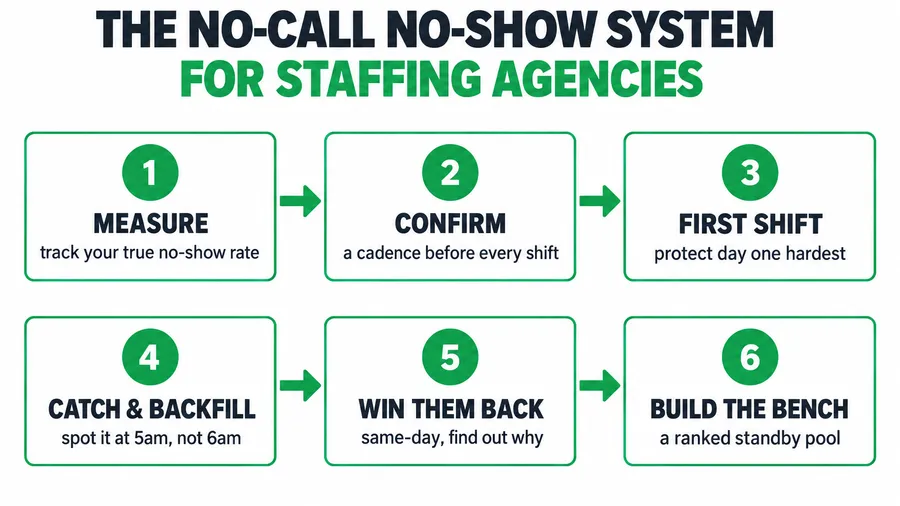
Confirm the logistics the way you would for a high-stakes interview: exact start time, where to go, who to ask for, what to bring, and a heads-up to the client manager to have the basics ready. Then check in on the candidate at the end of day one and again at the end of week one, not to nag but to catch anything before it festers. A candidate who hears “how was the first day” from you is a candidate who tells you about the problem instead of calling their old boss about the counteroffer they turned down. For temp and light-industrial placements, this first-shift protection is the exact hinge that keeps a start from becoming a day-one no-show, and the full version of it lives in the no-call no-show prevention system.
How it breaks. The recruiter counts the placement as done the moment the candidate starts, so nobody catches the bad first week until it is a quit. The fix is to extend your definition of a filled req to include a confirmed, happy week one, and to let the check-ins fire automatically so the last mile does not depend on anyone remembering. The broader set of levers that lift your overall fill and keep placements from leaking is covered in the guide to improving your fill rate.
Three real scenarios: solo, 8-seat, and 25-seat
The system is the same at every size. The shape of the fall-off changes.
The solo contingency recruiter, perm placements, 20 to 25% fees. The counteroffer is your single biggest threat, because one fall-off can be a month of income and you have no volume to absorb it. Your whole game is Stages 2, 3, and 5. Pre-close hard, get the real reason for leaving on record before you ever send the offer, coach the resignation word for word, and keep your second candidate warm so a backout is a delay, not a zero. Never treat a verbal yes as a banked fee. The gap between accepted and started is where your income lives or dies, and you cannot afford to leave it to chance.
The 8-recruiter light-industrial agency, temp and temp-to-hire, 40 to 80% markup. Here the fall-off is mostly the day-one no-start, the hourly version of the counteroffer, and it happens at volume. Your pressure point is that nobody has time to nurse every accepted candidate through to the first shift by hand across multiple clients. So the notice-period and first-shift cadences have to be automated, the worrying replies have to be flagged to a human, and you need a ranked backup bench per recurring order so a no-start is a quick cover. Track accept-to-start fall-off by client, because one site with a rough onboarding or a bad supervisor will quietly wreck your overall number.
The 25-recruiter healthcare or high-volume shop. The dangerous window here is accept-to-credentialed-to-start, where a long compliance and credentialing process creates weeks of silence that a competing offer loves. A fall-off can mean an unstaffed unit and a client relationship problem, not just a lost fee. At this scale the notice-period cadence runs alongside credential tracking, the backup bench is formal infrastructure, and the day-one and week-one check-ins are a staffed function. A one or two point improvement in start rate is a large number at this volume, which is exactly why the cadence gets automated rather than left to individual recruiters.
Common objections, answered
“If they take the counteroffer, they were never committed anyway, so why chase it?” Commitment is not a fixed trait, it is something the process either builds or leaves to chance. A candidate who gives you a soft yes and then gets ambushed by an emotional counteroffer in a closed-door meeting is not uncommitted, they are unprepared. The entire point of pre-closing and coaching the resignation is to turn a soft yes into a tested one before the pressure hits. You are not chasing an unwilling person, you are preparing a willing one for the one conversation that reliably undoes them.
“I can’t control what happens inside their current job.” You cannot, and you are not trying to. You are controlling the two things you own: how prepared the candidate is for the counteroffer, and how connected they feel to the new role during the notice period. The employer’s counteroffer is predictable, which means you can inoculate against it. The silence that lets cold feet grow is yours to fill. Control those and you move the fall-off rate a lot without ever touching the other side.
“Isn’t coaching the resignation manipulative?” Not if the candidate genuinely wants the new role, which is the only situation where you should be doing this at all. You are helping someone who has made a careful decision avoid being talked out of it by an emotional, last-minute pitch that the data says will not even make them happy. If the pre-close reveals they actually want to stay where they are, the honest move is to stop and not send the offer. Coaching is for the candidate who means it, so they can hold their own ground.
“Do I really need software for a handful of placements a month?” The wins here are boring and easy to automate, which is exactly why they get dropped by hand: send the right check-in on day three of the notice period, flag the candidate who went quiet, confirm the day-one logistics, nudge the week-one check-in. A recruiter does that well for one placement and forgets it on the Thursday three reqs land at once. That is why the Hiring Snapshot ships these cadences pre-built on GoHighLevel rather than as an empty account, and why a smaller desk often adds a trained GHL virtual assistant to own the notice-period follow-up so no accepted candidate goes dark.
FAQ
What is offer fall-off, or a backed-out placement?
Offer fall-off is when a candidate who has accepted a job offer does not actually start, either by reneging before they resign, backing out during the notice period, or failing to show on day one. In staffing it is most common in the window between acceptance and the first day, when a counteroffer, a competing offer, or cold feet can still change the candidate’s mind. It is common enough to plan for: Gartner research reported by SHRM found 50% of candidates accepted an offer and then went somewhere else instead.
Why do candidates accept an offer and then take a counteroffer?
Because resigning triggers the counteroffer, and most candidates are not prepared for it. When a valued employee gives notice, their employer often responds with more money, a new title, or a promise of change to avoid the cost of replacing them, and that pitch lands on a candidate who feels guilty and flattered. If nobody prepared the candidate to expect and refuse it, the emotional moment frequently wins, even when the raise does not fix the reason they wanted to leave.
Do most people who accept a counteroffer actually stay?
Usually not for long. Robert Half found that 52% of employees who accept a counteroffer leave within a year anyway, and 19% within six months, because a raise rarely addresses the real reason someone was leaving, such as a bad manager, a dead-end role, or the direction of the company. You will also see a widely repeated claim that 80% leave within six months, but that specific figure has no traceable source, so it is better to cite the real, named research than to repeat folklore.
How do I stop a candidate from reneging during the notice period?
Do not go silent. Run a light, scheduled cadence through the notice period: check in the day after they resign, share something real about the new team mid-notice, connect them with their future manager, and confirm the logistics a few days before the start. Keep the new role feeling real and wanted so cold feet and competing offers have less room to grow, and watch for the warning signs of a wobble, such as short replies or a missed check-in, so you can call before the candidate backs out.
Should I present a backup candidate to the client before day one?
You should keep a strong second candidate warm through the entire process rather than dropping them at the offer stage, so that if the first candidate falls off you can move within days instead of restarting. Whether you tell the client about the backup depends on the relationship, but having one ready is the difference between a fall-off that costs you a few days and one that costs you the fee and the account’s confidence.
How does GoHighLevel help lock the start?
A platform like GoHighLevel can run the whole post-acceptance window automatically: schedule the notice-period check-ins, flag a candidate who stops replying, send the day-before logistics message, and fire the day-one and week-one check-ins, so the last mile does not depend on a recruiter remembering it. It can also log the real reason a candidate gave for leaving, so that information is there when you need to defuse a counteroffer, turning a fragile hope into a managed stage.
About the author
Marcus Delgado is the Staffing Agency Growth Lead behind the Hiring Snapshot. He ran a light-industrial staffing desk before joining the team to focus on agency growth, and he thinks in placement economics: fill rates, redeploys, and gross margin per requisition. His posts lean on real desk math, not vanity metrics.
Related reading
- No-Call No-Show in Staffing: Why Placed Workers Ghost Your Shifts and the System That Stops It
- Candidate Onboarding Automation for Staffing Agencies: Close the Gap Between ‘Offer Accepted’ and ‘First Shift Worked’
- Cutting Interview No-Show Rate From 22% to 6% (The Cadence That Works)
- How to Improve Fill Rate at a Staffing Agency
- TCPA Compliance for Recruiting Texts: Consent, Timing, and Opt-Outs