· Marcus Delgado · Growth · 25 min read
How to Improve Your Fill Rate: The Six-Stage Funnel Fix That Turns More Job Orders Into Placements (2026)
Fill rate, not time-to-fill, is the number that decides whether a staffing desk makes money. Here is where orders quietly leak between accepted and filled, the six-stage system to plug each stage, and the exact candidate and client scripts you can steal today.
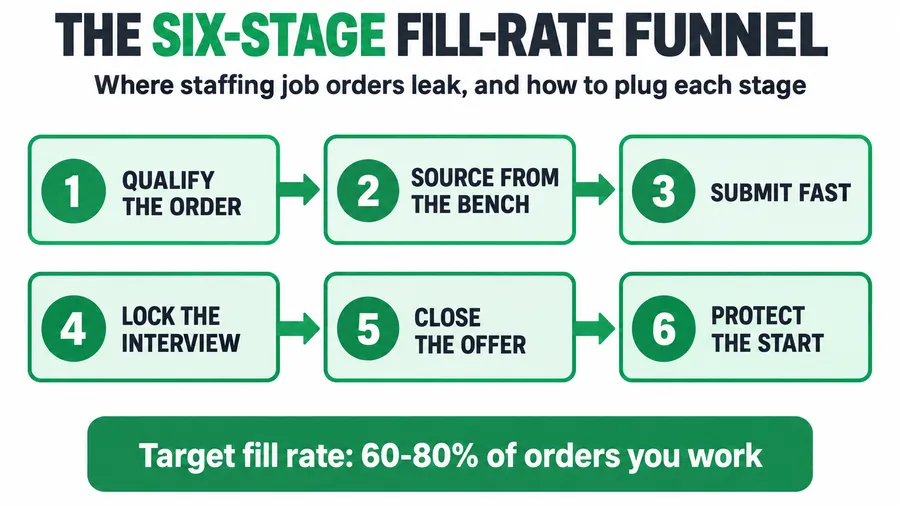
It is the last Friday of the month and you are looking at the board. Fourteen orders came in, you worked all of them, and six are filled. The rest are still open, a couple have gone cold, and one client already called the agency down the street. You put in the hours on every one of those fourteen, so it does not feel like a performance problem. It feels like bad luck. It is not. A 43% fill rate is a system leaking in six specific places, and every one of them is fixable.
The short answer: fill rate is the single number that decides whether a staffing desk makes money, and you raise it by treating the path from accepted order to filled seat as a funnel and plugging the leak at each stage, not by working harder on every req. Qualify the order before you touch it, source from a warm bench instead of a cold start, submit in hours not days, lock the interview against no-shows, close the offer before it ghosts, and protect the start date. A well-run desk fills 60 to 80% of the orders it works. This is the whole system, with the real benchmarks, the copy you can steal, and the traps that quietly drop your fill rate without you noticing.
Key takeaways
- Fill rate is not time-to-fill. Time-to-fill measures speed on the orders you close. Fill rate measures how many you close at all: filled orders divided by orders accepted. A desk can be fast and still fill half its board.
- The benchmark is 60 to 80%. A healthy general-staffing desk fills 60 to 80% of the orders it actively works; below 50% points to a systemic problem, and consistently above 85% usually means you are turning away winnable business.
- Most of the leak is self-inflicted. Bad orders you should have declined, cold sourcing, slow submittals, interview no-shows, and candidates who ghost between offer and start drop more orders than a tight talent market does.
- Margins are too thin to carry dead orders. Temp staffing gross margin averages around 25%, so recruiter hours burned on an order that never fills come straight out of the spread on the ones that do.
- The whole funnel can be automated. Capture, SMS qualification, submittal timing, interview reminders, and start-date confirmation are exactly the kind of work a CRM should run for you so nothing drops because a human got busy.
Table of contents
- Fill rate vs time-to-fill, and why the difference matters
- What a low fill rate actually costs you
- The six-stage fill-rate funnel
- Stage 1: Qualify the order before you work it
- Stage 2: Source from a warm bench, not a cold start
- Stage 3: Submit fast, while the candidate is still interested
- Stage 4: Lock the interview and kill the no-show
- Stage 5: Close the offer before it ghosts
- Stage 6: Protect the start date
- Three scenarios: solo, 8-seat, and 25-seat
- The compliance side: consent before you automate
- Common objections, answered
- FAQ
Fill rate vs time-to-fill, and why the difference matters
These two numbers get used like synonyms, and they measure completely different things. Time-to-fill is speed: how many days from opening an order to the candidate starting, measured only on the orders you actually close. Fill rate is conversion: of every order you accepted and worked, what share did you fill. The formula is simple, orders filled divided by orders accepted over a period, times 100, and it is the one that tracks closest to revenue, because an order you never fill earns you nothing no matter how fast you would have moved on it.
Here is why the distinction is not academic. A desk can post a great average time-to-fill and still be bleeding, because the average only counts wins. Work fourteen orders, fill six of them in nine days each, and your time-to-fill looks sharp while your fill rate is 43% and your P&L is soft. The six you did not fill still cost you sourcing hours, still annoyed a client, and still produced zero. If you only watch speed, you are grading yourself on the tape you won and ignoring the eight you lost. Track both, but when you are deciding where to spend the next hour, fill rate tells you the truth. For the speed side of the equation once an order is converting, the time-to-fill playbook covers the cadence; this piece is about why orders do not convert at all.
What a low fill rate actually costs you
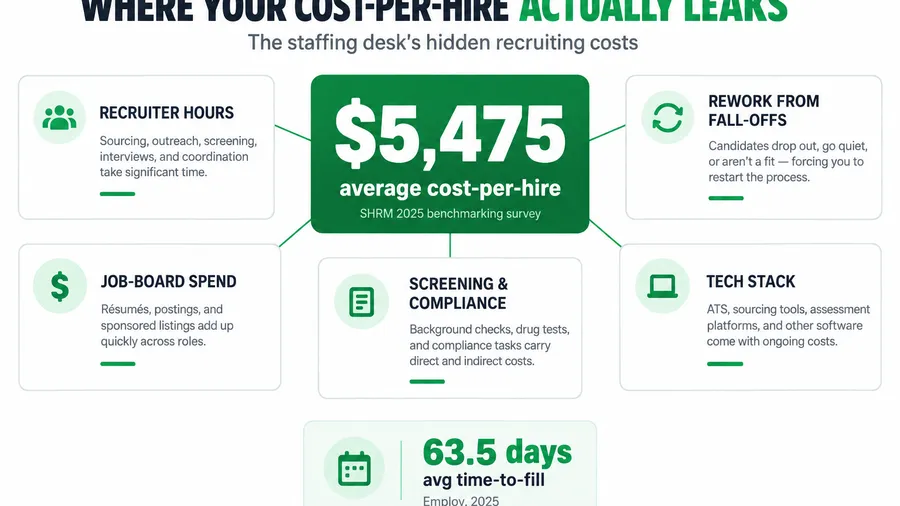
There are roughly 27,000 staffing and recruiting companies in the United States running about 54,000 offices, and together they put around 2.2 million temporary and contract workers to work in an average week (American Staffing Association). Every one of those desks lives on filling orders, and the margin on a filled order is thinner than outsiders assume. Average temp staffing gross margin runs around 25%, which means the recruiter hours you spend on an order that never fills are not free, they are paid for out of the spread on the orders that do.
Run the math on that Friday board. Fourteen orders, six filled, a 43% fill rate. If a filled light-industrial order is worth, say, $4,000 of gross margin over its life, the six wins bring in $24,000. But you also spent recruiter time on eight orders that produced nothing, and at a loaded recruiter cost of $40 an hour, even ten hours burned per dead order is $3,200 of labor against zero return, plus the client goodwill you spent. Lift that same board from 43% to the low end of healthy, 60%, and you fill about eight or nine orders instead of six on the identical pipeline. That is two to three more placements a month from work you were already doing, roughly $8,000 to $12,000 of gross margin you were leaving on the table every single month because the funnel leaked.
The client side hurts too. On the direct-hire world, the median time-to-fill sits around 44 days per SHRM, and a client who hands you an order is counting on you to beat their internal clock. Every order you accept and fail to fill teaches that client to split the next req across two agencies, which lowers your odds on the following one too. Low fill rate is not just lost revenue today, it is a shrinking share of tomorrow’s orders.
The six-stage fill-rate funnel
Raising fill rate feels like it should mean working harder, and it almost never does. The desks that fill 70 or 80% are not grinding more reqs than you, they are losing fewer candidates at each handoff. An order that fills has to clear six gates in order, and a leak at any one of them drops the whole order. Treat it as a funnel, find your worst-leaking stage, and fix that one first, because a 10-point gain at your weakest gate beats a 2-point gain at five strong ones.
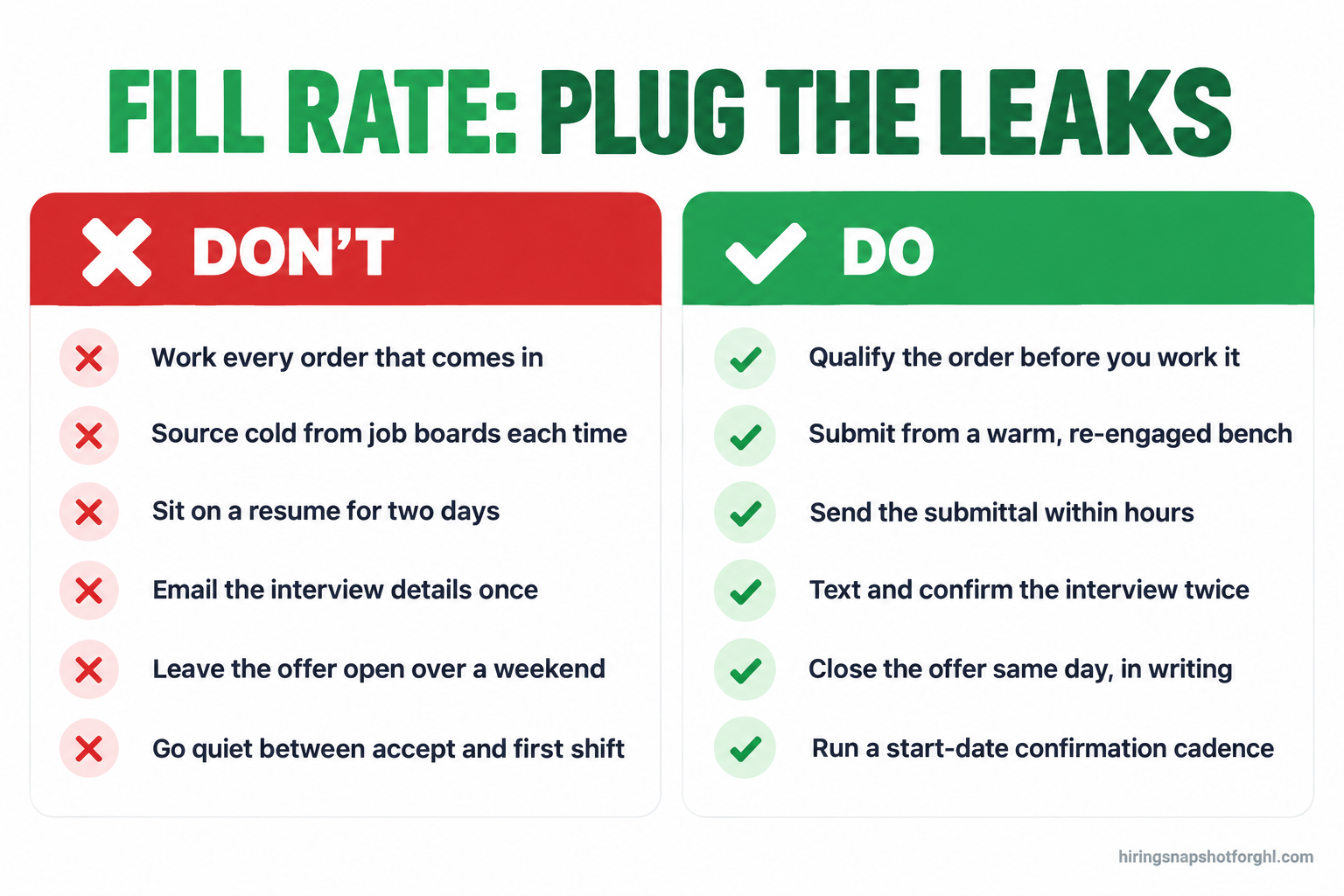
Stage 1: Qualify the order before you work it
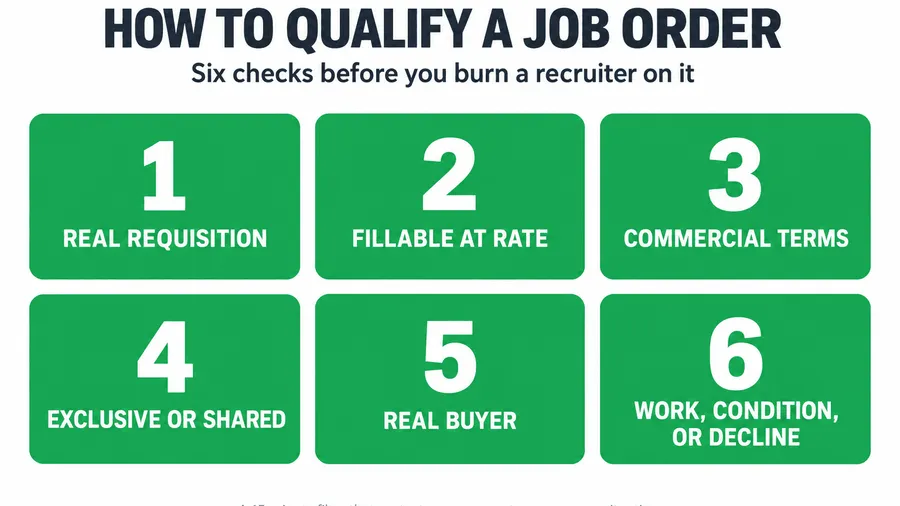
The fastest way to raise your fill rate is to stop accepting orders you were never going to fill. A req with an impossible pay rate, a client who is “just seeing what is out there,” a role already open with three other agencies, or a hiring manager who will not give you feedback, these are orders that drag your fill rate down while eating the same hours a real order would. Working them feels like effort, but effort on an unfillable order is just a slower way to lose.
Qualify at intake, every time, with the same short list of questions. Is the pay rate within the band that actually attracts this talent in this market, or is the client asking you to find a $25 forklift operator for $17? Is this exclusive, or am I racing two other desks to the same shrinking pool? Will the manager commit to a feedback turnaround, or does the order die in their inbox after I submit? What does “qualified” actually mean to them, in writing. An order that clears those questions is one you can fill, and one that does not is one you decline or renegotiate before it ever touches your fill rate. The full intake scorecard is in the job-order qualification guide, and it is the highest-value fill-rate work you will do, because a bad order you never accept cannot lower a number you never charged it against.
How it breaks. The “take everything” reflex, where accepting every order feels like growth but really just loads your board with reqs you cannot win, so your fill rate craters and your good orders starve for attention. And accepting a vague order on a promise to “firm up the details later,” which never happens, and you find out it was unfillable only after you have spent the sourcing hours. If you would not bet your own money that an order fills, do not spend your recruiters’ hours on it at full price.
Stage 2: Source from a warm bench, not a cold start
The second-biggest leak is starting every order from zero. If your answer to a new req is always “post it and pray,” you are sourcing cold every time, which is slow, expensive, and the reason an order sits for days before you have anyone to submit. The desks with high fill rates fill a large share of orders from people they already know: past placements, candidates who rolled off an assignment, applicants who were strong but lost out on a prior role. That bench is the cheapest, fastest talent you will ever submit, because you already have their consent, their history, and their trust.
Build the bench on purpose. Every candidate who ever applied, interviewed, or placed goes into your database tagged by skill, location, pay expectation, and availability, and you keep them warm with a light, regular touch so they answer when you call. When a worker rolls off an assignment, a redeploy nudge fires the same day instead of waiting for a recruiter to remember, which is why contractor redeployment is a fill-rate tool as much as a retention one, a redeployed worker is an order filled in hours. And a database reactivation campaign turns a dead list into live, ready candidates before you even have the order open. A warm bench is what lets you submit on day one instead of day four.
How it breaks. Treating the database as a graveyard, a place resumes go to die, so when an order lands you ignore the hundreds of people you already know and start a cold search anyway. And letting the bench go cold through neglect, so by the time you reach out the phone numbers are stale and nobody answers. A bench only fills orders if it is tended, which is a cadence problem, not a sourcing-skill problem.
Stage 3: Submit fast, while the candidate is still interested
Speed-to-submit is where good candidates leak out. In a tight market the strong people you want are talking to two or three other agencies, and the first qualified submittal in front of the hiring manager usually wins the slot, while the candidate who sits in your pipeline for two days gets scooped or goes cold. Every hour a resume sits on your desk is an hour the candidate is cooling off and a competitor is moving. The desks that fill fast submit within hours of sourcing, not days.
Tighten the clock from sourced to submitted. The moment you identify a candidate, the qualifying touch should go out automatically, an SMS that confirms interest, pay expectation, and availability in a two-minute exchange instead of three rounds of phone tag. SMS-first recruiting exists for exactly this reason, texts get read and answered in minutes while voicemails sit for hours. Once the candidate confirms, the submittal to the client should be a template you fill in, not a blank page you write from scratch each time, so the bottleneck is your decision, not your typing. Fast submittal is not about rushing quality, it is about removing the dead time between knowing a candidate is good and the client knowing it too.
Steal this: the candidate qualifying text (send the moment you source them)
“Hi [Name], it’s [You] at [Agency]. I’ve got a [role] in [area] paying [$X/hr], [shift]. Looks like a strong match for your background. Two quick questions so I can move fast: are you available to start within [timeframe], and does [$X/hr] work for you? Reply YES and I’ll call with the details and get you in front of the client today.”
Stage 4: Lock the interview and kill the no-show
You can source and submit perfectly and still lose the order at the interview, because the candidate does not show. Interview no-shows are one of the biggest single drops in the funnel, and they are almost entirely preventable. A candidate who confirmed on Monday and goes silent on Thursday was not lost to a better offer most of the time, they were lost to a cold cadence, nobody reminded them, nobody re-sold them on the role, and the interview fell off their radar behind everything else in their week.
Build a reminder cadence that treats the interview like the high-stakes appointment it is. A confirmation when the interview is booked, a reminder the day before, and a reminder the morning of, each one by text because that is what gets seen, each one making it one tap to confirm or reschedule rather than silently bail. When a candidate does start to drift, a quick human check-in catches it before it becomes a no-show. This exact cadence is what takes a no-show rate from the low twenties down to single digits, and the full build is in the interview no-show recovery playbook. Every no-show you prevent is an order that stays alive instead of resetting to zero.
Steal this: the three-touch interview reminder cadence
On booking: “You’re confirmed for [role] on [day] at [time], [location/link]. I’ll send a reminder the day before. Reply C to confirm or R if you need to reschedule.”
Day before: “Reminder: your interview for [role] is tomorrow at [time]. [Address or video link]. Bring [IDs/documents]. You’ve got this, reply here with any questions.”
Morning of: “Today’s the day, [Name]. Interview at [time], [location]. Give yourself [X] minutes to get there. Text me the second you’re done so I can get you quick feedback.”
Stage 5: Close the offer before it ghosts
The order is not filled when the offer goes out, it is filled when the candidate accepts and means it. This is where ghosting does its damage, and it is more common than most owners want to admit, around 78% of job seekers have said they would ghost a prospective employer, per an Indeed survey, and a candidate who goes quiet after a verbal yes has usually taken another offer or gotten cold feet, not changed their phone number. An offer left open over a weekend is an offer a counteroffer or a competing agency can walk right into.
Close fast and close in writing. The moment the client says yes, you get the offer to the candidate the same day, with the pay, the start date, and the first-day details in a message they can say yes to on their phone, not a formal letter that takes three days to produce. Then you keep contact warm through the gap between accept and start, because silence is where second thoughts grow. A candidate who hears from you between the yes and the first shift is a candidate who shows up, and one you leave alone for a week is a coin flip. If there is a counteroffer risk, name it out loud before it happens, because a candidate you have prepped for the “we’ll match it” conversation is one who already decided to come to you anyway.
Steal this: the same-day offer-close text
“Great news [Name], [Client] wants you for the [role]. Here are the details: start [date], [$X/hr], [shift], report to [name] at [location]. This is a firm offer and I’d love to lock it in today. Reply YES to accept and I’ll send onboarding next. If anything’s holding you back, call me now and let’s talk it through, I’d rather sort it out than lose you over something we can fix.”
Stage 6: Protect the start date
The cruelest leak is the one at the very end, the candidate who accepted, onboarded, and then never shows up for the first shift. On high-volume light-industrial desks this is a real and recurring loss, and it resets a fully worked order back to zero at the worst possible moment, after you have already told the client it is filled. The gap between “offer accepted” and “first shift worked” is where a surprising number of placements die, and it dies in silence, because everyone assumes the hard part is over.
Run a start-date confirmation cadence just like the interview cadence. A check-in a few days before the start to confirm the details and surface any problem, a reminder the day before with exactly where to go and what to bring, and a morning-of text that makes the first day feel expected and easy. Onboarding paperwork should be done before day one, not shoved at the candidate on the morning they are already nervous, which is the whole point of candidate onboarding automation, a candidate who finished their I-9 and direct deposit calmly at home is far more likely to walk through the door than one hit with a stack of forms at 6am. Protect the start, and the order you worked for two weeks actually counts.
How it breaks. Going dark the moment the offer is accepted, so the candidate’s enthusiasm cools in a week of silence and a competing offer or a nervous spouse talks them out of it. And treating the first shift as the client’s problem instead of yours, which it is not, an order is not filled until the worker has worked, and the agency that stays engaged through day one is the agency that keeps the placement and the fee.
Three scenarios: solo, 8-seat, and 25-seat
The funnel is the same at every size. The stage that leaks worst, and the fix that pays back fastest, is not.
The solo contingency recruiter, perm placements, 20 to 25% fees. Your fill rate is really your close rate on searches, and standard contingency fees run 15 to 25% with 20% the most common, so every search that dies before placement is a full fee gone with no volume to make it up. Your worst leak is usually Stage 1 and Stage 5: taking non-exclusive searches you share with three other recruiters, and losing closed candidates to counteroffers. Fix Stage 1 by pushing for exclusivity or a retainer before you work a search, and fix Stage 5 by prepping every candidate for the counteroffer before the resignation, because on a solo perm desk one saved placement is a month made.
The 8-recruiter light-industrial agency, temp and temp-to-hire, 40 to 80% markup. This is where volume magnifies every leak, and your biggest drops are almost always Stage 3 and Stage 4, slow submittals and interview no-shows, because at your order volume a few hours of delay or a 20% no-show rate compounds into dozens of lost placements a month. Automating the qualifying text, the submittal timing, and the interview reminder cadence is the highest-ROI move you can make, and it is exactly the work a CRM should carry. Watch your fill rate by recruiter and by client, because the blended number hides the desk or the account that is quietly dragging everyone down. The metrics worth tracking are laid out in the 2026 staffing benchmarks.
The 25-recruiter healthcare or high-volume shop. Here the leak is institutional. You are dealing with credentialing, compliance holds, and start-date fallout at a scale where Stage 6 becomes a major loss center, candidates who clear everything and still no-show for the first shift. Your defense is a systematized bench (Stage 2) deep enough to backfill a fallout same-day, and a start-date confirmation cadence that runs on every single placement without a recruiter touching it. At this scale, running the whole funnel inside one GoHighLevel recruiting pipeline so every stage is tracked and every drop triggers an alert is the difference between a fill rate you can see and manage and one you only learn about when the client calls.
The compliance side: consent before you automate
Every stage above leans on texting candidates, and that is where fill-rate automation meets compliance. The reminders, the qualifying texts, the offer-close messages, all of them are effective because SMS gets read, and all of them are regulated. Under the TCPA, you generally need prior express consent before you send automated or marketing texts to a candidate’s phone, and getting that wrong carries statutory penalties per message that can dwarf any single placement fee. The fix is not to avoid texting, it is to capture consent correctly at the top of the funnel, when the candidate applies or opts in, with clear language and an easy opt-out, so every downstream message rides on consent you can prove.
Build the consent into Stage 2, the bench. When a candidate enters your database, that is when you capture their agreement to be contacted by text, with the disclosure and the opt-out, so the warm bench you source from is also a consented bench you can legally text at speed. Keep the opt-out honored automatically, and keep a record of when and how consent was given, because the burden of proof is on you. The full consent language and the TCPA cadence rules are in the TCPA compliance guide for recruiting texts. This is general information, not legal advice, so confirm your setup with counsel, but the principle is simple, fast and legal are not in tension when consent is captured right at the start.
Common objections, answered
“My fill rate is low because the market is tight, not because of my process.” A tight market is real, and it is also the easiest thing to blame so you never look at the funnel. Pull your own numbers and find where orders actually die: if most of your loss is unfillable orders you accepted, slow submittals, or interview no-shows, that is process, not market, and it is in your control. The market sets the ceiling on a given order, but the gap between a 45% and a 70% fill rate on the same board is almost always the stages above, not the economy.
“I already work every order I get. How do I fill more without more orders?” By filling more of the ones you already have, which is the whole point of fill rate. Working every order harder is not the lever, plugging the leaks is: the same fourteen orders at a 70% fill rate instead of 43% is eight or nine placements instead of six, with no new business development at all. Fill rate is how you grow revenue without growing your order count, which is why it is the number to fix first.
“Won’t qualifying harder mean I turn away revenue?” The opposite, usually. An order you decline because it is unfillable was never revenue, it was a cost pretending to be an opportunity. Declining or renegotiating the orders you cannot win frees the recruiter hours those orders would have wasted and pours them into the orders you can, which raises your fill rate and your actual revenue at the same time. Turning away a bad order is not leaving money on the table, it is refusing to pay to chase money that was never there.
“Do I need software to do this, or can I just try harder?” You can run every stage by hand, and on a small desk you might for a while, but the leaks come back the moment a recruiter gets busy, which is always. The qualifying text that does not get sent, the interview reminder nobody had time for, the start-date confirmation that slipped, those are the leaks, and they happen because humans under load drop the follow-up. Automating the cadence is not about replacing recruiters, it is about making sure the funnel keeps moving when your people are heads-down on the next fire.
FAQ
What is a good fill rate for a staffing agency?
A healthy general-staffing desk fills roughly 60 to 80% of the orders it actively works. Below 50% usually signals a systemic problem in qualification, sourcing, or client fit, and consistently above 85% often means you are being too selective and leaving winnable orders, and revenue, on the table. The right target depends on your niche and how aggressively you accept orders, but if you are sitting below 50% on orders you chose to work, the funnel is leaking and the stages above are where to look.
How is fill rate different from time-to-fill?
Time-to-fill measures speed, the days from opening an order to the candidate starting, and it is calculated only on the orders you actually fill. Fill rate measures conversion, the share of all accepted orders that you fill at all. A desk can have an excellent time-to-fill and a poor fill rate at the same time, because the fast average only counts wins while the losses sit invisible. Both matter, but fill rate tracks closer to revenue because an unfilled order earns nothing regardless of how fast you would have moved.
How do I calculate fill rate?
Divide the number of job orders you filled in a period by the number of orders you accepted and worked in that period, then multiply by 100. Fourteen orders accepted and six filled is a 43% fill rate. Decide up front whether you count every order that came in or only the ones you chose to work, and stay consistent, because mixing the two makes the trend meaningless. Tracking it per recruiter and per client, not just agency-wide, is what reveals where the real leaks are.
What is the single biggest cause of a low fill rate?
For most desks it is one of two things: accepting orders you were never going to fill, and losing good candidates to slow follow-up at submittal, interview, or start. Unfillable orders drag the number down before you even start, and slow or cold cadences drop candidates who were ready to go. Both are process problems inside your control, which is why fill rate is fixable, find your worst-leaking stage and fix that one before touching the others.
Can automation actually improve fill rate, or is it just hype?
It improves fill rate specifically because it removes the human-under-load failures that cause most leaks. The qualifying text that goes out the instant a candidate is sourced, the interview reminder cadence that runs without anyone remembering, the start-date confirmation that fires on schedule, these are the follow-ups that get dropped when recruiters are busy, and dropped follow-ups are where orders die. Automating the cadence keeps every stage of the funnel moving, so fewer candidates leak out between the handoffs.
How long does it take to see fill rate improve?
The qualification and speed stages show up fast, often within a billing cycle or two, because declining bad orders and submitting faster change outcomes on the very next reqs. The bench and retention stages take longer to compound, because a warm, consented database and a reliable redeploy habit build over months. Pick your worst-leaking stage first, fix it, measure the move, then work down the funnel, rather than trying to overhaul all six stages at once.
About the author
Marcus Delgado is the Staffing Agency Growth Lead behind the Hiring Snapshot. He ran a light-industrial staffing desk before joining the team to focus on agency growth, and he thinks in placement economics: fill rates, redeploys, recruiter productivity, and gross margin per requisition. His posts lean on real desk math, not vanity metrics.
Related reading
- How to Qualify a Job Order Before You Work It: The Filter That Keeps a Staffing Desk Fillable
- How to Reduce Time-to-Fill: The GoHighLevel Playbook to Cut Days-to-Fill in Half
- Cutting Interview No-Show Rate From 22% to 6% (The Cadence That Works)
- Contractor Redeployment: The Automation That Turns One Placement Into Three
- Candidate Onboarding Automation: Close the Gap Between ‘Offer Accepted’ and ‘First Shift Worked’