· Marcus Delgado · Growth · 24 min read
No-Call No-Show in Staffing: Why Placed Workers Ghost Your Shifts and the System That Stops It
You filled the order, the worker said yes, and Monday morning they are not at the gate. Here is why placed workers ghost, what a single no-show really costs you, and the six-stage confirm-and-recover system that gets attendance up and keeps the client.
It is 5:52am and your phone buzzes with a text from the plant supervisor: “Where are your two people?” The shift started at 6:00. You placed those two workers last week. They confirmed the assignment, they picked up their badges, they sounded glad to have the work. And now, eight minutes before the line runs, both of them are not at the gate and neither one is answering a call. That is a no-call no-show, and it is not a rare event in staffing. It is a Tuesday.
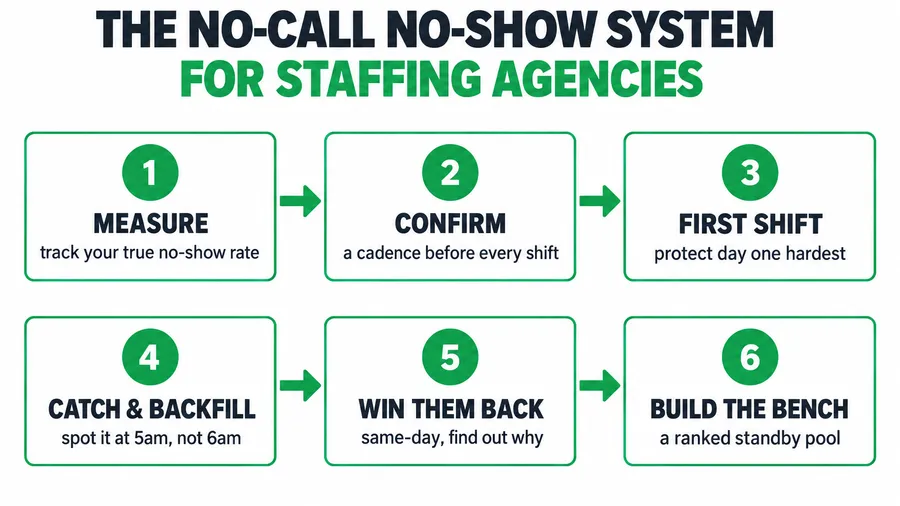
The short answer: placed workers ghost your shifts because the yes they gave you was soft, the gap between yes and the first shift was silent, and nobody made the shift feel real the night before. You fix it by treating attendance as a system, not a hope. Measure your true no-show rate and where it happens, confirm every shift before it starts, protect the first shift hardest, catch a no-show in minutes instead of at 6:01, find out why the worker vanished, and build a standby bench so a ghost becomes an inconvenience instead of a blown order. This is the whole confirm-and-recover system, with the exact copy you can steal, the desk math on what a ghost really costs, and the places it quietly breaks.
Key takeaways
- No-shows are normal, not a character flaw in your workers. During the tight labor market, Southwest reported 15% to 20% of new hires for some jobs did not turn up on day one, and Allied Universal put its day-one no-show rate near 15%, against a pre-pandemic baseline of about 8% (Wall Street Journal, 2022).
- The first shift is the danger zone. Among job seekers who admit to ghosting, 22% did it by accepting an offer and then not showing up for the first day of work (Indeed, 2023). Confirm that shift hardest.
- Silence is what kills the yes. A worker who hears nothing between “you start Monday” and Monday has had a week to take another offer. A confirmation cadence, not a single reminder, is the single biggest lever you own.
- A ghost that becomes a quit is a four-figure hit. A PeopleMatter survey reported by SHRM found hourly turnover running 49% a year at roughly $4,969 per departure. Recovering a no-show is far cheaper than sourcing a replacement.
- The client remembers the recovery, not the no-show. How fast you backfill and how straight you communicate is what keeps the account after a bad morning.
Table of contents
- Why placed workers ghost in the first place
- What one no-show actually costs you
- The confirm-and-recover system, six stages
- Stage 1: Measure your real no-show rate and when it happens
- Stage 2: Confirm every shift before it starts
- Stage 3: Protect the first shift hardest
- Stage 4: Catch the no-show in minutes, then backfill
- Stage 5: Find out why, and win them back
- Stage 6: Build the bench that makes a ghost survivable
- Three real scenarios: solo, 8-seat, and 25-seat
- Common objections, answered
- FAQ
Why placed workers ghost in the first place
Start by killing the story that no-shows are just flaky people. There are roughly 27,000 staffing and recruiting companies in the United States running about 54,000 offices, and together they put around 2.2 million temporary and contract workers to work in an average week (American Staffing Association). Every one of those desks fights the same no-show math, and the ones who win it are not the ones with better people. They are the ones who removed the reasons a worker drifts away.
A placed worker ghosts for a short list of reasons, and almost all of them are about the hours between yes and the first shift. They took a second offer, because they were applying to five places at once and yours went quiet while another agency kept talking. They lost their ride, or their childcare fell through, and had no easy way to tell you, so they said nothing. They could not remember exactly where to go, what time, or who to ask for, and shame beat confusion, so they just did not show. Or the job was oversold, the pay or the shift was not what they pictured, and vanishing felt easier than a hard conversation.
Notice what is not on that list: “they are lazy.” Ghosting is a communication failure far more often than a character failure, and that is good news, because communication is the one thing a staffing desk can actually systematize. It runs both ways, too: Greenhouse found 61% of job seekers were ghosted by employers after an interview, a nine-point jump in under a year. The agency that communicates like a human in a market full of silence becomes the one people actually show up for.
What one no-show actually costs you
Put a number on a ghost so you stop treating it as a minor annoyance. A no-show is not one cost, it is three, and they stack.
First, the lost margin on the shift. A light-industrial desk billing a worker at a $6-an-hour spread over pay loses that spread for every hour the seat sits empty, and on many contracts a no-show seat is simply unbilled. One empty eight-hour shift is not a disaster by itself. The problem is it rarely stays one shift.
Second, the scramble. When a worker ghosts at 5:52am, somebody on your desk drops everything, works the phone, and either pulls a standby worker or eats the hole. That is an hour of your best person’s morning, plus any overtime premium you promise the backfill to move fast, at the worst possible time of day.
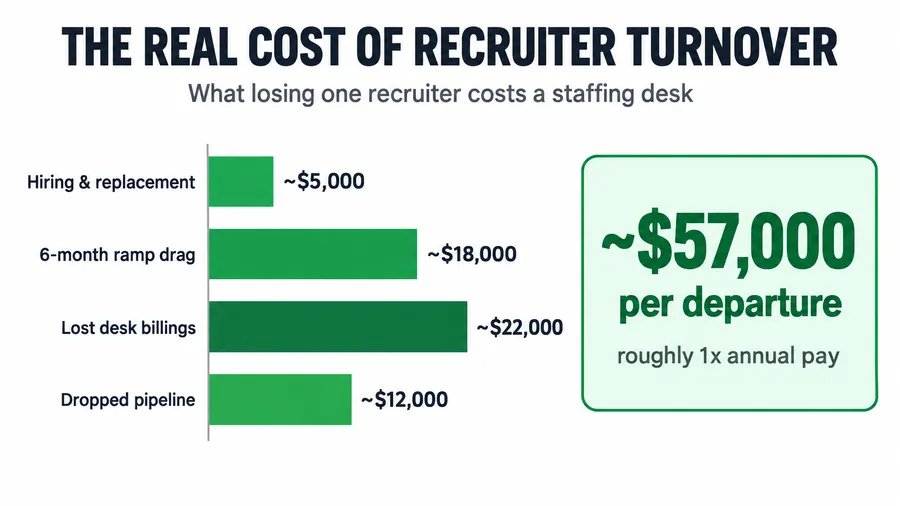
Third, and this is the expensive one, the ghost that becomes a quit. If that worker never comes back, you are not covering a shift, you are replacing a placement. The PeopleMatter survey reported by SHRM pegged hourly turnover at 49% a year and the cost of each departure at about $4,969, counting sourcing, screening, and the productivity you never got. You already paid to find, screen, and place that person. A no-show you recover costs you a stressful hour. A no-show you let drift into a silent quit costs you the whole sourcing bill again.
The confirm-and-recover system, six stages
Attendance feels like luck when you run it by hope and like a machine when you run it as stages. The desks whose workers show up are not blessed with better people. They close the gap at every step: they know their numbers, they confirm relentlessly before the shift, they treat day one as sacred, they catch a no-show in minutes, they ask why, and they keep a bench. Six stages, in order. Skip one and the rest have to work harder to cover for it.
Stage 1: Measure your real no-show rate and when it happens
You cannot fix a number you do not track. Most desks “know” they have a no-show problem the way they know traffic is bad, by feel, which means they cannot tell whether anything they try is working. So count it. For a rolling month, log every scheduled shift, every no-show, and crucially, when in the lifecycle it happened: did they ghost the first shift, or walk off an assignment they had been working for three weeks? Those are different failures with different fixes.
Split your rate into two buckets. The first-shift no-show rate tells you whether your confirm-to-start handoff is leaking. The ongoing no-show rate, a worker who has shown up before but ghosts a later shift, tells you whether the assignment itself is going sour, through pay, hours, a bad supervisor, or a better offer elsewhere. For context on where you stand, day-one no-shows ran 15% to 20% at Southwest and about 15% at Allied Universal during the tight market, against a pre-pandemic norm near 8%. If your first-shift rate is in the teens, you are normal and you have room to win.
How it breaks. The usual failure is tracking the number and doing nothing with the split. If you only know your overall rate, you will throw reminder texts at a problem that is actually a pay or supervisor problem on live assignments, and wonder why nothing moves. Separate first-shift from ongoing, and the fix for each becomes obvious.
Stage 2: Confirm every shift before it starts
This is the stage that moves the most no-shows, so build it first. A single reminder is not a confirmation. A confirmation is a short exchange, run on a cadence, that does three jobs: it reminds the worker, it makes them reply, and it surfaces the problem early enough that you can fix it before 6:00am instead of after.
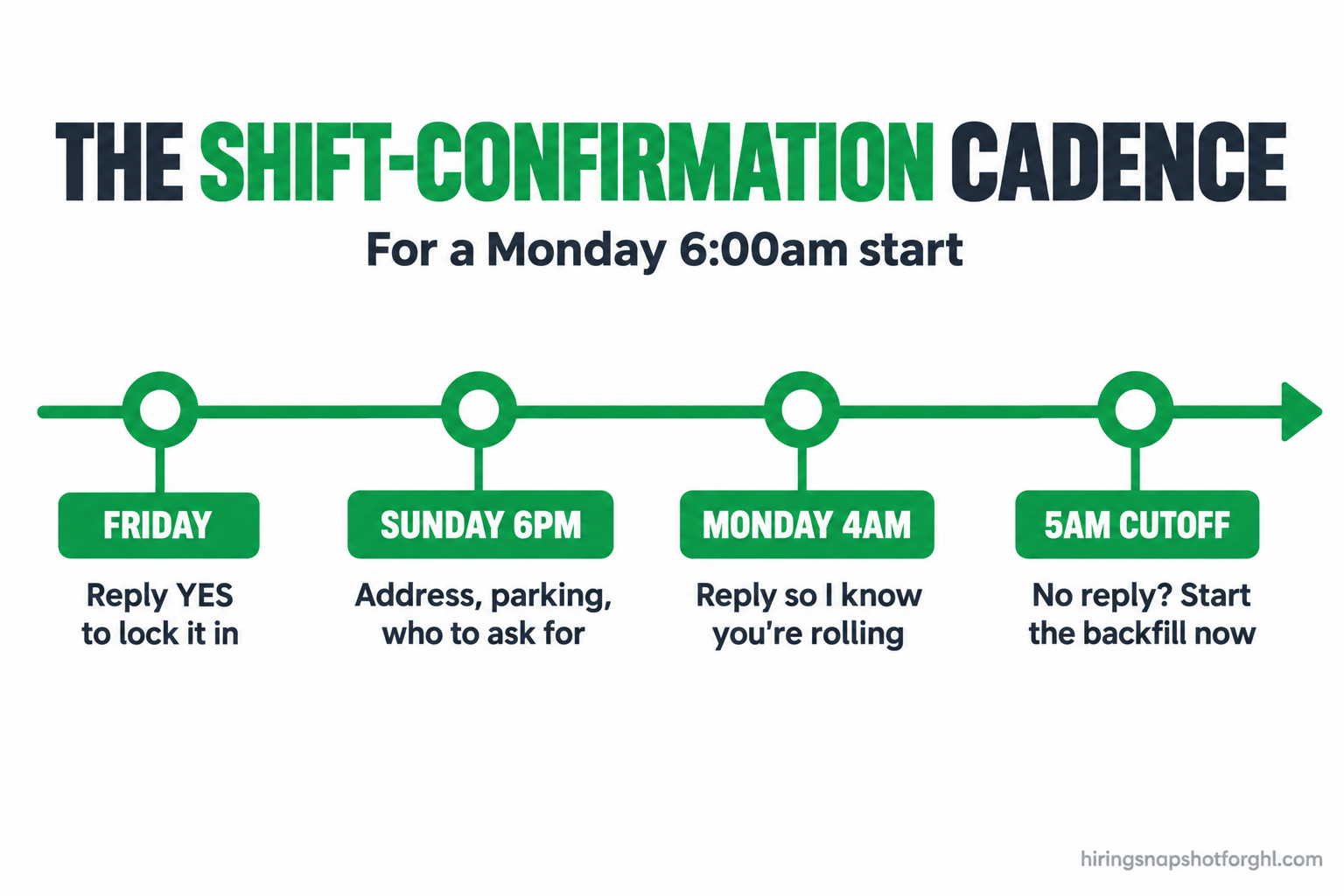
The shape that works for a shift starting Monday at 6:00am: a warm note Friday, a logistics note Sunday evening, and a reply-required ping two hours before. Keep every message plain, name a real person, and always give an easy way to say “I can’t make it,” because a worker who can tell you the night before is a backfill you can plan, not a hole you discover at the gate.
Steal this: the shift-confirmation cadence (Monday 6am start)
Friday, text: “Hi [Name], it’s [You] at [Agency]. You’re all set for Monday at [Client], 6:00am start, through Friday. Reply YES to lock it in. If anything’s changed and you can’t make it, just tell me now and we’ll sort it out, no hard feelings.”
Sunday 6pm, text: “Hi [Name], quick rundown for tomorrow: arrive 5:45am at [address], park in [lot], ask for [supervisor] at the front desk. Wear [boots/hi-vis]. Bring your ID. Text me if anything comes up tonight or in the morning, I’m reachable.”
Monday 4:00am, text: “Morning [Name]! Today’s the day, 6:00am at [Client]. Reply 👍 so I know you’re rolling. Any issue with your ride or timing, call me right now and I’ll help.”
The two-hour ping is the one that saves the morning. A reply means they are coming. No reply by a cutoff time, say 5:00am, is your signal to start the backfill before the shift starts, not after. That one change turns most 6:01am fire drills into 5:05am phone calls.
How it breaks. Two ways, constantly. The cadence is manual, so it depends on a human remembering to text forty workers on a Sunday night, which is exactly what fails. Or the messages go out but nobody watches the replies, so a “sorry, can’t make it, car died” at 9pm sits unread until morning and you have lost the chance to plan. Both are fixable by letting the system send the cadence and flag the non-repliers for you. One note on the texting itself: get written consent to message candidates and honor opt-outs, because the rules are real. The consent mechanics for a recruiting SMS cadence are covered in the guide to TCPA-compliant recruiting texts.
Stage 3: Protect the first shift hardest
The first shift is where placements die. A worker who has never set foot on the site has no relationship with the job, no face to feel accountable to, and the lowest switching cost they will ever have. Among job seekers who admit to ghosting, 22% did it by accepting an offer and simply not showing up on the first day (Indeed, 2023). So the first shift gets everything the ordinary cadence gets, plus three extra moves.
Shrink the gap. Every silent day between “you’re hired” and the first shift is a day a competing offer can win. When you can start a worker in two days instead of seven, you cut the window for second thoughts roughly in half. Speed is a retention tool, not just a fill-rate one.
Make it a person, not a dispatch. Before the first shift, a thirty-second call beats any text: “Really glad you’re starting Monday, anything you’re unsure about?” A worker who has talked to a human ghosts far less than one who got an automated badge pickup and silence.
Remove every excuse to not show. Confusion is the quiet killer here, so over-communicate the boring logistics: exact address with a map link, where to park, which door, who to ask for, what to wear, what to bring. Half of first-day no-shows are not defiance, they are a person who did not know where to go and was too embarrassed to ask. This is the hinge between “offer accepted” and “first shift worked,” and the full pre-start playbook lives in the candidate onboarding automation guide.
Steal this: the day-before-first-shift message
“Hi [Name], really looking forward to having you start at [Client] tomorrow. Here’s everything in one place so your morning is easy:
📍 [Full address + map link] 🕔 Arrive 5:45am, shift starts 6:00am 🅿️ Park in [lot], enter through [door] 🧑🔧 Ask for [Supervisor name] at the desk 👕 Wear [boots + hi-vis], bring photo ID
Save my number. If your ride falls through or anything goes sideways tonight or in the morning, call me first, before you decide not to come. We can almost always fix it. See you tomorrow.”
That last line does the real work. “Call me before you decide not to come” gives the worker a path that is not vanishing, and it is the difference between a solvable ride problem and a no-show.
Stage 4: Catch the no-show in minutes, then backfill
No cadence gets you to zero. People still ghost, so the question is how fast you know and how fast you move. The goal is to find out at 5:05am, not 6:01am, and to have a standby worker rolling before the client ever notices a gap.
Set a reply cutoff on the morning ping and make non-reply an alarm, not a shrug. If a confirmed worker has not replied by your cutoff, that is the moment to call them once, and if there is no answer, to start the backfill immediately. Do not wait and hope. The whole advantage of catching it early is the twenty or forty minutes it buys you to fill the seat before the line runs.
Then call the client before they call you. This is the move that saves the account. A supervisor who texts you “where are your people” at 5:52 has already lost confidence. A supervisor who gets a call from you at 5:10 saying “one of my two didn’t confirm, I’m pulling a replacement now, they’ll be there by 6:15, the other is on track” keeps it. Same no-show, opposite outcome, and the only difference is who made the call first.
Steal this: the client no-show heads-up call
“Hi [Name], it’s [You] at [Agency]. Heads up before your shift starts: one of the two I placed hasn’t confirmed this morning and isn’t reaching back, so I’m not going to risk it. I’ve already got [Backup] lined up, they’re [X] minutes out and will check in with you by [time]. Your other worker is confirmed and on the way. I’ll text you the moment [Backup] is on-site. Sorry for the shuffle, I’d rather you hear it from me than find out at the gate.”
Notice the shape. It leads with the bad news so there are no surprises, it shows you already solved it, and it gives a specific time. “I’m on it” is a worry. “They’ll be there by 6:15” is a plan.
How it breaks. The backfill play dies without a bench, which is Stage 6, and it dies when the no-show alert reaches a person who is not watching their phone at 5am. The desks that recover fast have a pre-ranked standby list and an alert that pings whoever is on call, so the scramble is a two-minute text to three standby workers, not a cold search. If your desk has no one owning 5am, a trained virtual assistant covering early-shift confirmations and backfill pays for itself the first week it saves an order.
Stage 5: Find out why, and win them back
A no-show is data, and most desks throw it away. The worker who ghosted either had a one-time problem, a flat tire, a sick kid, or a real reason the assignment is not working. You cannot tell which until you ask, and the asking is also the win-back, because a worker who ghosted out of shame will often come back if you make it easy instead of punishing.
Reach out the same day, warm, not angry. The message that works assumes a fixable problem and leaves the door wide open, because the alternative is a worker you already paid to source quietly joining the 49% annual hourly turnover you are trying to beat.
Steal this: the same-day win-back text
“Hi [Name], we missed you at [Client] this morning and I wanted to check you’re okay. No lecture, things happen. If it was a ride, a schedule, or the job just wasn’t the right fit, tell me straight and we’ll figure out the next move, whether that’s getting you back on this one tomorrow or finding you something that fits better. Give me a call when you can.”
If they come back, you saved a placement for the cost of a text. If they tell you the real reason, you just learned whether this is a one-off or a pattern, and whether the client site has a problem you need to know about before it costs you three more workers. Log the reason every time. A cluster of “the supervisor is rough” or “the pay wasn’t what I expected” at one client is a client conversation, not a worker problem, and it is the kind of signal that protects your fill rate on that account. The mechanics of pulling lapsed workers back into active assignments are in the guide to reducing interview and shift no-shows.
Stage 6: Build the bench that makes a ghost survivable
The endgame is not zero no-shows, which no desk hits. It is a desk where a no-show is a minor event because you can cover it in minutes and the worker usually comes back. That takes a bench, and a bench takes three unglamorous habits.
Keep a ranked standby pool for every recurring order. For a client who needs ten warehouse workers every week, you want three or four screened, ready, willing standby workers who know they are on the list and get first call when a seat opens. That is the difference between a two-minute backfill and a blown shift.
Keep good workers warm between assignments. A redeployed worker who already knows your desk shows up at far higher rates than a cold placement, and keeping them earning instead of drifting to another agency is pure retained margin. The cadence that turns one placement into repeat work is laid out in the contractor redeployment playbook.
Remove the friction that makes workers drift, starting with pay. Slow, confusing, or wrong pay is one of the fastest ways to turn a reliable worker into a ghost, because a temp who is not sure they will be paid right has no reason to prioritize your shift over the next offer. Reliable workers are the foundation of your fill rate, and the broader set of levers that lift attendance and placement rates is covered in the guide to improving your fill rate.
Three real scenarios: solo, 8-seat, and 25-seat
The system is the same at every size. The shape of the ghost changes.
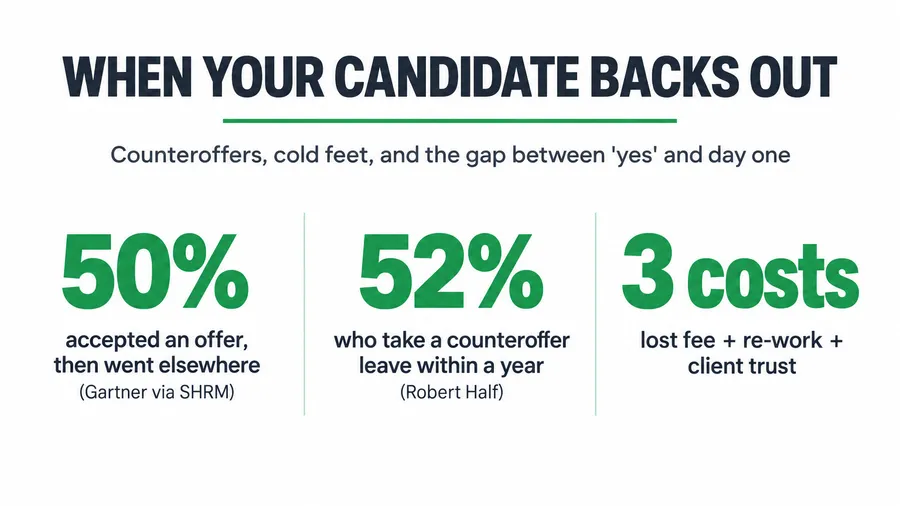
The solo contingency recruiter, perm placements, 20 to 25% fees. Your no-show is not a missed shift, it is a candidate who accepts your offer and then does not start, or ghosts the client interview you fought to arrange. The cost is brutal because you have no volume to absorb it: one fall-through can be a month of income. Your whole job is Stages 2, 3, and 5. Confirm the candidate relentlessly in the days before the start date, shrink the gap between offer and start so a counteroffer has less time to land, call them the day before like a human, and if they go dark, reach out warm the same day. Never assume a verbal yes is a done deal. The gap between accepted and started is where your fee lives or dies.
The 8-recruiter light-industrial agency, temp and temp-to-hire, 40 to 80% markup. This is the daily no-call no-show grind, and all six stages are live. Your pressure point is volume at dawn: forty confirmations to run on a Sunday night and a handful of 5am holes to fill before lines run across three clients. Manual does not scale here, so the confirmation cadence has to be automated and the non-reply alerts have to reach whoever owns the morning. Track first-shift versus ongoing no-shows by client, because one bad site will quietly wreck your overall number. Build a ranked bench per recurring order. This is the agency the whole system was built for.
The 25-recruiter healthcare or high-volume shop. Here a no-show can mean an unstaffed unit and a compliance problem, not just a lost margin. Confirmation is layered on top of credential checks, and the stakes of a ghost are higher, so the bench is formal infrastructure and the recovery play is a staffed function, not a scramble. At this scale a one or two point improvement in shift fill is a large number, and automated confirmations plus real-time no-show alerts are what earn it. The root-cause logging from Stage 5 becomes a client-by-client scorecard you use in account reviews.
Common objections, answered
“Isn’t this just flaky workers? You can’t fix people.” You cannot fix people, but you are not trying to. You are removing the reasons a normal person drifts away: silence, confusion, a ride that fell through with no way to tell you, a better offer you let win by going quiet. Those are communication problems, and a desk can fix communication. The data backs it, day-one no-shows roughly doubled when the market got tight and communication got worse, which means they move with how you handle the handoff, not with some fixed flakiness rate.
“Won’t constant texts annoy workers and make it worse?” Not if the texts are useful and human instead of nagging. A reminder that gives them the address, the parking, and a real person to call is a service, not spam. The line that matters is consent and tone: get written opt-in, keep the messages short and warm, always offer an easy out, and honor opt-outs immediately. Done right, the confirmation cadence is the thing workers thank you for, because most agencies leave them guessing. Keep it compliant with TCPA consent rules and it is an asset, not an irritant.
“I already send reminders and people still ghost.” A reminder is one-way and easy to ignore. A confirmation is a short exchange that requires a reply and surfaces the problem early. The difference is the reply-required ping and the cutoff: a worker who has not replied by 5am is a backfill you start at 5:05, not a surprise at 6:01. Most desks that “already do reminders” are sending one text and not watching the replies, which is the part that actually saves the morning.
“Do I really need software for this? My recruiters can text people.” They can, until it is a Sunday night and forty workers across three clients need confirming, and a human is the single point of failure. The wins here are boring and automatable: send the cadence on schedule, flag the non-repliers, alert whoever owns 5am, trigger the backfill list. That is exactly the kind of reliable, unglamorous routine that a human does well for a week and then drops under pressure, which is why the Hiring Snapshot ships these cadences pre-built on GoHighLevel rather than as an empty account, and why a desk without a dedicated ops person often adds a trained GHL virtual assistant to run the morning.
FAQ
What is a no-call no-show in staffing?
A no-call no-show, often shortened to NCNS, is when a placed worker fails to appear for a scheduled shift and does not call or message to say they will be absent. In staffing it happens most on the first shift of an assignment, when the worker has the weakest tie to the job, but it also happens mid-assignment when pay, hours, a supervisor, or a competing offer turns a reliable worker into a ghost. It is common: during the tight labor market, some employers reported day-one no-show rates of 15% to 20%.
Why do temp workers not show up for their first shift?
Usually because of silence, confusion, or a competing offer, not laziness. A worker who hears nothing between “you’re hired” and the start date has time to take another job. One who is unsure where to go, what time, or who to ask for may simply not show rather than admit the confusion. And a lost ride or childcare problem with no easy way to reach you becomes a no-show instead of a solvable heads-up. Among self-admitted ghosters, 22% did it by accepting an offer and not showing on day one, per Indeed.
How do I reduce no-shows at my staffing agency?
Run a confirmation cadence instead of a single reminder: a warm note a few days out, a logistics message the night before, and a reply-required ping a couple of hours before the shift, with a cutoff that triggers a backfill if the worker goes quiet. Protect the first shift hardest with a human call and over-communicated logistics, shrink the gap between offer and start, and keep a ranked standby bench so a no-show is a quick cover, not a blown order. Track first-shift versus ongoing no-shows separately so you fix the right problem.
What does a no-show cost a staffing agency?
More than the lost shift margin. A no-show costs the empty-seat margin, the scramble time and any overtime to backfill, and, if the worker never returns, the full cost of replacing them. A PeopleMatter survey reported by SHRM put hourly turnover at 49% a year and the cost of each departure near $4,969. Recovering a no-show with a same-day win-back is dramatically cheaper than sourcing a replacement, which is why the recovery step matters as much as prevention.
Should I fire a worker for one no-call no-show?
Not automatically, and not before you ask why. Many first no-shows are one-time problems, a flat tire or a sick child, and a warm same-day message often brings the worker back for the cost of a text. Reserve a hard line for repeat or pattern no-shows, and log the reason every time, because a cluster of ghosts at one client site is usually a problem with that site, not with your workers, and it is a signal worth acting on before it costs you more placements.
How does GoHighLevel help with shift confirmations and no-shows?
A platform like GoHighLevel can send the full confirmation cadence automatically, require a reply, flag the workers who do not respond by a cutoff time, and trigger a backfill alert to whoever owns the morning, so the routine runs whether or not a recruiter remembers it on a Sunday night. It can also log no-show reasons and fire the same-day win-back message. That turns attendance from a manual chore that fails under pressure into a system that runs on its own.
About the author
Marcus Delgado is the Staffing Agency Growth Lead behind the Hiring Snapshot. He ran a light-industrial staffing desk before joining the team to focus on agency growth, and he thinks in placement economics: fill rates, redeploys, and gross margin per requisition. His posts lean on real desk math, not vanity metrics.
Related reading
- Cutting Interview No-Show Rate From 22% to 6% (The Cadence That Works)
- Candidate Onboarding Automation for Staffing Agencies: Close the Gap Between ‘Offer Accepted’ and ‘First Shift Worked’
- Contractor Redeployment: The Automation That Turns One Placement Into Three
- How to Improve Fill Rate at a Staffing Agency
- TCPA Compliance for Recruiting Texts: Consent, Timing, and Opt-Outs