· Adrienne Boyd · Playbooks · 16 min read
How to Connect Indeed & ZipRecruiter to GoHighLevel for Houston Staffing Agencies (2026)
Every applicant who lands in your Indeed or ZipRecruiter inbox and waits for a human to copy them into your CRM is a placement you're about to lose. Here's the step-by-step playbook to connect both job boards to GoHighLevel so every Houston candidate flows in, gets an instant text, and books an interview — no manual re-keying.
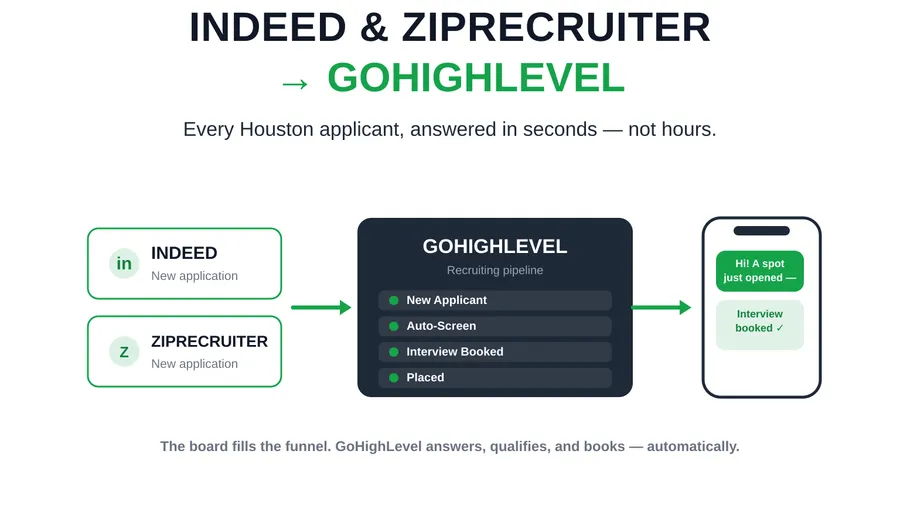
Short answer: connect Indeed and ZipRecruiter to GoHighLevel with a custom integration — an Indeed Apply / email-parse webhook plus the ZipRecruiter application feed — so the moment a Houston candidate applies, their name, phone, email, and role sync straight into your GHL pipeline, fire an instant SMS + email, and offer a self-book interview link. No recruiter copy-pastes anything, and no applicant sits in an inbox going cold. Your candidates apply from a phone, on their lunch break, to three agencies at once — and the one that texts back in seconds usually wins the placement. This is the full playbook: what “connecting” actually means, the three ways to do it, the exact build steps, what to automate on the other side, and how to stay TCPA-compliant.
Key takeaways
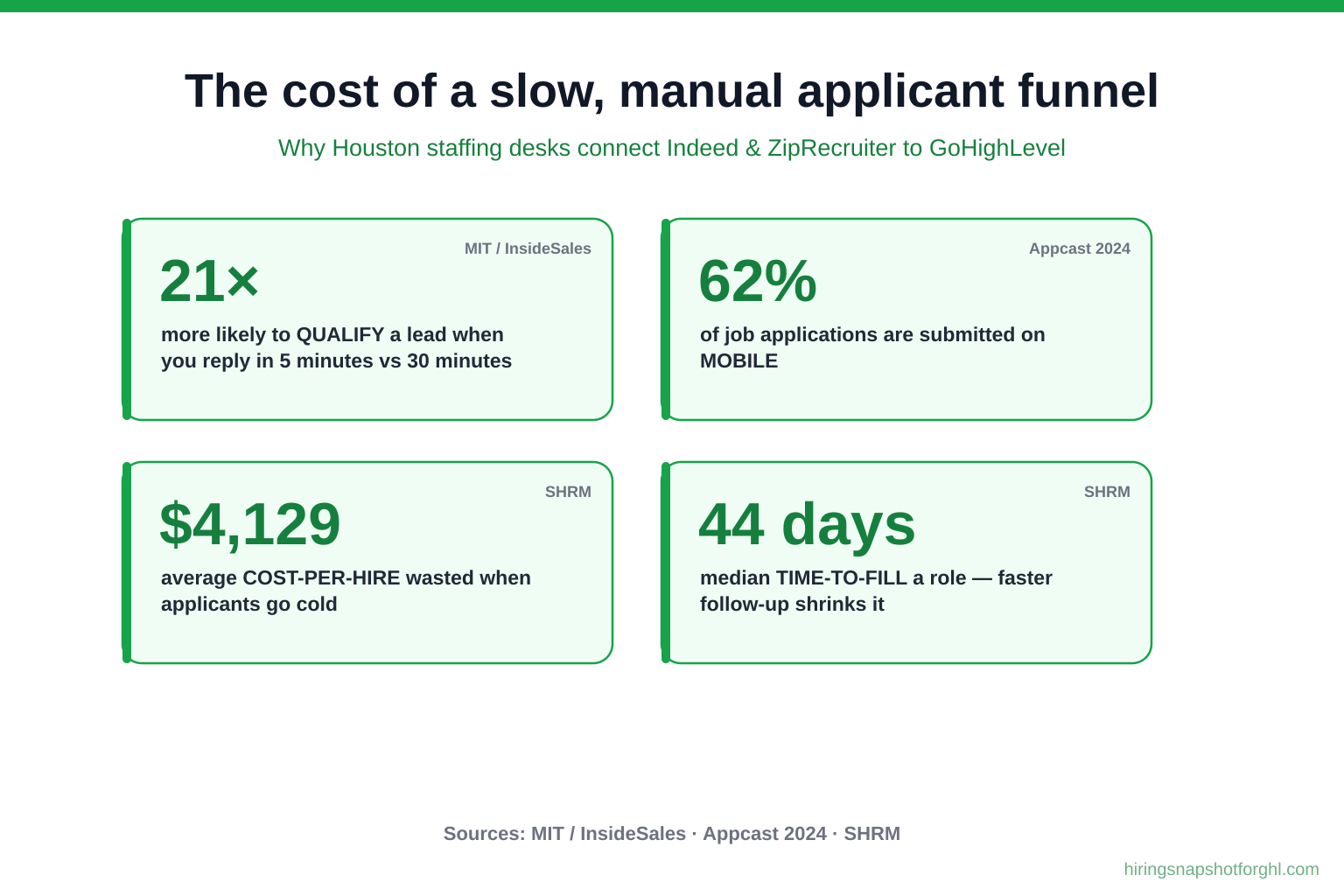
- Speed decides the placement. In the classic Lead Response Management study, contacting a new lead within 5 minutes vs. 30 minutes made you 21× more likely to qualify it and 100× more likely to connect (Dr. James Oldroyd, MIT / InsideSales). A GHL webhook replies in seconds — a recruiter checking an inbox replies in hours.
- The research is real, not folklore. An audit of 2,241 U.S. companies found firms that responded to a web lead within an hour were about 7× likelier to have a qualifying conversation than those who waited just an hour longer — and 60× likelier than firms that waited 24 hours or more (Harvard Business Review, 2011).
- Your candidates are mobile-first. About 62% of job applications were submitted on a phone in 2023 (Appcast 2024 Recruitment Marketing Benchmark Report) — so a text lands where the candidate already is, and a slow email doesn’t.
- The boards are huge, and so is the leak. Indeed helps 31 people get hired every minute as the #1 job site (Indeed / BusinessWire, 2026), and ZipRecruiter adds roughly 350,000 fresh resumes a month to its database (ZipRecruiter / BusinessWire, 2024). Volume you can’t answer fast is volume you’re paying for and wasting.
- Houston is a high-volume, always-hiring market. The Houston–The Woodlands–Sugar Land metro carries roughly 3.47 million nonfarm jobs, with about 558,400 in professional & business services alone (Dallas Fed / BLS, 2026) — a constant churn of light-industrial, healthcare, energy, and logistics roles that need filling this week.
- Manual re-keying is the enemy. Every applicant a recruiter hand-copies from a job board into a CRM is minutes lost and a candidate cooling off. The integration removes the copy-paste entirely — it’s a capture layer, not a replacement for a recruiter who still closes and credentials.
Table of contents
- Why Houston desks lose applicants between the board and the follow-up
- What “connecting Indeed & ZipRecruiter to GoHighLevel” actually means
- The speed-to-lead math that makes the integration pay
- The three ways to connect a job board to GHL
- How to build the integration, step by step
- What to automate once applicants land in GHL
- Staying compliant: TCPA consent on job-board applicants
- What the integration won’t do
- A Houston playbook by desk type
- FAQ
Why Houston desks lose applicants between the board and the follow-up
Houston runs on hiring velocity. The Houston–The Woodlands–Sugar Land metro carries roughly 3.47 million nonfarm jobs, and professional & business services — the sector that includes most staffing and contract-labor placements — accounts for about 558,400 of them (Dallas Fed / U.S. Bureau of Labor Statistics). Warehouses in Katy, energy-services firms along the Energy Corridor, home-health agencies across Harris County, hospital systems in the Texas Medical Center — all of them need bodies on shift, and they need them now.
So you spend real money advertising those roles on Indeed and ZipRecruiter. Indeed is the #1 job site on earth, helping 31 people get hired every single minute (Indeed / BusinessWire); ZipRecruiter refreshes its database with roughly 350,000 resumes a month (ZipRecruiter / BusinessWire). The applications come in. And then, on most desks, they sit — in a job-board inbox, in an email digest, in a browser tab a recruiter will “get to.” Someone eventually copies the name and number into the CRM by hand, hours or a day later.
That gap is where the placement dies. The candidate applied from a phone on a break — about 62% of applications are now mobile (Appcast 2024) — and by the time your recruiter re-keys the lead, they’ve already texted back the agency that answered first. You paid for the click. A competitor got the placement. Connecting the boards to GoHighLevel closes that gap to seconds.
What “connecting Indeed & ZipRecruiter to GoHighLevel” actually means
“Connecting” isn’t one switch — it’s a data pipe plus a set of triggers. Concretely, a working integration does four things the moment a candidate applies:
- Captures the application from Indeed (via Indeed Apply’s webhook / disposition sync, or a parsed application email) and from ZipRecruiter (via its application feed / notification email), including name, phone, email, the job title, and the source.
- Creates or updates a contact in GoHighLevel — deduplicated against people already in your database — tagged with the role and the board they came from.
- Drops them into the right pipeline stage (for example, “New Applicant → Auto-Screen”) so nothing lives in an inbox.
- Fires your automation — an instant SMS, an email, a qualifying question set, and a self-scheduling interview link — with zero human touch.
The point is not to replace Indeed or ZipRecruiter. You keep advertising there because that’s where the candidates are. The integration just makes GoHighLevel the engine room behind them: the boards fill the top of the funnel, and GHL answers, qualifies, and books every applicant instantly. If you’ve already read our GoHighLevel ATS & recruiting pipeline guide, this is the missing front door that feeds it.
The speed-to-lead math that makes the integration pay
Every argument for this build reduces to one number: how fast you answer. The most-cited research in the field, Dr. James Oldroyd’s Lead Response Management study, found that reaching a new lead within 5 minutes instead of 30 made a firm 21× more likely to qualify the lead and 100× more likely to make contact at all (MIT / InsideSales).
That’s not a lone data point. A separate audit of 2,241 U.S. companies, published in Harvard Business Review, found that firms responding to an inbound web lead within an hour were roughly 7× more likely to have a meaningful qualifying conversation than firms that waited even one hour longer — and about 60× more likely than those that waited 24 hours or more (HBR, 2011). A recruiting application is an inbound lead. The candidate raised their hand; the clock started; the manual funnel loses the race by design.
Now layer on the mobile reality. With 62% of applications submitted on a phone (Appcast 2024), an instant SMS from GoHighLevel lands on the exact device the candidate just applied from — while they’re still holding it. A delayed email fired by a recruiter the next morning lands in a folder they may never open.
The three ways to connect a job board to GHL
There are three realistic paths, and the right one depends on your volume and how clean you need the data. Here’s the honest tradeoff.
| Method | How it works | Best for | Watch-outs |
|---|---|---|---|
| Email-parse webhook | Indeed / ZipRecruiter application emails are auto-forwarded to a parser (or GHL’s inbound email), which extracts the fields and posts to a GHL workflow webhook. | Low-to-mid volume desks that want a fast, cheap start. | Parsing breaks if the board changes its email template; misses structured fields; needs error handling. |
| Zapier / Make middleware | A no-code connector watches for a new Indeed/ZipRecruiter application and creates a GHL contact + triggers a workflow. | Agencies already on Zapier who want speed over control. | Per-task cost adds up at high volume; limited dedup logic; another subscription and point of failure. |
| Custom API / Indeed Apply integration | A purpose-built connector uses Indeed Apply’s disposition/webhook flow and ZipRecruiter’s application feed to push clean, structured data straight into GHL, with dedup and retry logic. | High-volume Houston desks that can’t afford dropped or garbled applicants. | Needs a developer to build and maintain; the most robust option, and the one we build. |
For a two-req-a-week desk, the email-parse route is a fine place to start. For a Houston agency running dozens of open orders across light-industrial and healthcare, a custom connector is the difference between “most applicants get through” and “every applicant gets through, clean, in seconds.” That’s exactly the kind of build our GHL development team does — the service page literally lists “connect ANY platform to GHL” because job boards, ATS, and VMS systems are the most common request.
How to build the integration, step by step
Here’s the actual sequence, whether you build it yourself or have us do it. The order matters — get the pipeline and consent right before you turn on the firehose.
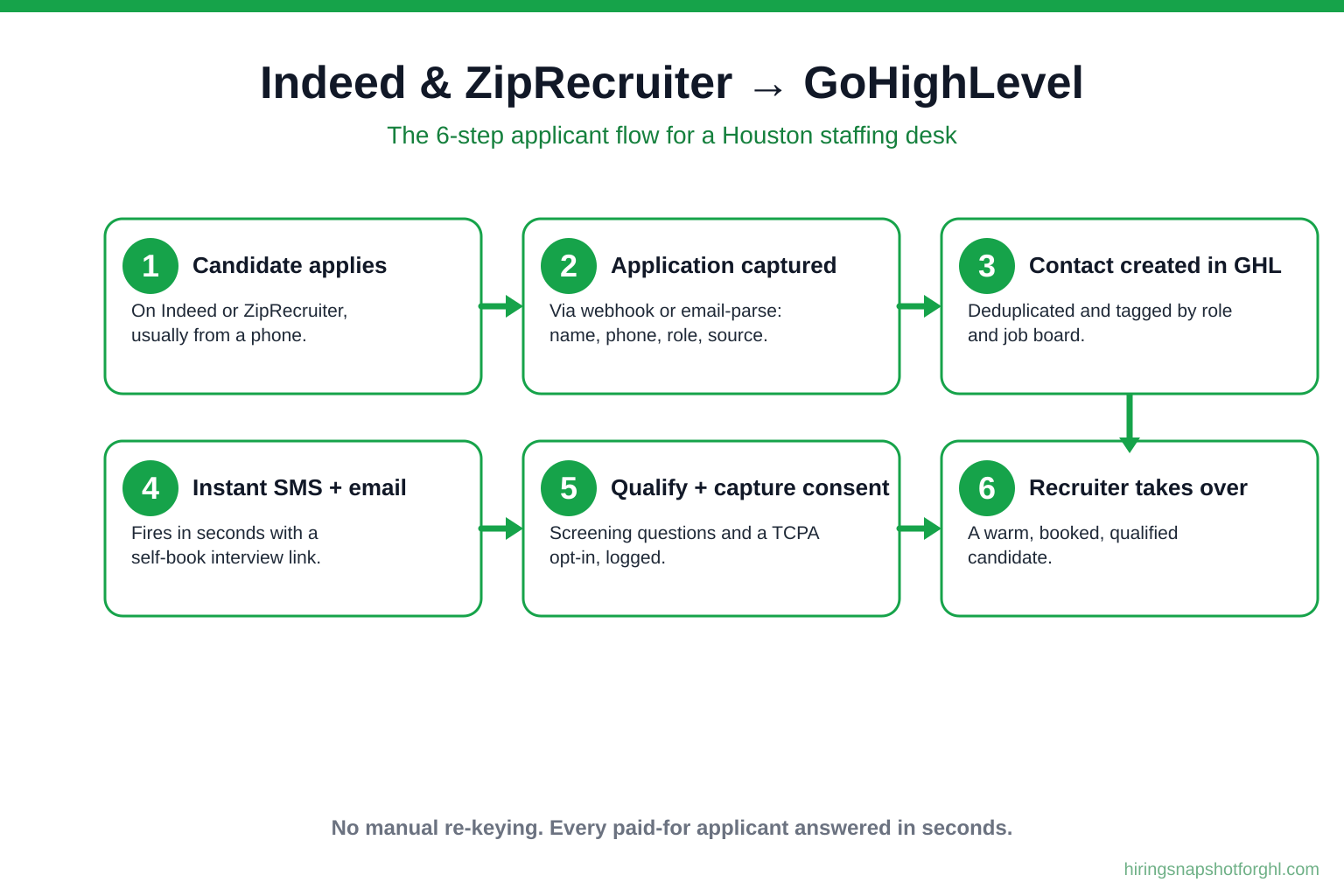
Step 1 — Map your pipeline first. In GoHighLevel, build the recruiting pipeline the applicants will flow into: stages like New Applicant → Auto-Screen → Interview Booked → Submitted to Client → Placed. Don’t pipe leads into a void.
Step 2 — Create the capture endpoint. Add an Inbound Webhook trigger in a GHL workflow. This is the address the boards’ data will be posted to. Note the URL.
Step 3 — Wire up Indeed. If you use Indeed Apply, configure its disposition/webhook to send completed applications to your endpoint. If not, set your Indeed application-notification emails to auto-forward into a parser (or GHL’s inbound email address) that extracts name, phone, email, and job title, then posts to the webhook.
Step 4 — Wire up ZipRecruiter. Do the same for ZipRecruiter’s application notifications — feed or email-parse into the same endpoint, stamping a source = ZipRecruiter field so you can measure each board separately later.
Step 5 — Map fields and deduplicate. In the workflow, map incoming fields to GHL contact fields, tag with the role and source, and use “create or update contact” so a repeat applicant doesn’t spawn a duplicate. This is where a custom build earns its keep — clean dedup and retries.
Step 6 — Attach the automation. Connect the new contact to your follow-up sequence (next section) and set the pipeline stage. Test with a real application on each board before you scale spend. Then watch applicants land, get texted, and self-book — untouched.
What to automate once applicants land in GHL
The pipe is worthless without what happens on the other end. This is where GoHighLevel — and the Hiring Snapshot built on top of it — does the work a recruiter can’t do at 9 p.m. on a Friday:
- Instant SMS + email, personalized to the role and board, within seconds of the application. This is the single highest-leverage automation you’ll ever turn on.
- A qualifying question set — right-to-work, shift availability, certifications, distance to the Houston job site — so the recruiter only spends time on candidates who fit.
- A self-scheduling interview link that books straight into the recruiter’s calendar, killing the phone-tag that stalls placements.
- No-show and reminder cadences so booked interviews actually happen. (Our interview no-show recovery playbook covers this in depth.)
- Long-term nurture for candidates you can’t place today, so your database becomes a redeployment asset instead of a graveyard.
The economics are blunt. SHRM pegs the average cost-per-hire near $4,129 and median time-to-fill around 44 days (SHRM), while Appcast puts the median cost-per-application near $19.40 (Appcast 2025). When you’re paying that much per applicant and per hire, letting applicants cool in an inbox is lighting money on fire. Answering every one instantly and booking more of them is how you drive time-to-fill down — the same lever we break down in how to reduce time-to-fill.
Staying compliant: TCPA consent on job-board applicants
An automated text is only an asset if it’s legal. Under the TCPA, sending automated SMS to a candidate requires their prior express consent, and a job application is not automatically that consent. Build it in:
- Capture consent at the point of application or on the first message — a clear opt-in line (“Reply YES to get interview updates by text”) and an easy STOP to opt out.
- Log the consent in GoHighLevel against the contact, with a timestamp, so you can prove it.
- Register for A2P 10DLC so your automated texts actually deliver and don’t get filtered as spam.
- Respect quiet hours and frequency — the fast first text is the win; blasting a candidate ten times is how you earn a complaint.
None of this slows you down; it’s a one-time setup baked into the workflow. Our compliance-minded cadences treat TCPA, EEOC, and FCRA as first-class, and our SMS-first recruiting guide walks through consent-safe texting in detail. If you’d rather not own the rules yourself, a trained GoHighLevel VA can run the consent-captured cadences for you.
What the integration won’t do
Honesty keeps this useful. Connecting the boards to GoHighLevel will not:
- Replace your recruiters. It captures, qualifies, and books. A human still closes the candidate, checks credentials, and manages the client relationship.
- Fix a bad job ad or bad targeting. If Indeed and ZipRecruiter are sending you the wrong applicants, faster follow-up just reaches the wrong people sooner. Fix the ad first.
- Guarantee the boards never change. Job boards update their apply flows and email formats; an email-parse setup needs occasional maintenance, which is one reason a maintained custom connector is more durable at volume.
- Work without clean consent. No TCPA opt-in, no automated SMS — full stop.
Set that expectation with your team, and the integration does exactly what it’s built for: make sure not a single paid-for applicant slips through the cracks.
A Houston playbook by desk type
How this looks in practice depends on your niche:
- Light-industrial & warehouse (Katy, Pasadena, north Houston). High volume, high turnover, phone-first candidates. Instant SMS + a two-question screen (shift + right-to-work) + self-book is transformative here — you’re always hiring, and speed is everything.
- Healthcare & allied (Texas Medical Center, Harris County). Credential-heavy. Route Indeed/ZipRecruiter applicants into an FCRA-aware onboarding cadence that starts license and background checks the moment they apply, so time-to-fill drops without cutting corners.
- Energy, engineering & skilled trades (Energy Corridor, Ship Channel). Lower volume, higher value per placement. The integration keeps every scarce qualified applicant warm and instantly booked with the right recruiter — no lead left in an inbox.
- Contract & professional staffing. Feed clean, deduplicated, source-tagged applicants into GHL so you can measure cost-per-placement by board and shift spend toward what actually fills reqs.
Whatever the desk, the pattern is the same: the board fills the funnel, GoHighLevel answers in seconds, and your recruiters spend their hours on warm, booked, qualified candidates instead of copy-pasting from an inbox.
Frequently asked questions
Can you connect Indeed and ZipRecruiter to GoHighLevel?
Yes. Indeed connects through Indeed Apply’s disposition/webhook flow or by parsing its application-notification emails; ZipRecruiter connects through its application feed or notification emails. Both can post applicant data straight into a GoHighLevel workflow that creates a contact and fires your follow-up automation. For a high-volume Houston desk, a custom API connector with deduplication is the most reliable route.
How fast does an applicant get contacted after they apply?
With the integration live, within seconds — the GoHighLevel workflow fires an SMS and email the moment the application posts to the webhook. That speed is the whole point: replying within 5 minutes instead of 30 makes you 21× more likely to qualify the lead (MIT / InsideSales).
Do I have to stop using Indeed or ZipRecruiter?
No. You keep advertising on both because that’s where the candidates are. The integration just makes GoHighLevel the engine behind them — the boards fill the top of the funnel, and GHL answers, qualifies, and books every applicant automatically.
Is texting job applicants TCPA-compliant?
It can be, and it must be. You need the candidate’s prior express consent before sending automated SMS, a clear opt-out (STOP), consent logged against the contact, and A2P 10DLC registration for deliverability. Build the opt-in into the application or the first message, and the automated cadence is both fast and defensible.
What does a custom Indeed/ZipRecruiter-to-GHL integration cost?
Every build is scoped and quoted individually because no two agencies have the same stack, but ATS- and job-board-to-GHL connectors typically start in the low four figures (GHL Development). The fastest way to a real number is to book a scoping call so we can look at your boards and pipeline and give you a fixed quote and timeline.
Can a GoHighLevel VA run this for me instead of my recruiters?
Yes. Once the integration is built, a trained GoHighLevel VA can manage the pipeline, monitor the automations, keep consent logs clean, and handle the manual touches — so your recruiters stay focused on closing and credentialing.
About the author
Adrienne Boyd is the Recruiting Automation Strategist behind the Hiring Snapshot, based in Austin, TX. She spent a decade building applicant-capture funnels and SMS-first nurture cadences for staffing agencies before moving full-time into GoHighLevel automation. She writes the playbooks and field reports, and she is happiest when a manual, three-person process collapses into a single fast trigger.
Related reading
- The GoHighLevel ATS: Build a Recruiting Pipeline That Actually Closes
- SMS-First Recruiting: Why Email-Only Agencies Are Losing the 2026 Talent Market
- High-Volume Recruiting in GoHighLevel: The Automation Stack
- How to Reduce Time-to-Fill: The GoHighLevel Playbook
- Migrating a Staffing Agency to GoHighLevel: The New York City Field Guide
Want every Indeed and ZipRecruiter applicant answered in seconds? Get a custom GHL integration, see how the Hiring Snapshot works, or have a trained GHL VA run it for you.