· Marcus Delgado · Growth · 25 min read
How to Qualify a Job Order Before You Work It: The Filter That Keeps a Staffing Desk Fillable (2026)
Working every job order that comes in is how a staffing desk goes broke busy. Here is the six-check system for qualifying a req before you burn a recruiter on it, the exact intake questions to ask, and the scripts to decline or renegotiate the ones you should not touch.
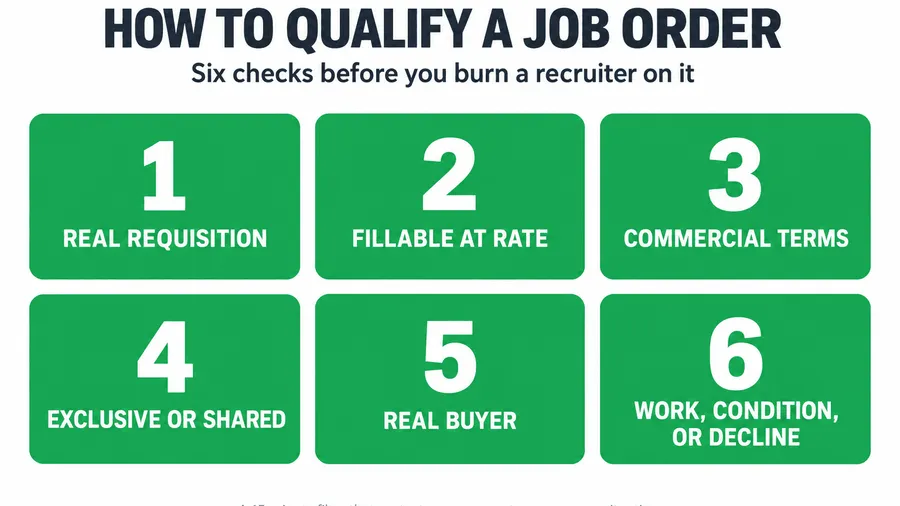
It is 9:15 on a Monday and a new client emails you a job order. Three CNCs, first shift, “as soon as possible,” rate is “competitive,” and by the way they are also talking to two other agencies. You have a recruiter free, so you do the natural thing. You post the role, you start sourcing, you make calls. Three weeks later you have submitted four solid people, one got hired somewhere else mid-process, the client went quiet, and then a note lands saying they “filled it internally.” You just spent twenty-plus recruiter hours on a req that was never really yours to win.
The short answer: you qualify a job order the same way you qualify a client’s credit, before you spend a dollar you cannot get back. Score whether the role can actually be filled at the rate offered, whether the commercial terms make it worth a recruiter’s week, whether the order is exclusive or a free-for-all, and whether the client is a real buyer with a real process, then decide to work it, work it on conditions, or decline it. A job order is not a gift. It is a request to spend your most expensive resource, recruiter time, on a bet. This is the six-check system for deciding which bets to take, the exact questions to ask on the intake call, and the scripts to renegotiate or walk away from the orders that will only ever waste your desk.
Key takeaways
- Not every req is winnable, and the split is huge. A job order worked non-exclusively against several other agencies fills at a fraction of the rate of an exclusive or engaged one, so the first qualification question is how many desks are racing you to the same hire (RecruitBPM on contingency vs retained completion rates).
- Recruiter time is the cost, not the fee. AI-assisted search and screening can save recruiters roughly 4.5 hours a week on sourcing and another 3.6 on screening (Bullhorn GRID 2025). Spend those hours on a dead req and you cannot get them back.
- Speed only pays on an order you can win. Responding to a lead in 5 minutes instead of 30 makes you 21 times more likely to qualify it, which is exactly why you should point that speed at qualified orders, not phantom ones.
- Qualification is a filter, not a full search. A tight intake call and a simple score take 15 minutes and save the week you would have lost.
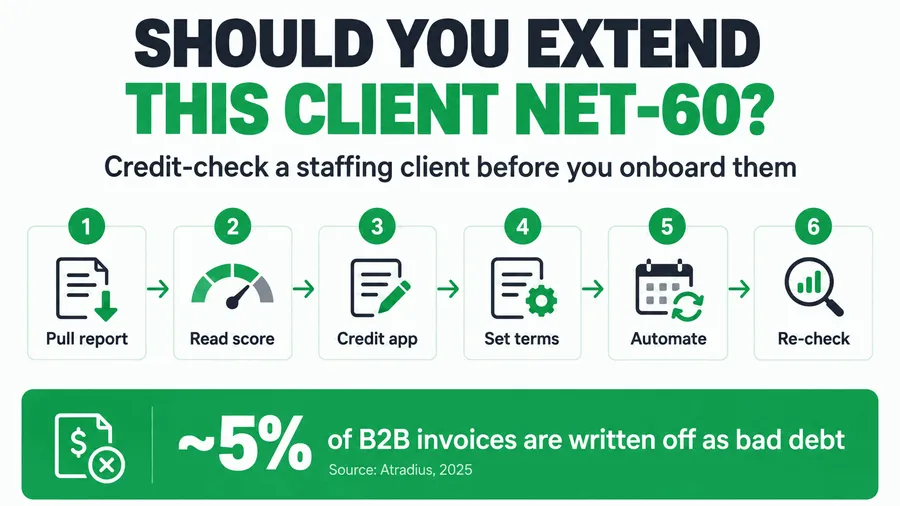
- The client’s ability to pay is part of the order. A fillable role for a client who pays net-90 or not at all is still a bad order, so vet the business before you place anyone (client credit checks).
Table of contents
- What working bad job orders actually costs
- The qualification system, six checks
- Check 1: Get the real requisition, not the vague one
- Check 2: Score fillability at the rate offered
- Check 3: Do the commercial terms clear the bar
- Check 4: Exclusive, engaged, or a free-for-all
- Check 5: Is the client a real buyer with a real process
- Check 6: Decide, work it, condition it, or decline
- Steal this: the intake questions and the scripts
- Three scenarios: solo, 8-seat, and 25-seat
- The compliance line you cannot cross
- Common objections, answered
- FAQ
What working bad job orders actually costs
There are roughly 27,000 staffing and recruiting companies in the United States running about 54,000 offices, and together they put around 2.2 million temporary and contract workers to work in an average week (American Staffing Association). Every one of those desks runs on the same scarce input, and it is not candidates and it is not job orders. It is recruiter hours. You have a fixed number of them every week, and the single biggest leak on most small desks is pouring them into orders that were never going to close.
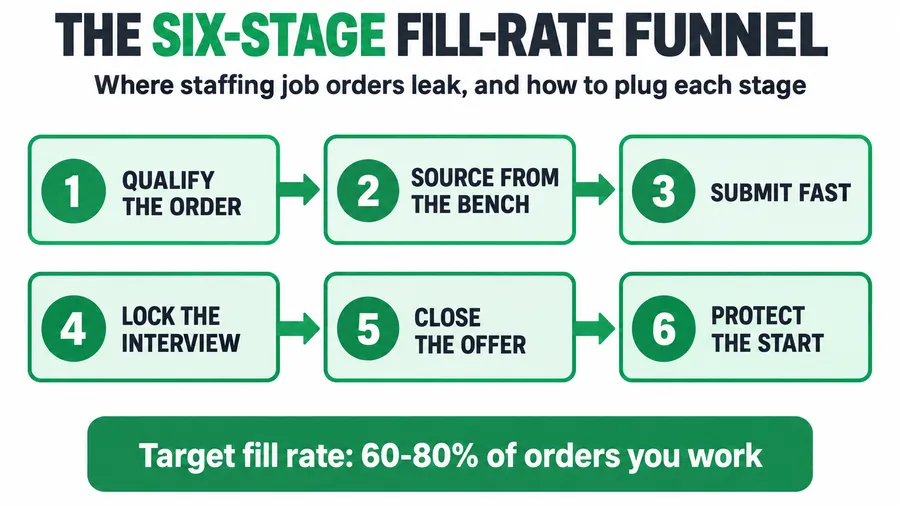
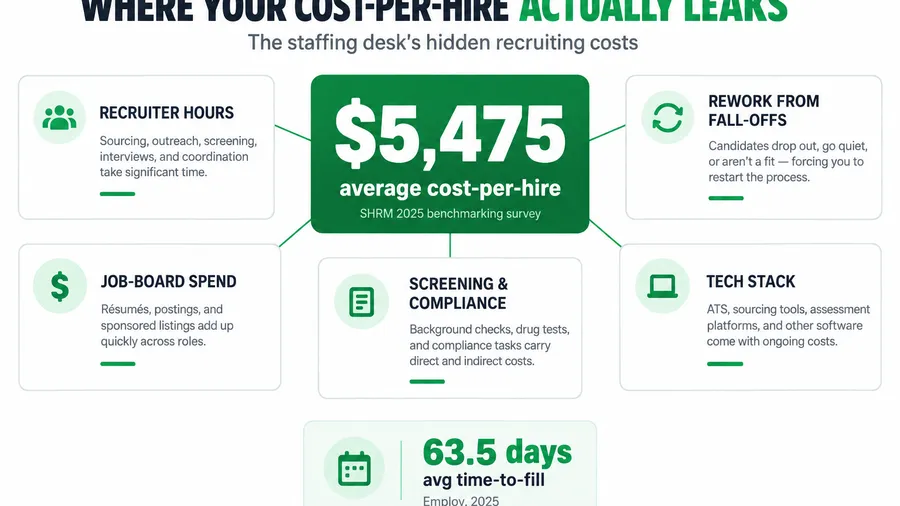
Think about what one dead req actually costs. A recruiter works a typical order across sourcing, screening, submitting, and coordinating for something like 15 to 25 hours before a placement or a dead end. Bullhorn’s 2025 GRID research found that AI-assisted search and match can give a recruiter back about 4.5 hours a week on candidate searches and another 3.6 hours on screening and admin, which tells you how valuable those hours are: firms claw them back with expensive technology. Now spend a full block of them on a job order that three other agencies are also working, for a client who was never going to move fast. That is not a placement that fell through. That is a placement you never had, paid for in the currency you have least of.
The math gets worse because of opportunity cost. While your recruiter chases the phantom req, the fillable order sitting next to it gets your leftover attention. You lose the one you could have won because you refused to say no to the one you could not. Speed is the whole game in staffing, responding to a web lead in 5 minutes instead of 30 makes you 21 times more likely to qualify it and yet the average first response still takes 42 hours. Speed on a bad order is just a faster way to waste the week. Qualification is what points that speed at the orders worth winning.
The qualification system, six checks
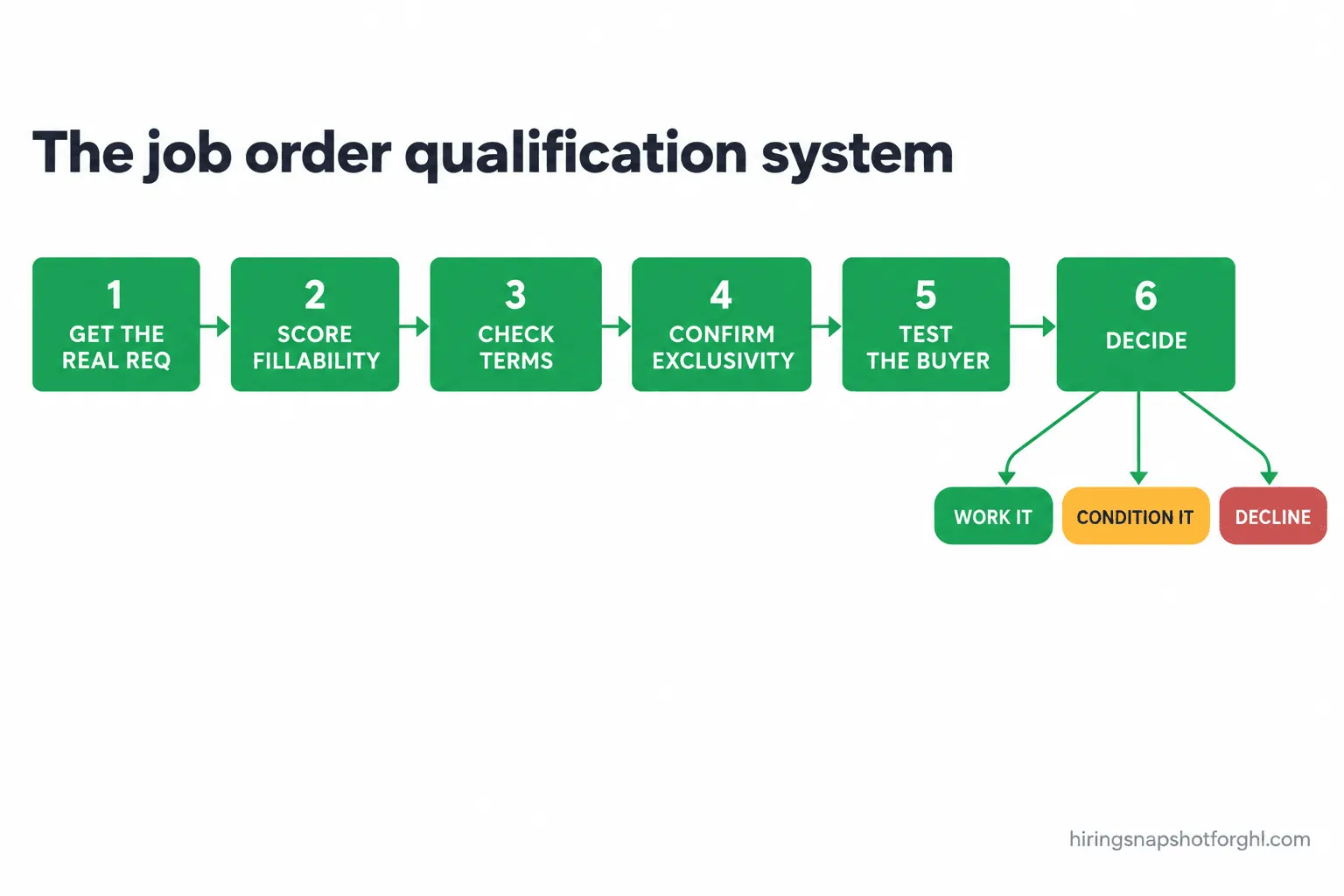
Qualifying a job order is not a full pre-search. It is a 15-minute filter you run before you commit a recruiter, and it answers one question: is this order worth a week of the desk’s time. Six checks get you there. The first pulls the real requisition out of the vague one a client sends. The next two score whether the role is fillable and whether the terms are worth it. The fourth measures your actual odds by counting who else is racing you. The fifth tests whether there is a real decision on the other end. The sixth turns all of that into a call, work it, work it on conditions, or decline. Run them in order, because a later check can kill an order the earlier ones passed, and you want to find that out in minute 12, not week three.
Check 1: Get the real requisition, not the vague one
The order a client first sends you is almost never the real one. “Three CNCs, competitive pay, ASAP” is a wish, not a requisition. Before you can score anything, you have to turn that into specifics: the exact role and shift, the real pay range the client will approve, the must-have skills versus the nice-to-haves, the actual start date, the reason the seat is open, and who makes the hire decision. If you cannot get those, that is itself a signal, and usually a bad one.
The fastest way to get them is a structured intake, the same ten questions every time, asked on a five-minute call or a form the client fills before you start. You are not being difficult. You are protecting both sides from a three-week search for a person the client will not actually hire. The full intake question set is in the steal-this section below.
How this breaks: the client “does not have time” for intake and wants you to “just start.” Working a role you have not defined is how you submit five good candidates and hear “not quite what we pictured” on every one. A client who will not spend five minutes defining the role will not spend an hour reviewing your submittals either. Treat refusal to do intake as a yellow flag that pulls the whole order’s score down.
Check 2: Score fillability at the rate offered
Now that you have the real requisition, ask the only question that matters about the candidate side: can this person be found and hired at this pay, in this market, on this timeline. A role is not fillable in the abstract. It is fillable or not at a specific rate. A warehouse associate at market pay on a bus line is fillable this week. The same associate at 15 percent below market, on a night shift, at a site with no transit, is a different and much harder order, even though the job title is identical.
Score it on four things. Supply: how many qualified people are realistically in your reach for this role and geography. Pay position: where the client’s rate sits against the market rate, because below-market pay is the single most common reason a “simple” order never fills. Requirements: whether the must-haves are actually common or whether the client has stacked five of them onto one unicorn. Timeline: whether the start date is possible given how long this kind of role takes you to fill. Your own historical time-to-fill by role type is the best input here, if you track it.
How this breaks: the client insists the rate is “competitive” when it is not. This is where most desks lose. You believe the client, you work the order, and the market tells you the truth three weeks in when nobody qualified will take the pay. Catch it in Check 2 by pricing the role against what similar workers are actually earning, and raise it before you source, not after you fail.
Check 3: Do the commercial terms clear the bar
A fillable role can still be a bad order if the economics do not work. For a perm placement, that means the fee percentage, the fee basis, the guarantee period, and whether the fee is on total first-year comp or just base. For a temp or contract order, it means the bill rate, the markup over pay, and therefore the gross margin per hour the order throws off. A temp desk running 40 to 80 percent markup has a floor below which an order simply is not worth staffing, and you should know your number before the call.
Two terms quietly wreck orders that look fine on rate. The first is the guarantee or fall-off clause on perm work, a 90-day guarantee with a full refund turns a risky candidate into a liability you carry for a quarter. The second, on temp work, is the payment terms, because a good markup on net-60 or net-90 terms may cost you more in funding the float than the margin is worth. The rate is only half the commercial picture. When you get paid is the other half.
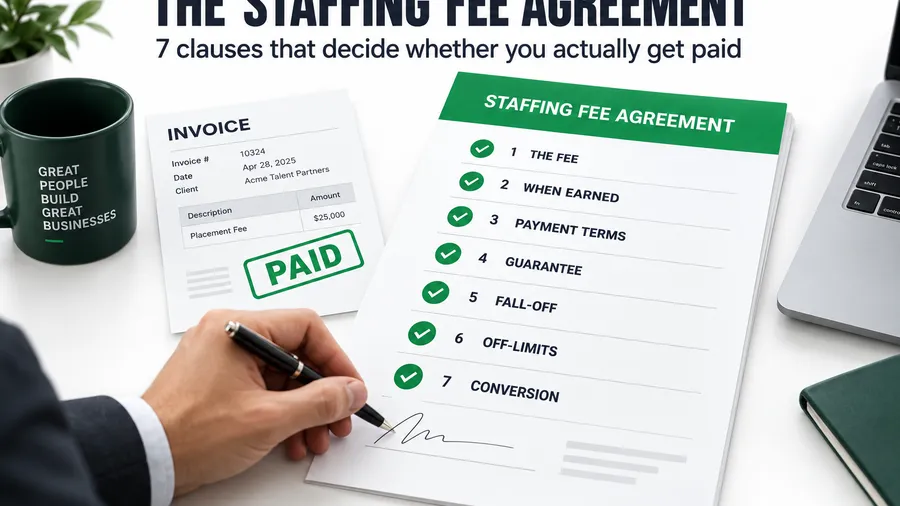
How this breaks: you agree to terms verbally and the real numbers show up in the client’s own paperwork weeks later, a lower fee, a longer guarantee, a slower pay cycle. Lock the fee, the markup, the guarantee, and the payment terms in a signed agreement before you submit a single candidate. A great candidate against unsigned terms is an advantage you have handed to the client.
Check 4: Exclusive, engaged, or a free-for-all
This is the check that decides your actual odds, and the one most desks skip because they are afraid of the answer. Ask the client, directly: are we the only agency on this, how many others are working it, and is there any exclusivity or engagement. Because the difference is not small. An order you work exclusively, or with an upfront engagement fee, is one you are highly likely to fill, because the client is committed and you are not racing anyone. A contingency order shared across several agencies fills at a far lower rate, because you are one of four desks all submitting to a client who owes none of you anything until someone hires.
The completion gap between the models is the whole reason retained and engaged search exists: an exclusive or retained engagement is commonly reported to close in the high 80s to mid 90s percent range, while shared contingency work completes far less often. You do not need the exact number to act on it. You need to know, before you spend the week, whether you are the favorite or a long shot. A long shot can still be worth working if the role is easy and the fee is large. But you work it differently, faster, lighter, and you do not bet a scarce recruiter’s full week on it.
How this breaks: the client says “you’re the only one we’re really working with,” which is technically true and completely misleading, because “really” is doing all the work in that sentence. Push past it. Ask how many agencies have the order, not whether you are the favorite. If the honest answer is four, you now know to either ask for exclusivity in exchange for your full effort, or to work it as the light-touch long shot it is.
Check 5: Is the client a real buyer with a real process
A fillable role, good terms, and exclusivity still add up to nothing if there is no real hire at the end. The last non-financial check is whether the client is an actual buyer: is the budget approved, is the role backfilling a real vacancy or a “we’d hire if the right person showed up” maybe, who signs off on the offer, and how fast does their interview-to-offer process move. A role with three internal approvers and a two-week gap between interview rounds will lose your best candidates to faster employers no matter how well you work it.
You are also, quietly, qualifying the client’s ability to pay. A business that fills the seat but pays you net-90, disputes the invoice, or quietly goes under is a bad order dressed as a good one, which is why a credit check on a new client belongs in the same qualification pass as the requisition itself. The order and the client are one decision, not two.
How this breaks: the client is “just seeing who’s out there.” This is the perpetual open req, the one that has been posted for eight months and will be posted for eight more, because there is no real vacancy and no real urgency, only a manager who likes keeping a pipeline warm on your dime. The tell is a role with no hard start date and no approved backfill. Do not work it as a live order. Put the client on a light nurture and spend the hours on someone who is actually hiring.
Check 6: Decide, work it, condition it, or decline
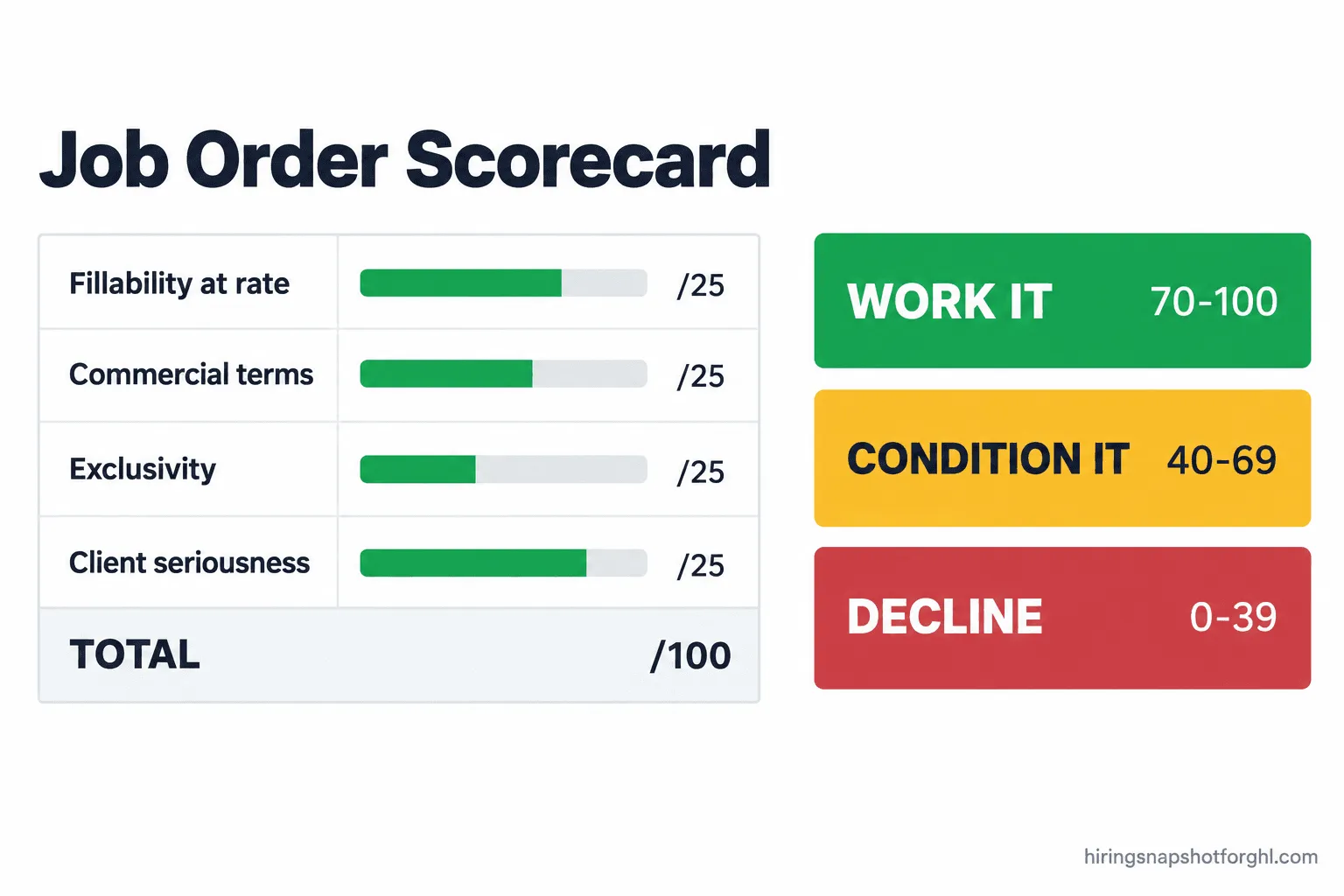
Now you have five checks’ worth of signal. Turn it into a decision, and give it a number so it is consistent across your desk instead of living in one recruiter’s gut. Score each check, fillability, terms, exclusivity, client seriousness, roughly out of 100, and set two lines. Above the top line, you work it with full effort and speed. In the middle band, you work it on conditions, more exclusivity, a better rate, signed terms, or a real start date, and you say so plainly to the client. Below the bottom line, you decline, or you keep the relationship warm without committing a recruiter.
The conditional band is where good desks make their money, because most orders are not clean yeses or clean nos. They are “yes, if.” Yes, if you make us exclusive for two weeks. Yes, if the rate comes up to market. Yes, once the terms are signed. Asking for the condition is not losing the order, it is the difference between a placement and a wasted week. The worst outcome is not declining a bad order. It is working a middling one at full effort because nobody on the desk was allowed to say no.
Steal this: the intake questions and the scripts
Here is the actual language. Use the intake questions verbatim on every new order, and keep the decline and renegotiate scripts where your recruiters can reach them, because the hardest part of qualification is not knowing an order is bad, it is saying so out loud to a client you want to keep.
The 10-question job order intake (ask before you source):
- What is the exact role, shift, and work location?
- What is the approved pay range, and is that final or is there room?
- Is this temp, temp-to-hire, or direct? If temp, what bill rate and terms?
- What are the true must-have skills or certifications, and what is just preferred?
- What is the real start date, and what is driving it?
- Why is the seat open, new headcount, a backfill, or a replacement?
- How many other agencies are working this order right now?
- Is there any exclusivity or engagement available if we commit our full desk?
- Who makes the final hire decision, and how fast does your interview-to-offer process move?
- What would make you say yes to a candidate, and what is an automatic no?
Script, ask for exclusivity on a shared order:
“Happy to put a recruiter on this today. When we work an order exclusively, we put our full sourcing effort behind it and we usually fill it fast. When it’s shared across several agencies, everyone hedges, and it tends to sit. Can we have a two-week exclusive? If we don’t deliver a shortlist you like in that window, it opens back up, no obligation.”
Script, raise a below-market rate:
“I want to be straight with you so we don’t both waste two weeks. At the rate on this order, the qualified people we’d want to send are already earning more, so the search stalls. To fill this reliably we’d need the pay at about [X]. If that’s not possible, I’d rather tell you now than send you candidates who’ll turn it down.”
Script, decline the phantom or unfillable order (keep the relationship):
“I’ve looked at this one closely and I don’t think we’re the right fit to work it right now, mostly because [no firm start date / the rate is below where this role clears / it’s shared too widely for us to commit properly]. I don’t want to take your time or mine on a search I can’t win for you. If [that changes / the budget gets approved / you’d like to make it exclusive], call me and I’ll put someone on it the same day.”
That last script is the one that pays off for years. Declining an order you cannot win, honestly and with a reason, builds more trust than quietly working it and failing. Clients remember the agency that told them the truth about their own req.
Three scenarios: solo, 8-seat, and 25-seat
The system is the same at every size. What changes is who runs it and how formal it gets.
The solo recruiter. You are the intake, the search, and the accountant, so qualification is survival, not process. Every hour you waste on a bad order is an hour your desk simply does not have. Run the six checks in your head on the first call, and be ruthless about the exclusivity question, because you cannot afford to be the fourth agency on anything. Your edge is that you can qualify and decide in one conversation. Use it. Say no fast and put everything behind the two or three orders you can actually win.
The 8-seat agency. Now qualification has to survive being done by eight different people with eight different tolerances for a bad order. This is where you write the intake down, set the scoring lines, and make it a rule that no recruiter commits to an order below the bottom line without a manager’s sign-off. The failure mode at this size is the eager recruiter who works every order that comes in to look busy, and quietly tanks the desk’s fill rate. A shared, scored intake fixes that by making “should we work this” a number, not a mood.
The 25-seat shop. At this scale, unqualified orders do not just waste hours, they corrupt your data. Your fill-rate reporting, your recruiter productivity numbers, your forecast, all of it gets polluted by orders that were never real. Qualification becomes a gate in the system: an order does not enter the pipeline until it clears intake and scoring, so the reqs your team works are pre-filtered and your benchmarks actually mean something. The largest desks treat a job order like a sales-qualified lead, because that is exactly what it is.
The compliance line you cannot cross
Qualifying a job order is mostly commercial, but two lines have legal weight and you should know them before you start. The first is co-employment. When you staff temp and contract workers, you and the client share aspects of the employer relationship, so be careful what you promise in qualification and in your agreement. Do not let a client dictate terms that quietly make you the sole employer for liability while they direct the work, and do not market guarantees you cannot legally keep. This is worth a conversation with counsel who knows staffing before you sign a client agreement, not after.
The second is worker classification. Part of qualifying a temp or contract order is confirming the role is genuinely a staffing engagement and not an attempt to misclassify what is really a direct employee. The Department of Labor’s rules on employee versus independent contractor status under the Fair Labor Standards Act decide this, not the client’s preference, and getting it wrong is a back-wages and penalties problem that lands on you as the employer of record. If an order only works because someone is misclassified, it is not a fillable order, it is a liability. This is general information, not legal advice, so run anything close to the line past an attorney who knows staffing.
Common objections, answered
“If I qualify this hard, I’ll turn away business I could have won.” You will turn away business you could not have won, which is the point. The orders that fail qualification are overwhelmingly the ones that were going to fail anyway, just slower and more expensively. Declining them does not shrink your revenue, it moves the hours you were wasting onto orders that close. Desks that qualify hard fill more, not less, because their recruiters are not spread across phantom reqs.
“My clients will be offended if I ask who else is working the order.” The good ones will not, because they respect a professional who protects their own time. Frame it as effort, not suspicion: you ask because exclusivity changes how hard you can go, and you want to give them your best shot. A client who is offended by a straight question about exclusivity is usually a client who was hoping you would not ask, which tells you exactly how to work the order.
“I don’t have time to run six checks on every order.” The whole filter is 15 minutes, and it replaces the 20 hours you would have spent on the orders it screens out. You are not adding work, you are moving it to the front, where it is cheap, from the back, where it is a wasted week. And once the intake is a form and the scoring is a habit, most orders clear or fail in the first conversation.
“I already use an ATS, doesn’t it handle this?” Most ATS tools track orders you have already decided to work, they do not help you decide whether to work them. Qualification happens upstream of the pipeline. You can build it into the same system, a structured intake that scores the order and only lets qualified ones through, which is exactly the kind of thing a properly built GoHighLevel pipeline does, but the ATS itself does not qualify orders for you. The judgment is yours. The system just makes it consistent.
FAQ
What does it mean to qualify a job order in staffing?
Qualifying a job order means deciding, before you commit a recruiter to it, whether the order is worth working. You confirm the real requirements, score whether the role can be filled at the rate offered, check that the fee or markup and payment terms clear your threshold, find out how many other agencies are working it, and confirm the client is a real buyer with an approved budget and a decision-maker. Then you choose to work it, work it on conditions, or decline. It is a short filter, usually about 15 minutes, that protects your scarcest resource, recruiter time, from orders that were never going to close.
How do I know if a job order is worth working?
Score it on four things: how fillable the role is at the pay offered, whether the commercial terms are worth a recruiter’s week, whether you have any exclusivity or are one of several agencies, and whether the client has a real, approved hire with a decision-maker and a fast process. An order that is fillable, exclusive or lightly shared, priced at market, and attached to a serious buyer is worth full effort. One that is shared across four agencies, priced below market, with no firm start date, is usually worth declining or working only as a light-touch long shot.
Should I work contingency job orders that other agencies also have?
Sometimes, but differently. A shared contingency order fills at a much lower rate than an exclusive one, so you should not put a recruiter’s full week behind it as if it were yours to win. Work it lighter and faster, or ask the client for a short exclusivity window in exchange for your full effort. If the role is easy to fill and the fee is large, a shared order can still be worth a quick, high-speed run. If it is hard, shared, and below market, it is the classic req that quietly wastes a desk.
What questions should I ask a client before working a job order?
Ask for the exact role, shift, and location; the approved pay range and whether it is final; whether it is temp, temp-to-hire, or direct and on what terms; the true must-have versus preferred skills; the real start date and what is driving it; why the seat is open; how many other agencies have the order; whether exclusivity is available; who makes the final decision and how fast their process moves; and what would make them say yes or no to a candidate. Those ten answers tell you whether the order is real and whether you can win it.
How is job order qualification different from qualifying a client?
They overlap and should happen together. Qualifying the client is about whether the business is a good one to work with at all, its industry, its volume potential, and critically its ability and willingness to pay you on your terms. Qualifying the job order is about whether this specific req is worth working right now. A great client can still hand you a bad order, a below-market, widely-shared phantom req, and a shaky client can hand you a clean, fillable one. You assess both, because the order you work and the business that pays you are a single decision.
Can I automate job order qualification?
You can automate the capture and the scoring, not the judgment. A structured intake form can collect the ten answers the moment a client submits an order, a simple scoring rule can flag where it falls against your lines, and routing can send qualified orders to the right recruiter instantly while parking the ones that fail. That removes the friction and makes qualification consistent across a whole desk. The final call on a borderline order still belongs to a person, but the system makes sure the question gets asked every time instead of being skipped whenever the desk is busy.
About the author
Marcus Delgado is the Staffing Agency Growth Lead behind the Hiring Snapshot. He ran a light-industrial staffing desk before joining the team to focus on agency growth, and he thinks in placement economics: fill rates, redeploys, recruiter productivity, and gross margin per requisition. His posts lean on real desk math, not vanity metrics.
Related reading
- How to Reduce Time-to-Fill: The GoHighLevel Playbook to Cut Days-to-Fill in Half
- Staffing Agency Bill Rate & Markup: The Margin Math That Keeps a Desk Profitable
- Staffing Client Credit Check: Vet a Business Before Net-60
- How to Use GoHighLevel as an ATS: Build a Recruiting Pipeline That Fills Reqs Faster
- Staffing Industry Benchmarks 2026: The Recruiting Metrics That Actually Matter