· Marcus Delgado · Growth · 15 min read
Local SEO for Tampa Staffing Agencies: How to Rank in the Google Map Pack (2026)
When a Tampa plant manager searches 'staffing agency near me,' Google shows three businesses in the map pack — and most of the clicks go to them. Here's the operator's playbook for getting your recruiting desk into that top three.

Short answer: to win candidates and job orders in Tampa, your staffing agency has to show up in the “map pack” — the three local businesses Google shows with a map when someone searches “staffing agency near me.” You get there by nailing three things Google’s local algorithm actually weighs: a complete, correctly-categorized Google Business Profile; fast, real location pages with proper local schema; and a steady flow of recent reviews. Get those right and you become the default agency a Tampa plant manager or a job seeker calls first. Get them wrong and you’re on page two, invisible, while a competitor with a worse desk but a better profile eats your inbound. This is the operator’s playbook — how the local algorithm works, the factors that move rankings, and the exact steps to run.
Key takeaways
- The map pack is the prize. Google’s local algorithm ranks businesses on relevance, distance, and prominence (Google Business Profile Help) — and the top three are what most local searchers see and click first.
- Your Google Business Profile is the single biggest lever. Business Profile signals account for roughly 32% of local-pack ranking weight — more than on-page, reviews, or links (BrightLocal, Local Search Ranking Factors).
- Reviews are the fastest-growing factor. Review signals have climbed to about 20% of local-pack weight, up from 16% — recency and volume both count (BrightLocal).
- Speed is a local ranking multiplier. Core Web Vitals are a Google ranking signal (Google Search Central), and 53% of mobile visits are abandoned when a page takes over three seconds to load (Think with Google).
- Tampa is a real market with real competition. The Tampa–St. Petersburg–Clearwater metro carries roughly 1.58 million jobs (U.S. Bureau of Labor Statistics) — plenty of desks competing for the same reqs.
- The map pack still owns local intent. Even as AI answers spread, local packs appear on the vast majority of local-intent searches, far more often than AI Overviews (Whitespark).
Table of contents
- Why local SEO decides which Tampa agency gets the call
- How Google actually ranks the map pack
- The local ranking factors that move the needle
- The 6-step playbook to rank in the Tampa map pack
- Why site speed is a local ranking multiplier
- Local SEO in the age of AI Overviews
- A realistic 90-day timeline
- FAQ
Why local SEO decides which Tampa agency gets the call
Staffing is a proximity business. A warehouse in Plant City wants associates who can get to the shift; a Tampa hospital wants credentialed nurses who live in the metro; a hiring manager in the Westshore district wants an agency that knows the local wage floor. So when either side of your market goes looking, they search locally — “staffing agency near me,” “light industrial staffing Tampa,” “healthcare recruiter St. Pete” — and Google answers with a map and three businesses. Those three get the calls.
The market is big enough that ranking matters. The Tampa–St. Petersburg–Clearwater metro carries roughly 1.58 million jobs, with a mean wage of $31.96 an hour as of May 2025 (U.S. Bureau of Labor Statistics). Office and administrative support alone makes up 12.8% of local employment — exactly the high-volume, high-turnover roles a staffing desk lives on. That’s a deep pool of candidates and clients, and a crowded field of agencies all trying to be the one that shows up first.
Zoom out and the stakes are national too: U.S. staffing industry sales were $124.0 billion in 2024, and agencies employed 11.2 million temporary and contract workers over the year (American Staffing Association). It’s a huge market — but a local one. You don’t compete with every agency in America. You compete with the six other desks that show up when someone in your part of Tampa Bay searches. Local SEO is simply the discipline of being one of the three Google chooses to show.
How Google actually ranks the map pack
Google is refreshingly explicit about how local ranking works. Three factors decide who lands in the local pack (Google Business Profile Help):
- Relevance — how well your Business Profile and website match what the person searched. A profile categorized as “Employment agency” with recruiting-specific services listed is more relevant to “staffing agency near me” than a vague, half-filled listing.
- Distance — how far your listed location is from the searcher (or the area they named). You can’t move your office to the searcher, but you can make sure Google knows exactly where you are and which areas you serve.
- Prominence — how well-known and trusted your business is. This is built from reviews, links, citations, and your overall web presence. Prominence is the factor you have the most long-term control over, and it’s where most agencies quietly lose.
The practical read for a Tampa desk: you can’t out-distance a competitor that’s physically closer to a given searcher, but relevance and prominence are earned, not fixed. A complete profile, a fast website that names your service areas, real local schema, and a steady stream of recent reviews tell Google you’re both relevant and prominent — which is how you show up even when you’re not the closest pin on the map.
The local ranking factors that move the needle
Not every signal carries equal weight. BrightLocal’s ongoing Local Search Ranking Factors study — the industry’s most-cited breakdown of what actually drives the local pack — weighs the categories roughly like this:
Read that chart like an operator reading a P&L. The two biggest line items — your Google Business Profile (about 32%) and your website’s on-page signals (about 19%) — are things you control completely and can fix this month. Add reviews (about 16%, and the fastest-growing factor) and you’ve accounted for roughly two-thirds of what moves the local pack (BrightLocal). None of it requires a bigger ad budget. It requires setup done right and kept fresh — which is exactly the kind of work that pays back for years instead of disappearing when you stop spending.
The 6-step playbook to rank in the Tampa map pack
Here’s the sequence that works, in order. Do them in this order because each one compounds the next.
1. Optimize your Google Business Profile
This is your single highest-leverage hour of work. Claim the profile, then fill everything: the exact business name (no keyword stuffing — that’s against Google’s guidelines and gets you suspended), the primary category (“Employment agency” or “Staffing agency”), secondary categories for your niches, your service area, hours, phone, and a real description. Add photos of your office and team, list your services, and keep the profile active with occasional posts. A complete, accurate profile is worth more than any trick — because it’s the ~32% factor doing its job.
2. Fix your NAP and citations
NAP is your Name, Address, and Phone number, and it has to be byte-for-byte identical everywhere it appears — your website, your Google profile, your Facebook page, and every directory that lists you. “Suite 200” in one place and “Ste. 200” in another is the kind of inconsistency that quietly erodes trust in Google’s eyes. Pick one canonical format and enforce it. Citations (mentions of your NAP on other sites) reinforce that you are who and where you say you are.
3. Build fast, real location pages
Here’s where most staffing agencies fall down, and where it costs them the most. A single thin homepage that says “we serve Tampa Bay” is not a local SEO strategy. What ranks is a real page per service and per service area — a “light industrial staffing in Tampa” page, a “healthcare staffing in St. Petersburg” page, a “clerical staffing in Brandon” page — each genuinely written, each fast, each with its own title, meta description, and schema. That structure is exactly what our Get a Website service is built to ship: fast Astro sites with proper location pages, clean sitemap.xml, robots.txt, and llms.txt, and a guaranteed 90+ PageSpeed score. If you’re weighing platforms, our Astro vs GoHighLevel website comparison breaks down why a page-builder site struggles here.
4. Add LocalBusiness and Service schema
Schema markup is structured data that tells Google — and AI answer engines — exactly what your business is, where it operates, and what it offers. A LocalBusiness block with your NAP and geo-coordinates, plus Service blocks with an areaServed of “Tampa, Florida,” makes your relevance unmistakable. Most page builders make this awkward or impossible to edit. On a purpose-built site it’s baked into every page.
5. Earn reviews on autopilot
Reviews are ~16% of the ranking weight and climbing, and they’re the factor most agencies neglect because the “ask” moment never lines up with a busy desk. The fix is to automate it: trigger a review request at every placement and client win, route happy responders to Google and unhappy ones to you privately first. That’s the whole discipline, and it’s covered in depth in our guide to why Google reviews make or break staffing agencies. Fresh reviews beat a stale wall of old ones — recency is its own signal.
6. Keep the site fast
Speed is the multiplier that makes the other five steps pay off, and it’s important enough to earn its own section below.
Why site speed is a local ranking multiplier
Two of the biggest ranking categories — your Business Profile and your reviews — funnel searchers to your website. If that site is slow, you lose them at the door, and Google notices. Page experience, measured by Core Web Vitals, is an official Google ranking signal, with “good” thresholds of LCP under 2.5 seconds, INP under 200 milliseconds, and CLS under 0.1 (Google Search Central). (INP replaced FID as a Core Web Vital in March 2024, so if your last audit predates that, it’s out of date.)
The conversion side is even blunter. Google’s mobile benchmark research found that 53% of mobile site visits are abandoned if a page takes longer than three seconds to load, and that bounce probability rises sharply as pages get slower:
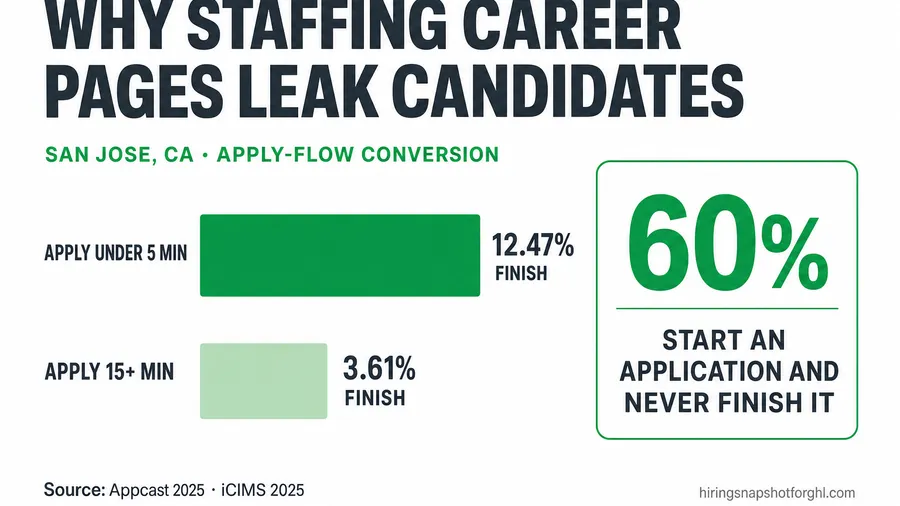
For a staffing desk this isn’t abstract. Your audience is overwhelmingly on phones — the majority of job applications are now submitted on mobile (Appcast) — so the slowest, heaviest version of your site is exactly the one most candidates see. A three-second delay isn’t a technical footnote; it’s the applicant who bounced before your form loaded, and the hiring manager who called the agency whose page opened instantly. Fast is a feature. It’s why every site we build carries a 90+ PageSpeed guarantee instead of hoping for the best.
Local SEO in the age of AI Overviews
A fair question in 2026: does any of this matter now that Google shows AI-generated answers and people ask ChatGPT for recommendations? For local search, the answer is that the map pack still dominates. Research tracking local-intent queries found that local packs appear on the large majority of them, far more often than AI Overviews do (Whitespark). (Estimates of how often AI Overviews show up on local queries vary widely between studies — one puts it near 15%, another closer to 40% — but every study agrees the local pack is still the primary surface for “near me” intent.)
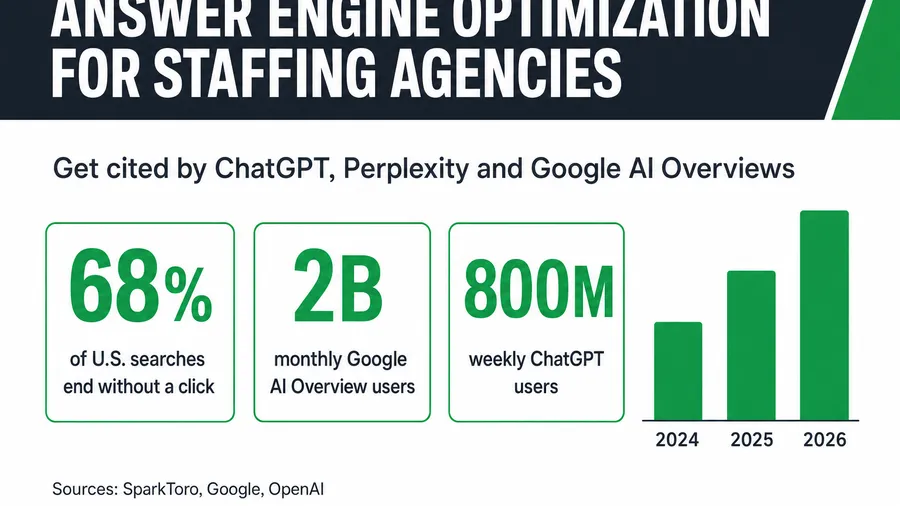
And here’s the useful part: the same work that wins the map pack also wins the AI answer. Answer engines like Google’s AI Overviews, Perplexity, and ChatGPT lean on structured data, clear entity signals, and authoritative content to decide which local business to name. A complete Business Profile, LocalBusiness schema, an llms.txt file, and clean, answer-first location pages are precisely what makes you citable in both places at once. Optimizing for the map pack is optimizing for AEO and GEO — you don’t have to choose.
A realistic 90-day timeline
Anyone promising day-one local rankings is selling something. Local SEO compounds; it doesn’t flip a switch. A realistic cadence for a Tampa desk:
- Weeks 1–2: Claim and fully optimize the Google Business Profile. Audit and fix NAP everywhere. This alone can lift you on branded and hyper-local searches quickly.
- Weeks 3–6: Stand up fast location pages for your top services and service areas, with proper titles, meta, and
LocalBusiness/Serviceschema. Submit an updated sitemap. - Weeks 6–12: Turn on automated review requests at every placement, and start responding to every review. Build a handful of quality local citations and links.
- Months 3–5: Rankings firm up as prominence accumulates. This matches the window we guarantee on Get a Website builds — with proper pages, schema, and clean technical files, agencies typically start ranking in their area within three to five months. It keeps compounding after that.
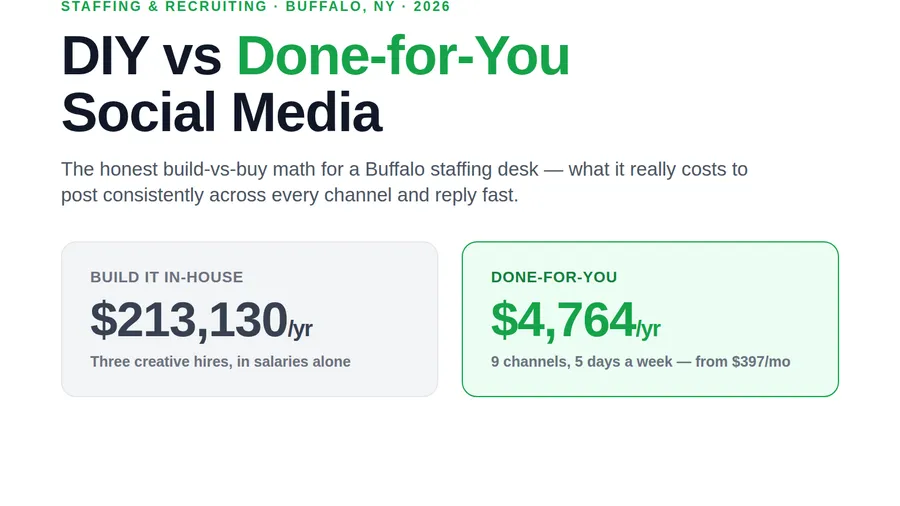
None of this competes with running your desk — it’s mostly one-time setup done right, plus a review workflow that runs itself. If you’d rather not build and maintain the site, the schema, and the review automation by hand, that’s exactly what we ship. The point is simple: in a metro this size, being findable is table stakes, and the agency that shows up in the map pack is the one that gets the first call.
FAQ
What is the “map pack” and why does it matter for a staffing agency? The map pack (or “local pack”) is the block of three local businesses Google shows with a map for local-intent searches like “staffing agency near me.” It sits above the regular organic results and captures a large share of local clicks, so for a proximity business like staffing, being in the top three is often the difference between getting the inbound call and never being seen.
How long does it take a Tampa staffing agency to rank locally? Expect meaningful movement in weeks for branded and hyper-local terms once your Google Business Profile is optimized, and three to five months for competitive “near me” and service-area terms as reviews, links, and prominence accumulate. Local SEO compounds, so the profile keeps getting stronger over time rather than resetting.
Do I need separate location pages, or is one homepage enough? Separate pages win. A single homepage that lists every city is thin and generic; a real page for each service and service area — with its own title, content, and schema — is far more relevant to a specific local search and ranks accordingly. Just make sure each page is genuinely written and fast, not a duplicated template.
Is my Google Business Profile more important than my website? They work together, but the Business Profile carries the most direct local-pack weight (roughly a third of ranking influence), while your website supplies the relevance, schema, and speed that back it up. Neglecting either caps your ceiling — a great profile pointing at a slow, thin site still leaks candidates and clients.
Does website speed really affect local rankings? Yes, in two ways. Core Web Vitals are a direct Google ranking signal, and a slow site drives up bounce rates — over half of mobile visitors abandon a page that takes more than three seconds — which hurts the behavioral signals and conversions that ranking ultimately depends on.
Written by Marcus Delgado, Staffing Agency Growth Lead for the Hiring & Staffing GHL Snapshot, based in Tampa, FL. Marcus ran a light-industrial staffing desk before joining the snapshot team, and thinks in placement economics — fill rates, redeploys, and gross margin per requisition — translating those numbers into the systems that actually move them.
Related reading