· Marcus Delgado · Growth · 23 min read
The Staffing Agency's Year: A Seasonal Hiring Playbook for Light-Industrial Desks (2026)
Light-industrial demand is not a flat line, it is a wave: a Q4 peak, a January cliff, and a long rebuild in between. Here is the four-season operating plan that keeps a warehouse and logistics desk filling through the surge, holding its bench through the slowdown, and never starting from zero in August.
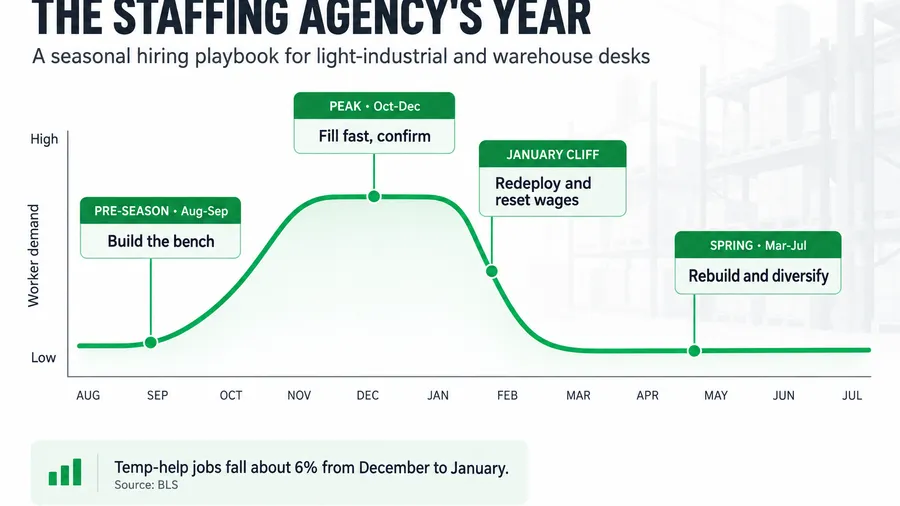
It is the second week of October and your phone will not stop. A distribution center you have worked with for two years just told you they need forty pickers and packers by Monday, a third-party logistics client wants thirty more for a night shift, and the retailer down the road is asking if you can “scale” for the holidays. Three weeks ago you were calling old clients trying to drum up orders. Now you cannot fill fast enough, and in nine weeks every one of those assignments ends on the same Friday and your billings fall off a cliff.
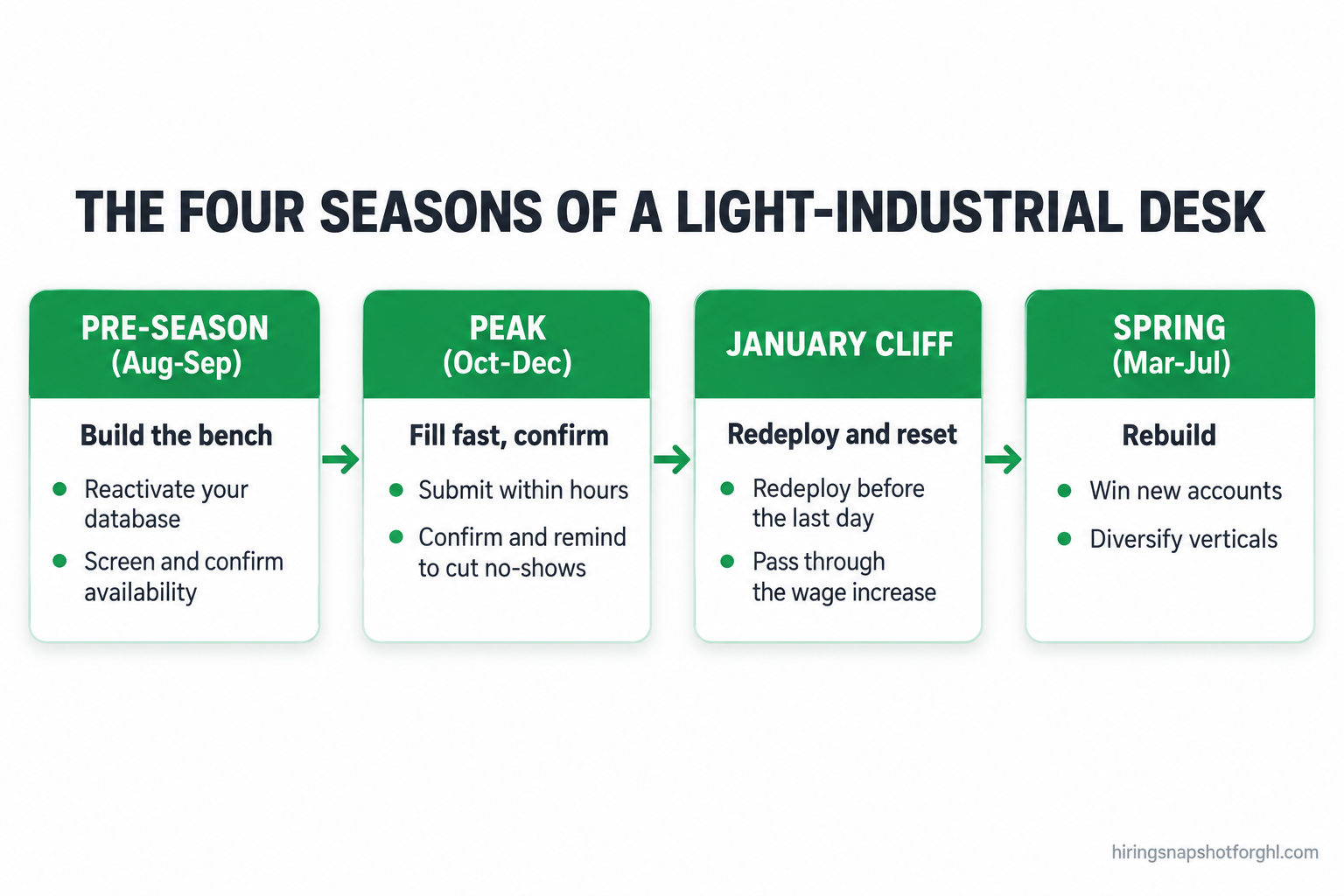
The short answer: light-industrial staffing demand is a wave, not a flat line, and the desks that win run a different play in each of its four seasons instead of reacting to all of them the same way. You build the bench in late summer before the surge, you fill and hold workers through the Q4 peak, you fight the January cliff with redeployment and a passed-through wage reset, and you spend spring rebuilding accounts and diversifying so you are not betting the whole year on December. This is the full calendar, with the real desk math, the exact messages you can steal for each phase, and the ways each season quietly breaks a desk that treats it like every other.
Key takeaways
- The year peaks in Q4 and troughs in January. The American Staffing Association reports that December is usually the peak month for temporary staffing employment and January the trough, and because its index is not seasonally adjusted, the swing you feel on the desk is the real one.
- The surge is real but softening. Amazon planned to hire 250,000 seasonal workers for the 2025 peak at an average of about $19 an hour, while UPS cut its 2026 seasonal target to 100,000, down from 110,000 in 2025 and 125,000 in 2024, its second straight year of reduced holiday hiring. You cannot assume the wave lifts every boat.
- January resets your cost base. On January 1, 2026, the minimum wage rose in 19 states and 49 cities and counties, so a bench you built in October bills at a higher pay floor in January whether or not your client rate moved.
- Ghosting is a peak-season tax. New-hire ghosting has climbed for years: one Gartner survey found 51% of new hires backed out late or disappeared within their first year, up from 36% in 2019, and high-volume peak hiring is exactly where it bites, so a tight confirm-and-remind cadence pays for itself.
- Redeployment is how you survive the cliff. A worker you placed for peak and redeploy in January is a fill you do not have to source, which is why the back half of this playbook matters more than the front.
Table of contents
- Why the staffing year is a wave, not a line
- Season 1: The pre-season bench build (August to late September)
- Season 2: The Q4 peak surge (October to mid-December)
- Season 3: The January cliff (late December to February)
- Season 4: The spring rebuild (March to July)
- Steal this: the messages for each season
- Three desks: solo, 8-seat, and 25-seat
- The compliance layer that runs all year
- Common objections, answered
- FAQ
Why the staffing year is a wave, not a line
There are roughly 27,000 staffing and recruiting companies in the United States running about 54,000 offices, and together they put nearly 2.2 million temporary and contract workers to work in an average week (American Staffing Association). Over the course of a full year that same industry hires 12.7 million temporary and contract employees, because the work turns over constantly and the demand moves with the calendar. For a light-industrial desk, that movement is not a rounding error. It is the single biggest fact about your business.
The shape is consistent, and the government’s own numbers show it clearly. In the Bureau of Labor Statistics temporary-help series, measured without seasonal adjustment, employment builds through the fall to its high in October, holds near that level through the holidays, then falls by about 157,000 jobs, roughly 6%, from December to January (BLS, via FRED). The American Staffing Association tells the same story from the industry side: it describes December as typically the peak month for temporary staffing employment and January as the trough, and its index routinely dips in late December in what one ASA economist called “holiday frostbite,” then stages a modest rebound in January in line with the normal seasonal pattern. The ASA is explicit that its index is not adjusted for seasonal factors, so unlike the smoothed national jobs numbers, both measures show the raw wave the way you live it on the desk.
That wave is driven by where light-industrial workers actually go: warehouses, fulfillment centers, third-party logistics, and the retail supply chain that floods with volume before the holidays. The scale is enormous and it is where the seasonal signal is loudest.
The surge is real, but 2026 is a good year to remember it is not guaranteed. Amazon aimed to hire about 250,000 workers for the 2025 holiday season, the same as the year before, at an average pay of roughly $19 an hour. UPS, on the other hand, announced in October 2026 that it would hire only 100,000 seasonal workers, down from 110,000 in 2025 and 125,000 in 2024, its second straight annual cut, as it trimmed operations. The lesson for your desk is simple: the wave still comes, but you cannot sit back and let the giants’ overflow fill your orders. You have to run the play.
Season 1: The pre-season bench build (August to late September)
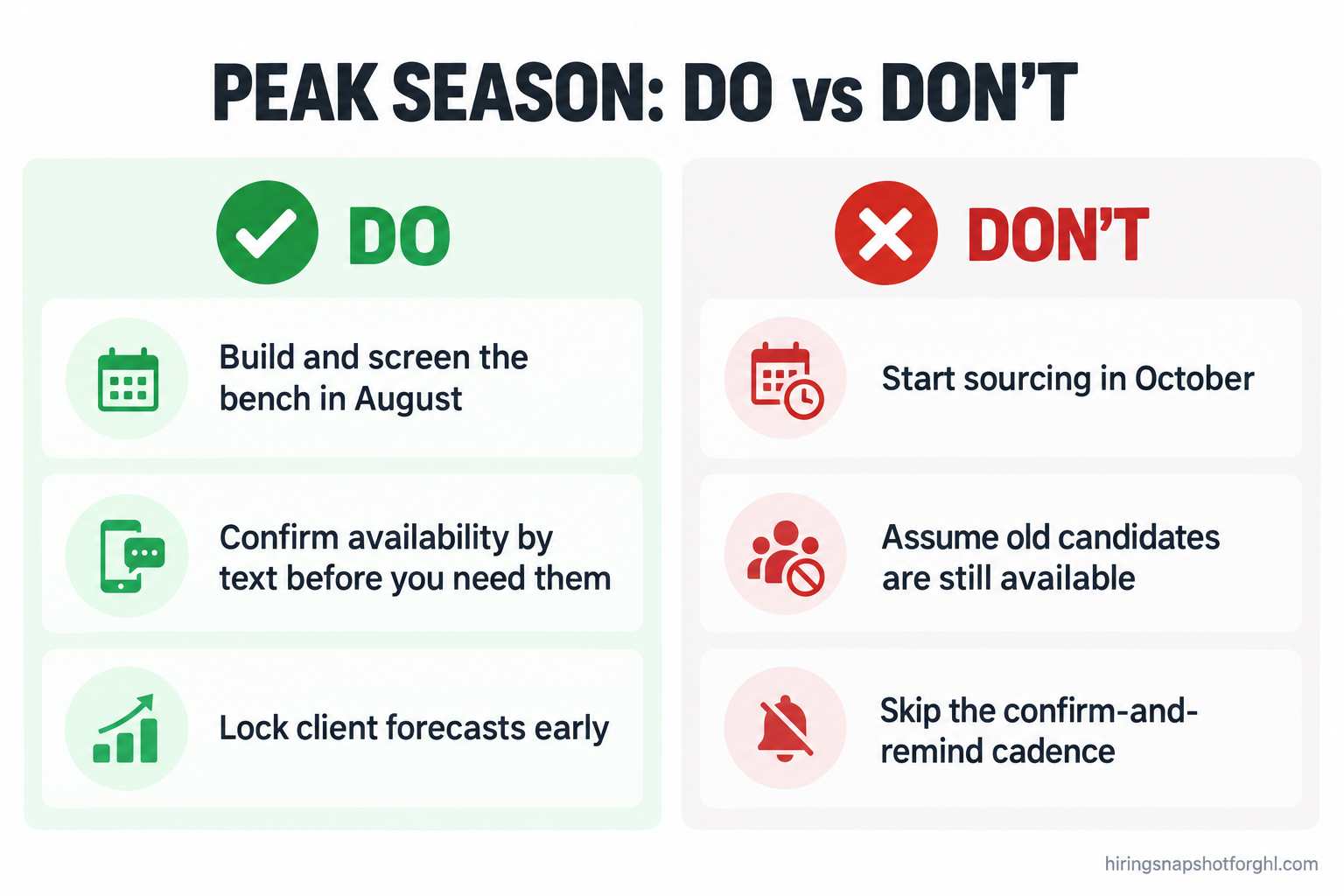
The desks that drown in Q4 are the ones that start sourcing in October. By then every other agency is fishing the same pond, pay rates are climbing, and the best workers are already placed. The pre-season is where the peak is actually won, six to ten weeks before a single surge order lands.
The job in this window is to build a bench of ready-to-work, compliance-cleared candidates before you need them. That means three things running at once. First, reactivate the people you already have. Your database is full of workers who finished an assignment in spring and went quiet, and they are far cheaper to re-engage than a cold applicant. Second, get them work-ready now: I-9 and E-Verify started, background checks and any required screenings cleared, availability and shift preferences confirmed, so that when the order comes you are submitting, not starting paperwork. Third, lock your clients’ forecasts. Call every peak account in August and get a number and a date, even a rough one, so you are building the right bench and not guessing.
How this breaks. The classic failure is a bench that looks full on paper but is not actually deployable. You “have” 120 candidates, but half have expired screenings, a third never answered your availability text, and you do not find out until the Monday the client needs forty people. The second failure is building a bench with no demand behind it, burning cash on screenings for workers you never place. The fix for both is a single source of truth: every candidate tagged with their real status (screened, available, placed, cold) so your deployable number is honest, and every peak client tagged with a forecast so the bench is sized to real orders. This is exactly the kind of tracking a GoHighLevel recruiting pipeline is built to hold, and it is the difference between a bench and a list.
Season 2: The Q4 peak surge (October to mid-December)
This is the money season. Orders come in faster than you can fill them, the client who ignored your calls in July now needs fifty people yesterday, and whoever responds first gets the placement. Speed is the whole game, and it is also where volume quietly destroys margin and reputation if you have no system under it.
Two things matter more than anything in the surge. The first is submission speed. A light-industrial order is usually won in hours, not days, so the agency that confirms a candidate’s availability, screens for the two or three real requirements, and submits within the morning beats the agency that is still “reviewing resumes” that afternoon. This is why your pre-season bench matters: you are not sourcing, you are deploying. If you want the mechanics of cutting that response window, the time-to-fill playbook breaks down where the days actually hide.
The second is show-up rate. Peak season is high-volume hiring, and high-volume hiring is where ghosting spikes. New-hire ghosting has climbed for years, and one Gartner survey found that 51% of new hires either backed out late or disappeared within their first year, up from 36% in 2019 (HR Executive). On a single warehouse order for forty people, a 20% no-show rate on day one is eight empty slots, an angry client, and a reputation hit right when you are trying to win next year’s business. The counter is a tight confirm-and-remind cadence: a confirmation the moment they accept, a reminder the day before with the address and what to bring, and a morning-of text with a one-tap “I’m on my way” or “I can’t make it” so you know by 6 a.m. whether you need to backfill, not at 8 when the shift starts. Automating that cadence is the single most valuable thing a light-industrial desk can do in Q4, and it is covered in depth in the no-call-no-show playbook.
How this breaks. Beyond no-shows, the surge breaks desks through margin erosion they do not notice until January. Pay rates spike in October as everyone competes for the same workers, and if you fill a surge order at a pay rate your old client bill rate cannot carry, you are billing those forty people at a loss for nine weeks. The fix is to know your floor before peak and refuse orders that do not clear it, which sounds obvious and is routinely ignored when the phone is ringing. The bill-rate and markup math is the pre-season homework that keeps the surge profitable instead of just busy.
Season 3: The January cliff (late December to February)
Here is the season nobody plans for. The holiday assignments end, often all at once, the ASA index takes its December “holiday frostbite” dip, and in the first weeks of January your billings can fall by half. At the same time, your cost base resets upward: on January 1, 2026, the minimum wage increased in 19 states and 49 cities and counties, with large-employer rates reaching $15.92 in New Jersey, $16.90 in California, and $17.13 in Washington. A bench you built at October pay rates now bills at a January pay floor, and if your client rate did not move with it, your margin did.
The cliff is survived in two moves. The first is redeployment. Every worker whose peak assignment is ending is a placement you already own, and moving them to a new assignment is a fill you do not have to source. The agencies that come through January strong are the ones who started the redeployment conversation in early December, before the worker’s last day, not after they have already taken a job somewhere else. A worker redeployed is cheaper, faster, and more reliable than a cold hire, and the whole economics of it are laid out in the contractor redeployment playbook. The second move is the wage reset itself: if you have a pass-through clause in your client agreements, the January 1 minimum-wage increase automatically lifts your bill rate, and your margin holds. If you do not, you are eating the increase until you can renegotiate, which on a large account can be thousands of dollars a month.
How this breaks. The desk that treats January as a dead month and goes quiet is the one that loses its bench. Workers who finish an assignment and hear nothing from you for three weeks take the first job they find, usually from a competitor who kept texting. The fix is to keep the bench warm with availability check-ins and real redeployment offers, not silence. The second failure is absorbing the wage increase by accident, point by point, across dozens of placements, because no one flagged which assignments crossed under the floor on January 1. Tagging each placement with its margin and firing an alert when a wage change pushes it below your floor turns that silent bleed into a task you handle.
Season 4: The spring rebuild (March to July)
Spring is the quiet season, and quiet is dangerous because it feels like a break. Demand is softer and flatter, the surge is a memory, and the temptation is to coast on whatever accounts are still running. The desks that have a good next Q4 are the ones that use this window deliberately, for the three jobs that cannot be done when the phone is ringing.
The first job is to win new accounts. You have time now to prospect, to have the slow conversations, to run the client credit checks you skip in October, and to land the accounts that will carry your peak. A disciplined approach to winning staffing clients in the slow season is worth more than any amount of scrambling in the busy one. The second job is to diversify your verticals so you are not betting the entire year on holiday logistics. Light-industrial is not only warehousing. Manufacturing, food production, and construction run on different calendars, and a desk with two or three seasonal profiles has a flatter, safer revenue line than one that lives and dies on December. The third job is to clean and reactivate the database for the next bench build, so when August comes you are starting from a warm, tagged, deployable list instead of from zero. Reactivating an existing database is far cheaper than buying new applicants, and the mechanics are in the database reactivation playbook.
How this breaks. The spring failure is treating slow as rest. The accounts you do not win in April are the surge orders you cannot fill in October, and the database you do not maintain is the cold list you will be panic-sourcing from in Q4. The quiet season is not downtime, it is pre-production for the next wave, and the desks that understand that never start their year from nothing.
Steal this: the messages for each season
Automation is only as good as the copy running through it. Here is the real text for the cadences that carry a light-industrial desk through its year. Keep them short, keep them human, and make every one easy to answer with one tap. Confirm you have documented TCPA consent before any of these go out.
Pre-season reactivation (August):
“Hi [Name], it’s [Recruiter] at [Agency]. Peak season is coming and we’ve got warehouse and logistics shifts opening up in [City] at $[rate]/hr. Are you available for work in the next 6 weeks? Reply YES and I’ll call you with the details.”
Availability and work-ready confirm:
“[Name], to get you first in line for the best shifts, I need two things: are your [screening/certs] still current, and what days/shifts can you work? Reply here or call me at [number].”
Peak-season offer (speed is everything):
“[Name], got a shift that fits you: [role] at [company], [City], starts [date], $[rate]/hr, [shift times]. Want it? Reply YES in the next hour and it’s yours.”
Day-before reminder:
“See you tomorrow at [company]! Address: [address]. Start time: [time]. Bring [ID/boots/etc.]. Reply C to confirm you’re set, or call me if anything changed.”
Morning-of show-up check:
“Good morning [Name]! Your shift at [company] starts at [time]. Reply 1 = on my way, 2 = running late, 3 = can’t make it. I’m here if you need anything.”
January redeployment (send before the last day):
“[Name], your assignment at [company] wraps [date] and you did great work. I don’t want you sitting idle. I’ve got [role] at [company] starting [date] at $[rate]/hr. Want me to line it up so there’s no gap? Reply YES.”
Spring warm-up check:
“Hi [Name], it’s [Recruiter] at [Agency]. Just checking in. Still working, or ready for your next assignment? Reply READY and I’ll see what fits your [shift/location]. We’re staffing up for the year.”
These are starting points, not scripts to send verbatim to everyone. The point is that each phase of the year has a different job, and the message has to match the job: reactivate in August, deploy fast in October, hold the bench in January, warm it back up in spring.
Three desks: solo, 8-seat, and 25-seat
The seasonal play is the same shape at every size, but what you can actually execute changes with your headcount. Run the calendar honestly against your real capacity.
The solo contingency recruiter. You cannot work the surge by hand. If you are sourcing, screening, submitting, confirming, and reminding forty workers yourself, you will drop half the balls in the first week of October, and the dropped balls are no-shows and lost clients. For a solo desk, the pre-season bench build and automation are not nice-to-haves, they are the only way to survive peak at all. Build a small, deep bench of 30 to 50 genuinely deployable workers in August, automate every confirm-and-remind cadence so the system handles the volume, and be ruthless about only taking orders that clear your floor. One good peak account you can actually service beats three you cannot. In January, redeployment is your lifeline, because sourcing from cold while billings are down is a cash-flow trap, and net-60 terms make it worse, which is why cash flow in the slow season deserves its own plan.
The 8-seat agency. You have enough recruiters to split the year by role: assign pre-season bench building and reactivation to specific people in August so it actually happens instead of getting lost behind live orders. Your risk in Q4 is coordination, two recruiters submitting the same worker to two clients, or a candidate confirmed for one shift and reminded for another, which a shared pipeline prevents. Your January risk is that redeployment falls through the cracks because everyone assumes someone else is calling the ending assignments. Assign it. Make redeployment a named job with a list, not a vague intention. Use the spring to formalize your account diversification so the whole team is not dependent on the same three logistics clients.
The 25-seat shop. At this size the seasonal wave is a forecasting and margin-control problem. You can carry a larger standing bench, but you also have more placements silently crossing under the floor when the January wage reset hits, so pass-through clauses and automated margin alerts are not optional, they protect real money across hundreds of assignments. Your advantage is data: three years of your own order history tells you exactly when each client’s surge starts and how big it gets, so your August bench build is a forecast, not a guess. Your discipline problem is the opposite of the solo desk’s: with capacity to spare you will be tempted to take low-margin volume to keep recruiters busy in peak, and that volume is what crushes your blended margin in January when the pay floor rises. Hold the line on the floor at every size, but especially here.
The compliance layer that runs all year
Speed and volume are where compliance gets skipped, and peak season is both, so the rules deserve a dedicated place in the plan rather than a footnote. Three things matter for a light-industrial desk running the seasonal wave. First, TCPA consent: every one of the text cadences above requires documented, express consent before you message a candidate, and “we have their number” is not consent. Capture it at application and keep the record. Second, I-9, E-Verify, and background screening have to be genuinely complete before a worker starts, not rushed through on the Monday of a surge, and the FCRA and screening checklist is the one to run before peak, not during it. Third, the January wage reset is a compliance event as much as a margin one: placing a worker below the new state or local minimum, even by accident because your bench was built at the old rate, is a wage-and-hour problem, not just a thin-margin one. Build the pay-floor check into your January redeployment so no one is ever offered an illegal rate. This is general information, not legal advice, so confirm the current rules in your state and localities with counsel.
Common objections, answered
“I’ve always just reacted to orders as they come. Why plan a calendar?” Because reacting is what makes peak miserable and January scary. The orders come on the same rough schedule every year, and the agency that prepared for them in August fills them profitably while the agency that is surprised by them every October scrambles, drops workers, and loses the client. A calendar does not slow you down, it means that when the surge hits you are deploying a bench instead of building one from scratch under pressure.
“Won’t all this automated texting annoy my workers?” The opposite, when it is done right. Light-industrial workers are not annoyed by a clear shift confirmation, a reminder with the address, and a one-tap way to say they cannot make it. They are annoyed by recruiters who go silent, send them to the wrong address, or do not call for three weeks in January and then expect them to still be available. A tight, useful cadence is a sign of a professional desk, and it is exactly what keeps your best workers choosing you over the agency across town.
“I’m a one-person desk. Isn’t a four-season system overkill?” It is the opposite of overkill, it is survival. A big agency can throw recruiters at a bad October. You cannot. For a solo desk, the pre-season bench and the automated cadences are the only way to handle surge volume without dropping placements, and redeployment is the only way to keep cash flowing in January. The smaller the desk, the more the seasonal system matters, because you have no slack to absorb a blown peak.
“My demand doesn’t really follow the holidays.” Then map your own wave, because you still have one. Manufacturing, food production, agriculture, and construction all have seasonal profiles that are not the retail holiday peak, and the playbook is identical, only the dates move. Pull your own two or three years of order history, find your real peak and your real trough, and run pre-season, surge, cliff, and rebuild against your calendar instead of the warehouse one.
FAQ
When is peak season for light-industrial staffing?
For warehousing, fulfillment, logistics, and the retail supply chain, peak season runs roughly from October through mid-December, driven by holiday order volume. The American Staffing Association reports that December is usually the peak month for temporary staffing employment overall and January the trough. If your clients are in manufacturing, food production, or construction, your peak may fall at a different time of year, so map your own demand from your order history rather than assuming the holiday calendar.
How do I prepare my staffing bench for peak season?
Start six to ten weeks early, in August and September. Reactivate the workers already in your database, get them fully work-ready with current I-9, E-Verify, background checks, and any required screenings, and confirm their real availability and shift preferences. At the same time, call your peak clients for a forecast so you build a bench sized to actual demand. The goal is that when a surge order lands in October you are submitting deployable, pre-cleared workers in hours, not starting paperwork.
Why do staffing billings drop so hard in January?
Holiday assignments end, often many on the same date, and the industry hits its seasonal trough. The ASA Staffing Index typically dips in late December and rebounds only modestly in January. On top of that, minimum-wage increases took effect in 19 states and 49 localities on January 1, 2026, so your cost base resets upward at the same moment demand falls. The combination is why desks that do not plan redeployment and wage pass-throughs feel January as a cliff.
What is redeployment and why does it matter for seasonal staffing?
Redeployment is moving a worker from an ending assignment straight to a new one, instead of letting them go idle and sourcing a replacement later. It matters most at the January cliff: a worker you redeploy is a fill you do not have to source, they are cheaper and more reliable than a cold hire, and keeping them working keeps your billings up when demand is at its lowest. The key is to start the redeployment conversation before the worker’s last day, not after they have taken a job elsewhere.
How do minimum-wage increases affect a staffing agency in January?
When a state or city raises its minimum wage on January 1, the pay rate for affected workers rises immediately, which lifts your cost on every placement at or near that floor. If your client agreements include a pass-through clause, your bill rate rises automatically and your margin holds. If they do not, you absorb the increase until you can renegotiate, and you also risk placing a worker below the new legal minimum if your bench was built at the old rate. Build a pay-floor check into your January redeployment to protect both margin and compliance.
How much of peak season hiring can I actually automate?
Most of the repeatable communication, which is where the volume and the dropped balls live. Candidate capture, availability and work-ready confirmations, shift offers, day-before reminders, morning-of show-up checks, and redeployment follow-ups can all run on automated SMS cadences, so a recruiter’s time goes to the judgment calls: qualifying the order, matching the worker, and handling exceptions. What you do not automate is the relationship, the recruiter still owns the client and the placement, but the system carries the dozens of small, timely messages that keep no-shows down and the bench warm.
About the author
Marcus Delgado is the Staffing Agency Growth Lead behind the Hiring Snapshot. He ran a light-industrial staffing desk before joining the team to focus on agency growth, and he thinks in placement economics: fill rates, redeploys, recruiter productivity, and gross margin per requisition. His posts lean on real desk math, not vanity metrics.
Related reading
- Contractor Redeployment: The Automation That Turns One Placement Into Three
- No-Call, No-Show at Your Staffing Agency: The Confirm-and-Remind System That Fixes It
- How to Reduce Time-to-Fill: The GoHighLevel Playbook to Cut Days-to-Fill in Half
- Staffing Agency Cash Flow: How to Cover Payroll When Clients Pay Net-60
- Reactivate Your Candidate Database: Turn Old Applicants Into This Week’s Placements