· Neha Chandra · Operations · 19 min read
Reference Checks for Staffing Agencies: The System That Verifies a Candidate Without Killing the Placement (2026)
Most desks either skip reference checks or let them stall a placement for a week. Here is the staged system that matches the depth of the check to the type of placement, automates the request so it finishes in hours, and keeps you on the right side of FCRA and the EEOC, with the real scripts you can steal.
It is Thursday afternoon and you have a warehouse supervisor ready to start Monday. The client is thrilled, the candidate signed, everyone is happy. Then you remember you never actually called his last manager. You leave two voicemails and a text, and hear nothing. Monday comes and you start him anyway, because the client needs the body on the floor. Three weeks later the client calls: he has been written up twice for walking off mid-shift, and his old employer let him go for exactly that. You could have known on Thursday. You just had no system for finding out.
The short answer: a reference check is not a formality you rush at the end. It is a verification step you run on purpose, sized to the risk of the placement, and automated so it finishes in hours instead of stalling your start for a week. Done right, it catches the candidate who stretched the truth and confirms the one who did not, without becoming the reason your placement slips to a competitor. Done wrong, which is how most desks do it, it is either skipped entirely or it turns into three days of voicemail tag that costs you the fill. Here is the staged system that fixes both ends of that problem.
Key takeaways
- Match the depth to the placement. A light-industrial temp, a travel nurse, and a direct-hire controller need three different levels of reference checking. One check for all of them wastes time on some and under-protects you on others.
- Candidates stretch the truth. In a January 2025 survey of 2,000 applicants, 24% admitted lying on their resume, most often about years of experience and skills. The reference is where you catch it.
- Speed is the whole game. A manual phone-based check takes thirty minutes to over an hour per candidate across three or four days, per SHRM. Automating the request collects the same answers in hours.
- The compliance line is who does the checking. A reference you verify yourself sits outside the Fair Credit Reporting Act. The moment you hire an outside reference-checking service, it likely becomes an investigative consumer report with notice and consent rules attached.
What this guide covers
- What botching references actually costs you
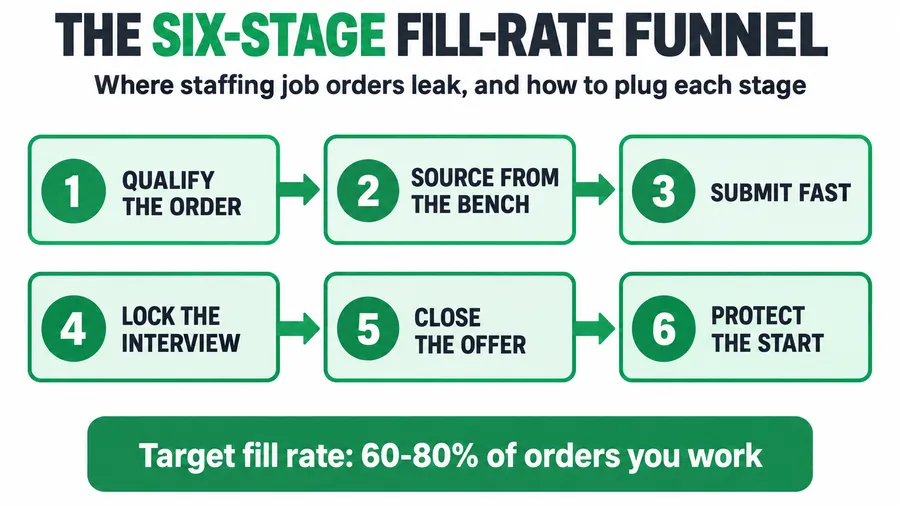
- The six-stage reference-check system
- Stage 1: Set the depth to match the placement
- Stage 2: Collect the right references at the right moment
- Stage 3: Ask the questions that predict performance
- Stage 4: Automate the request so it finishes in hours
- Stage 5: Read the signal a reference is sending
- Stage 6: Document it, and act within the rules
- Three scenarios: solo desk, high-volume, healthcare and direct-hire
- Compliance: FCRA, the EEOC, and the questions you cannot ask
- Objections
- FAQ
What botching references actually costs you
Start with the size of the bet. There are roughly 27,000 staffing and recruiting companies in the United States running about 54,000 offices, and together they put around 2.2 million temporary and contract workers to work in an average week (American Staffing Association). Every one of those placements is a person you are vouching for. When one goes bad, the client does not blame the candidate. They blame you.
And candidates do not always tell you the truth. In a January 2025 ResumeBuilder survey of 2,000 people who had applied for a job, 24% admitted lying on their resume and 44% admitted lying somewhere in the hiring process (ResumeBuilder). Among those who lied on the resume, the most common fibs were years of experience (38%), skills and abilities (34%), and the length of positions held (32%). Those are exactly the three things a decent reference call confirms or breaks in five minutes.
References earn their keep on the other side too. SHRM reports that 73% of companies that run reference checks call the process somewhat or very effective at identifying poor performers, and that nearly 40% of HR professionals now spend more time on reference checking than they did three years ago (SHRM). More time spent is not a badge of honor. It is the symptom this system cures: get the predictive value of a good reference without burning half a day per candidate to get it. The cost of getting it wrong is never just the one bad placement. It is the fall-off, the free replacement your fee agreement promises, the recruiter hours spent refilling, and the dented client relationship that sends the next order somewhere else.
The six-stage reference-check system
Reference checking fails for two opposite reasons. Some desks skip it because it is slow and they are busy. Others do it religiously and let it add four days to every placement. The fix for both is the same: a defined process that decides how much checking a placement needs, collects what it needs fast, and routes the result to a decision. Six stages, run in order.
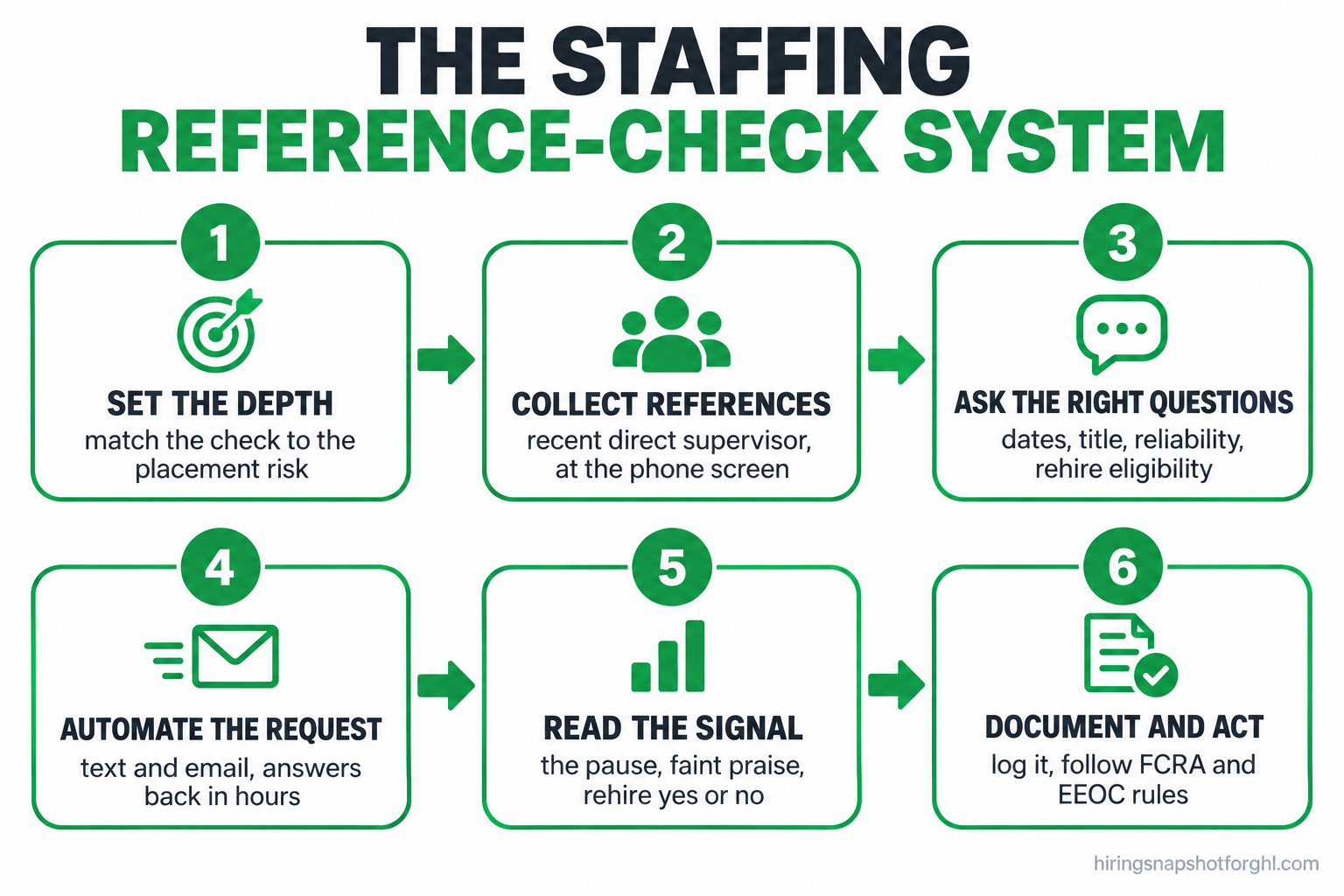
The discipline is not doing every stage on every candidate. It is doing the right amount for the placement in front of you, which is where Stage 1 comes in.
Stage 1: Set the depth to match the placement
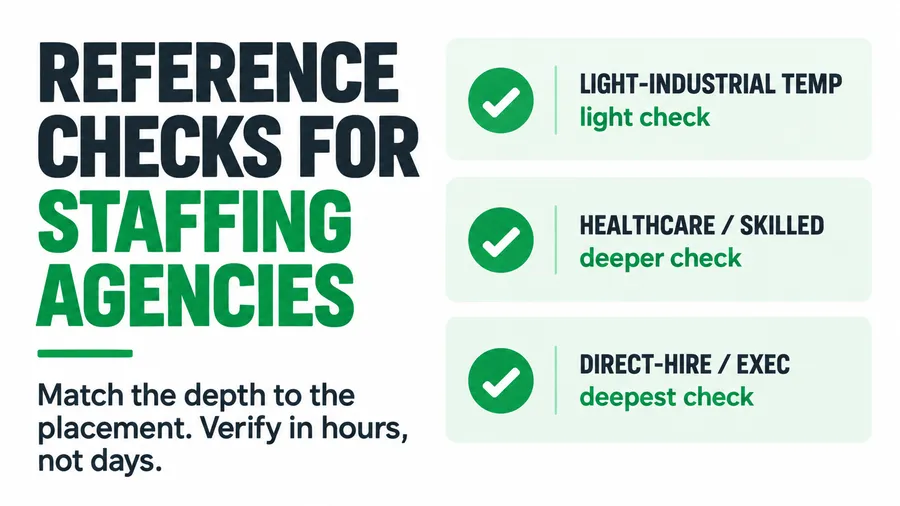
Not every placement deserves the same reference check, and pretending otherwise is why desks either skip checks on the jobs that need them or over-check the jobs that do not. Decide the depth before you make a single call, based on the risk of the role. A light-industrial temp going into a warehouse for two weeks needs a light touch: confirm they worked where they said and are eligible for rehire, done. A healthcare or skilled placement needs more, because the client is trusting the worker with patients, equipment, or a licensed function. A direct-hire or executive placement, where your fee is a percentage of a full-year salary, deserves the deepest check: multiple references, a recent supervisor, and real conversations about performance. Write the tiers down and attach them to your order types so every recruiter runs the same depth on the same kind of job. That consistency is also a compliance requirement, because checking some candidates harder than others for the same role is exactly what the EEOC warns against.
How it breaks. With no tier, reference depth depends on how busy the recruiter feels that day. The high-liability healthcare placement gets a rushed single call because the recruiter was slammed, and a throwaway temp gets a full three-reference workup because the recruiter had a quiet afternoon. Define the tiers once, in writing, and the decision stops being a mood.
Stage 2: Collect the right references at the right moment
Two questions decide whether a reference is worth anything: who it is, and when you ask. Who matters because a candidate handing you a best friend’s cell number tells you nothing. You want a direct supervisor from a recent, relevant job. Ask for it that way: “I need the name and number of your most recent direct supervisor.” A candidate who cannot produce one is itself a signal. When matters because timing interacts with the offer. For most staffing placements, collect references during or right after the phone screen, so you verify before you present the candidate, not after. For roles with a background check or drug screen, many desks make the offer conditional and verify after acceptance but before the start date. Either works. What does not work is leaving it undefined, so references become the thing you remember on Thursday for a Monday start. Collecting them cleanly up front is the same discipline that makes your phone screen script pull its weight.
How it breaks. The candidate gives you references who never answer. Set the expectation at collection: “I will be reaching out this week, so give them a heads-up.” A warned reference answers; a cold one goes to voicemail. The second failure is collecting references so late that the client has already fallen in love with the candidate, which turns verification into an awkward renegotiation if something comes back wrong.
Stage 3: Ask the questions that predict performance
A call that asks “was he a good employee?” gets you “yes” and tells you nothing. The questions that predict performance are specific, behavioral, and verifiable, and they are the same whether you ask by phone or by form. Start with facts you can confirm against the resume: dates of employment, job title, and whether the pay band matches what the candidate claimed. Those catch most of the resume lies in the chart above. Then move to behavior: attendance and reliability, how they handled a busy stretch, whether they needed close supervision, and why they left. Close with the one question that carries more signal than any other: “Is this person eligible for rehire?” A clean yes is gold. A pause, an “I would have to check with HR,” or a flat no tells you what the polite answers were hiding.
Steal this: the five-minute reference script
“Hi, this is [You] from [Agency]. [Candidate] listed you as a former supervisor and gave permission for me to reach out. I have about five minutes of questions, is now okay?
- Can you confirm the dates [Candidate] worked for you and their job title?
- What were they responsible for day to day?
- How was their attendance and reliability?
- Did they work well on their own, or need close direction?
- Why did they leave?
- Is [Candidate] eligible for rehire with your company?
Thank you, this is a real help.”
Notice what is not in that script: nothing about age, health, disability, religion, national origin, or family status. Those questions are not just bad form, they are legal exposure, and we come back to them in the compliance section.
How it breaks. Recruiters freelance the questions, so two references on the same candidate get asked different things and the answers cannot be compared. Lock the script. The other failure is treating “we only confirm dates and title” as a dead end. Many companies confirm only employment facts, which is fine, because dates and title alone catch the length-of-employment and job-title lies, two of the three most common.
Stage 4: Automate the request so it finishes in hours
This is the stage that decides whether references help you or slow you down. The manual version, a recruiter playing phone tag across three or four days, is why so many desks quietly stopped doing reference checks at all. SHRM describes the traditional process as thirty minutes to over an hour of calling per candidate spread over several days (SHRM). On a desk filling dozens of orders a week, that math never works, so the check gets skipped. Automation fixes the timing without changing the questions. The moment a candidate hits the reference stage, the system texts and emails each reference a short, branded request with the same structured questions from your script and a one-tap way to respond. References who ignore a voicemail will answer a text in the parking lot. A reminder cadence nudges the ones who go quiet, and completed answers drop straight onto the candidate record. This is the same engine that runs your recruiting pipeline inside GoHighLevel: a trigger, a message, a form, a reminder, a record.
How it breaks. Automating a bad process just produces bad answers faster. If the questions are vague, a tidy form full of vague answers is no better than a vague phone call, so keep the behavioral questions from Stage 3 inside the request. The second failure is making it feel robotic, so references ignore it. Keep it short, sign it with a real recruiter’s name, and make it obvious a human reads the answers.
Stage 5: Read the signal a reference is sending
References speak in code, because the person giving one is usually worried about saying something that gets them sued. Your job is to hear what the careful answers are protecting. The loudest signal is the one you asked for: rehire eligibility. “Absolutely, I would take him back tomorrow” and “I would have to check with HR on that” are two very different references wearing the same polite clothes. The second loudest is the pause. When you ask about reliability and the reference goes quiet before landing on a neutral word like “fine,” that hesitation is data. So is faint praise: “He was always on time,” in answer to a question about quality of work, is a reference telling you the work was not the strong part.
Weigh the signal against the depth you set in Stage 1. A soft reference on a two-week warehouse temp is a shrug. The same soft reference on a direct-hire where your fee rides on the person lasting a year is a reason to make a second call or ask for another supervisor. And weigh references as a pattern, not a verdict. One lukewarm reference among three good ones is noise. Two cautious references and a supervisor the candidate suddenly cannot reach is a pattern.
How it breaks. Recruiters hear what they want to hear, because they have a placement on the line and a soft reference is inconvenient. Write down the actual words the reference used, not your interpretation, so the decision rests on evidence and not on hope. The reference that makes you want to look away is usually the one worth a second call. It is the same instinct that keeps a placement from backing out after acceptance: catch the wobble early, while you can still act on it.
Stage 6: Document it, and act within the rules
Whatever you learn, write it on the candidate record: who you reached, when, the questions, the answers in their own words, and the decision you made. Documentation protects you two ways. If the placement goes bad, you can show the client you did the diligence. And if a candidate ever claims unfair treatment, a consistent, documented process applied the same way to everyone is your defense. Acting on a bad reference is where the rules get real. If you verified the reference yourself, you are mostly clear to use what you heard, applied consistently. If you ran the check through an outside service, you have likely triggered the Fair Credit Reporting Act, and declining a candidate based on that report comes with notice steps you cannot skip. That distinction gets its own section below.
How it breaks. Desks document the good references and scribble nothing on the bad ones, which is backwards. The reference you acted on negatively is the one you most need a record of. Capture it in the moment, inside the system, not in a recruiter’s memory.
Three scenarios: the same framework, three different checks
The whole point of Stage 1 is that the right reference check depends on the placement. Here is the framework run three ways.
The solo contingency recruiter. You charge 20 to 25% on direct-hire placements, and your fee rides on the person still being there when the guarantee ends. References are not optional, they are the cheapest insurance you can buy against a fall-off. Run the deep tier: two references minimum, at least one recent direct supervisor, the full behavioral script, and the rehire question. The automation matters less for your volume and more for your professionalism, because a clean, fast reference process is part of what justifies your fee to a skeptical client.
The high-volume light-industrial desk. You place warehouse, production, and logistics temps by the dozen, and a three-day check on every one would bury you. Run the light tier by default: confirm employment dates, title, and rehire eligibility, collected by automated text at the phone-screen stage, and move on. Reserve the deeper check for the roles that carry real risk, like anyone operating equipment or handling cash. Automation is doing the heavy lifting here, because it is the only way references survive at your volume. Matching depth to risk keeps the system from slowing your fills, the same logic behind every move that cuts your time-to-fill.
The healthcare or executive placement. The client is trusting your candidate with patients, a license, or a leadership seat, and the liability if it goes wrong is enormous. Run the deepest tier: three references, a current or very recent supervisor, verification of any required credential, and a real conversation, not just a form, for the top references. Here the slowness is acceptable because the stakes justify it, and the documentation doubles as your defense if the placement is ever questioned. Depth is the product you are selling.
One framework, three depths. The desk that runs all three placements through the same check either wastes a day on the temp or under-protects the executive hire.
Compliance: FCRA, the EEOC, and the questions you cannot ask
Two federal frameworks touch reference checks, and both are easy to stay on the right side of once you know the lines.
The Fair Credit Reporting Act turns on who does the checking. If you, the staffing agency, call a candidate’s former supervisor yourself, that is generally not a consumer report and the FCRA does not attach. The moment you hire an outside reference-checking or background-screening firm to do it for you, the result can become an “investigative consumer report,” which the FTC defines as a report based on personal interviews about a person’s character, reputation, and traits (FTC). When that applies, you owe the candidate a stand-alone written notice, you need their written permission, and if you decline them based on the report you must follow the pre-adverse-action and adverse-action steps, including handing them a copy of the report and a summary of their FCRA rights (FTC). None of that is hard. It just has to be built into the workflow so it fires automatically, the same discipline that keeps your background-check process clean on FCRA, I-9, and E-Verify.
The EEOC turns on consistency and what you ask. The joint EEOC and FTC guidance is blunt: apply your checks the same way to everyone, and do not run a deeper check on some applicants but not others for the same job (EEOC). That is exactly why the depth tiers in Stage 1 are written down and attached to order types, not left to a recruiter’s mood. The second EEOC rule is about the questions: never ask a reference anything tied to a protected characteristic, which means nothing about age, disability, health, race, religion, national origin, pregnancy, or family status, and no fishing for them indirectly. Stick to the behavioral script and you will not stray. This is the layer most staffing content ignores, and it sits right next to the broader co-employment and liability exposure every agency carries.
Objections
“References always say nice things, so why bother?” Because the useful signal is rarely in the words, it is in the specifics and the gaps. A reference that will not confirm rehire eligibility, cannot recall basic dates, or goes quiet on a direct question has told you plenty without saying anything negative. And the facts, dates, title, and responsibilities, are not opinions you can soften. They match the resume or they do not, and in a quarter of cases they do not.
“It slows my placement down.” Only if you do it the slow way. The point of Stage 4 is that a text-and-form request collects in hours what phone tag takes three or four days to collect. The desks that complain references are slow are almost always the ones still leaving voicemails. Fix the method and the objection disappears.
“My candidates can’t reach their old managers.” Some genuinely cannot, especially in light-industrial work where a supervisor has moved on. That is what the depth tiers are for. For a low-risk temp, employment verification through the company directly, confirming dates and title, is enough. Reserve the live-supervisor requirement for the placements where it matters, and do not let a perfect-reference standard block a warehouse fill.
“I do high-volume light-industrial, references are overkill.” They are overkill only if you run the deep version on every temp, which nobody is asking. The light tier, an automated employment and rehire-eligibility check, costs you a text message and catches the two most common resume lies. Skipping even that is how a worker fired for walking off shifts ends up on your client’s floor, and how that client starts shopping for a new agency.
The Thursday problem, solved
Go back to the warehouse supervisor. The problem was never that reference checks are useless. It was that you had no system, so the check depended on a recruiter remembering to make calls on a busy Thursday for a Monday start, and when the calls went to voicemail, the step evaporated. A system does not depend on anyone remembering. The candidate hits the reference stage, the request goes out by text and email automatically, the questions are the same every time, the answers land on the record, and a reminder chases the ones who go quiet. By Friday morning you know whether he is eligible for rehire, and you make Monday’s decision with the information instead of hoping. That is the difference between a reference check as a chore you skip and a verification step that protects your fee, your client, and your reputation, without costing you the placement.
About the author
Neha Chandra keeps the Hiring Snapshot honest. With a background in HR operations and contingent-workforce compliance, she audits every cadence against TCPA, EEOC, and FCRA realities so automation never outruns the rules. She writes the compliance notes and the operations deep-dives that keep agencies fast and defensible at the same time.
Related reading
- The Staffing Agency Background Check Checklist: FCRA, I-9 and E-Verify Without a Lawsuit
- The Staffing Phone Screen Script: Exact Questions to Ask Candidates (and the Ones You Can’t)
- When Your Placed Candidate Backs Out: Counteroffers, Cold Feet, and the System That Locks the Start
- How to Use GoHighLevel as an ATS: Build a Recruiting Pipeline That Fills Reqs Faster
- Co-Employment Risk for Staffing Agencies: What You’re Actually Liable For in 2026
- How to Reduce Time-to-Fill: The GoHighLevel Playbook to Cut Days-to-Fill in Half